
301 vs 303 Laser Pointer: Key Differences & Buying Tips
Both 301 and 303 are popular green laser pointers. Learn the key differences in head design, focusing capability, power accuracy, and which is better for your use case.
Image Gallery
If you're comparing 301 vs 303 laser pointers, here's the short answer:
- 301 = simple, fixed‑focus pointer
- 303 = adjustable, more versatile tool
They share the same core green DPSS laser technology, but the head design changes how the laser actually behaves in real use. That difference matters more than most listings suggest.
This guide cuts through the marketing noise to explain what actually separates the 301 from the 303, which tasks each handles better, and what safety issues the forums don't always mention upfront.
301 vs 303: Core Design Differences
At first glance, the 301 and 303 appear nearly identical. Both are handheld green laser pointers typically operating around 532nm wavelength. Both commonly advertise power levels in the 5-200mW range. But the devil is in the details — specifically, the head design.
The 301 typically ships with a simple fixed head. It produces a consistent dot-style beam optimized for pointing at distant objects. This makes it straightforward for presentations, astronomy use, or general pointing tasks where you need a clean, steady reference point.
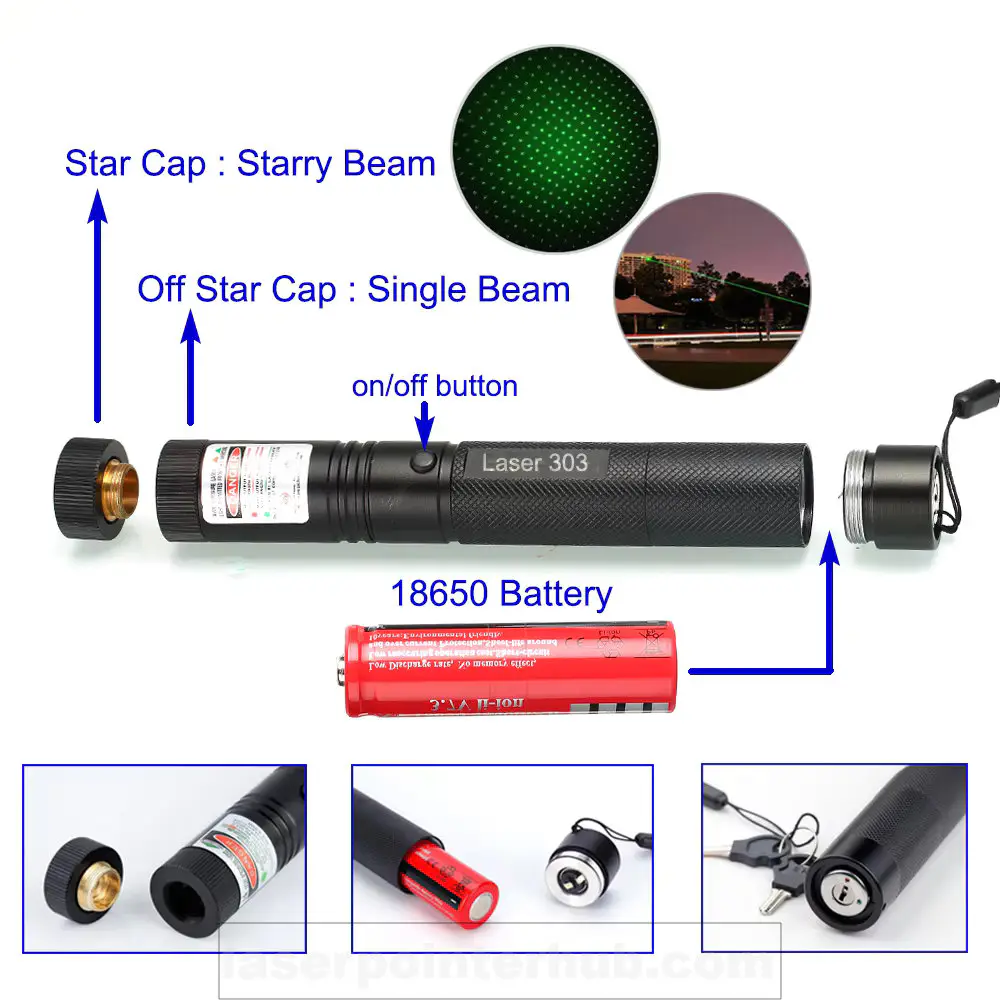
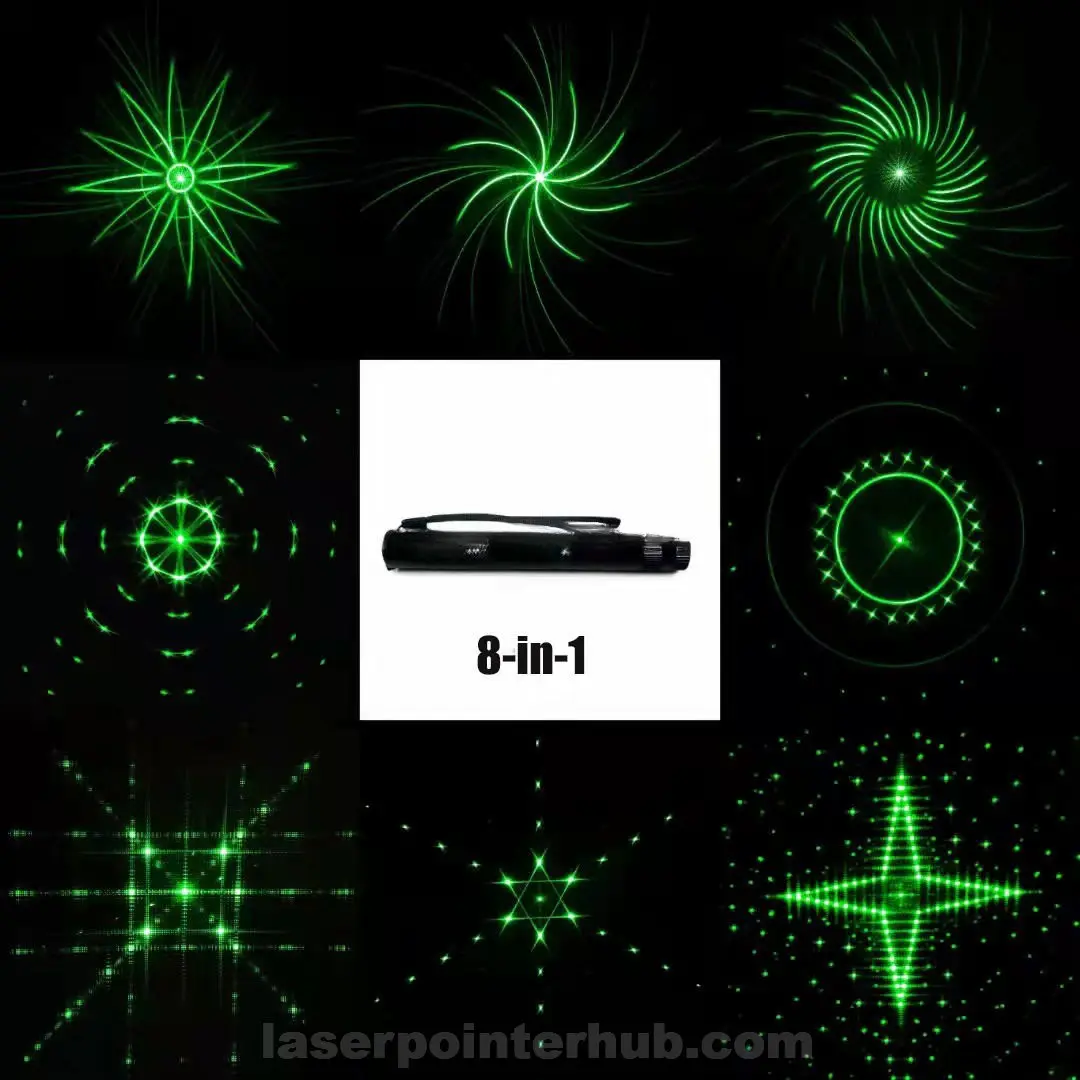
The 303 adds a rotatable focusing module and often includes a "star cap" attachment. The focusing head lets users manually adjust the focal length, changing the beam from a tight distant spot to a wider, more intense close-range beam. The star cap diffuses the beam into a radial pattern for visual effects.
The Reddit community frequently notes that the 303's versatility makes it more appealing to users who want to experiment with different beam shapes, while the 301's simplicity suits those who just need reliable pointing performance.
For a quick reference, here’s how the two models compare:
| Feature | 301 (Basic) | 303 (Feature-Rich) |
|---|---|---|
| Head Type | Fixed, non-focusable | Rotatable focusing module |
| Star Cap Support | Usually not included | Yes, often with multiple pattern options |
| Common Battery | 16340 or generic 18650 | 18650 (branded recommended) |
| Safety Lock | Rare | Often included |
| Best For | Presentations, astronomy, pointing | Experiments, effects, photography, versatile use |
For a deeper look at what the Laser 303 platform actually delivers at its honest price point, check our best laser pointer under $50 guide, which compares the $27 B303 against $5 eBay knockoffs and shows where to stretch your budget next.
Why Sellers Often Mix Up 301 and 303 (Important Buying Insight)
This is something most articles miss.
“301” and “303” are not strict technical standards. They are housing styles, not certified product classes. That means:
- The same internals can be used in both shells
- Listings are often rebranded or mislabeled
- You can find identical lasers sold as both 301 and 303
Implication for buyers: the model number alone does NOT guarantee performance. What actually matters is internal diode quality, heat dissipation, and assembly consistency. This is why two “303” lasers can behave completely differently.
Neither design is objectively better — it depends entirely on your intended use. If you want a no-fuss pointer, the 301's fixed head is less to manage. If you want options, the 303's focusing capability adds practical flexibility.
For safety fundamentals that apply to both models, consult a laser pointer safety guide.
Why the 303's Focusing Head Matters for Burning and Experiments
Here’s a counterintuitive fact: most buyers assume a “brighter” laser is automatically “stronger.” But with the 303, the real advantage isn’t brightness — it’s energy density. By focusing the same output into a smaller spot, the 303 can achieve thermal effects that a brighter but unfocused laser cannot.
Energy density is all about focus. When you rotate the 303's head to shorten the focal length, you concentrate the same amount of laser power into a smaller spot. This dramatically increases energy density (power per unit area). A 100mW laser with a tightly focused spot can ignite dark materials, pop balloons, or melt thin plastics — tasks that are impossible with the same laser outputting a wide, diffused beam.
The Amazon product documentation for 303-type units highlights the focusing mechanism as a key feature for users who want to experiment with beam effects or conduct close-range thermal demonstrations.
Practical use cases where focus matters:
- Lighting matches
- Adjusting beam size for photography or video effects
- Switching between wide star-field patterns and tight spots
Star caps add another layer of versatility. With the right accessories, a 303 can switch from a tight beam to a variety of creative patterns in seconds — making it a favorite for visual effects and creative photography. Many 303 models, including the one we recommend, come with interchangeable star caps to expand your creative options.
The ability to manually adjust focus gives the 303 a significant advantage over the 301 for users interested in exploring a laser's full range of capabilities. But this power comes with responsibility — tighter focus means higher risk of accidental burns, eye damage, or fire hazards if mishandled.
Understanding the laser power specifications helps you choose the right power level for your intended applications.
Real Power Output: Labeled vs Actual Performance
Here's where buyer expectations frequently collide with reality: the power number on the box rarely matches what comes out of the laser.
The laser pointer market has a documented power labeling problem. Community testing on Laser Pointer Forums consistently shows that budget models — regardless of whether they're labeled 301, 303, or something else — often output significantly different power than advertised. Some read higher, many read lower, and batch-to-batch variation can be substantial.
Thermal management is the invisible factor. Cheap laser pointers frequently lack adequate heat sinking. When these lasers run continuously, their output power drops as the diode overheats. A unit that starts at 150mW might settle at 80-100mW after 30 seconds of operation. This isn't defect — it's physics working against poorly engineered products.
What this means for you:
- Never trust the labeled mW number alone
- Budget models require extra scrutiny
- Continuous use reveals true stable output, not peak initial reading
- Higher listed power with cheap components often means worse thermal management
The practical takeaway: when comparing 301 vs 303 models, focus more on the build quality and thermal design than the advertised power number. A well-engineered 50mW laser often outperforms a poorly-engineered 200mW unit in sustained use.
You’ll notice most product listings skip these details entirely — they’d rather advertise “burns matches” than explain power stability. But if you’re buying a laser you plan to use seriously, these are exactly the factors that separate a reliable tool from a frustrating one.
For deeper technical understanding, see our high power handheld lasers guide.
IR Leakage, Safety Accessories, and Battery Concerns
Green DPSS lasers emit more than just visible green light. This hidden fact is one of the most underappreciated safety issues in the budget laser market.
The IR leakage problem. DPSS green lasers work by converting infrared light from a diode into visible green through crystal harmonic conversion. However, this process is never 100% efficient. A typical green laser pointer may emit significant infrared radiation alongside the visible green beam — and because IR is invisible, your eye won't trigger the blink reflex when exposed.
The NIST Laser Safety Program warns that human eyes focus 400-1400nm wavelengths directly onto the retina, making near-infrared especially dangerous precisely because there's no natural warning signal like there is with visible light.
What reputable sources say:
- FDA regulations establish 5mW as the typical consumer limit for visible laser pointers; devices above 5mW up to 500mW fall into Class 3B, which carries significantly higher eye injury risk.
- UC Berkeley EHS notes that even Class 3R lasers (1–5mW visible) can exceed the eye’s natural blink reflex under sustained viewing.
- Community testing shows IR filters are rarely installed on budget models.
Battery and charger risks deserve equal attention. Forum discussions repeatedly highlight that bundled chargers and batteries from budget sellers are frequent failure points and occasional fire hazards. Using quality cells from reputable brands and dedicated laser-safe chargers is not optional — it's essential.
Essential safety accessories:
- Laser safety glasses rated for your laser's wavelength and power
- IR filter if your unit leaks significant infrared
- Quality batteries with proper protection circuits
- A charger with overcharge protection
Protect your eyes with proper laser safety glasses before operating any laser above basic pointer power levels.
What to Look for in a 303 Model
If you've decided the 303's versatility matches your needs, not all 303 units are created equal. Based on community feedback and our own testing, here are the features that separate a good 303 from a frustrating one:
🔋 Quality 18650 Battery
Many budget 303 units ship with generic, poorly performing batteries. A reliable 18650 cell provides longer runtime, more stable output, and safer operation.
🔑 Safety Key Lock
This simple feature prevents accidental activation — especially important if you're transporting the laser or have children around. It's a small addition that makes a big difference in responsible use.
🌟 Multiple Star Caps
The 303's head design allows for interchangeable star caps. A good set includes a variety of creative patterns, giving you flexibility for presentations, photography, or just visual enjoyment. Our recommended 303 model comes with a full set of star caps ready to use.
✅ Why This Matters
When these features are included together, you get more than just a laser pointer — you get a complete, ready-to-use tool that doesn't require hunting for compatible accessories or worrying about basic safety gaps.
Frequently Asked Questions
Q1: Are 301 and 303 lasers basically the same thing?
A1: They're in the same product family and use the same core technology, but the head design differs. The 301 typically has a fixed head optimized for pointing. The 303 adds a rotatable focusing module and often includes a star cap attachment. If you want beam flexibility and focusing capability, the 303 is the better choice. If you want simple, reliable pointing, the 301 suffices.
Q2: Does the 303's focusing head actually make a difference for burning things?
A2: Yes, measurably. Adjusting focal length changes energy density at the target. A tightly focused beam concentrates power into a smaller spot, dramatically increasing what you can ignite or melt. The 303's focusing capability makes it significantly more versatile for experiments compared to a fixed-head 301 at the same power level.
Q3: Why do budget laser pointers often have inaccurate power labels?
A3: The consumer laser market has minimal enforcement of power labeling accuracy. Budget manufacturers frequently use optimistic numbers for marketing rather than actual specifications. Thermal management quality also varies wildly — a laser that starts at 200mW may drop to 100mW after warming up. Community testing consistently shows most budget models deviate 20-50% from labeled output.
Q4: How dangerous is IR leakage from green DPSS lasers?
A4: IR leakage is a serious but often ignored hazard. Human eyes focus near-infrared directly onto the retina with no natural protection mechanism since IR is invisible. NIST research confirms this danger exists even when the visible green beam appears relatively weak. Quality IR filters can help, but they're rarely included with budget models. The safest approach is assuming IR leakage exists and wearing appropriate laser safety glasses.
Q5: Are the included battery and charger safe to use?
A5: This is one of the most common pain points in budget laser pointers. Many bundled chargers lack overcharge protection, and generic batteries may have unstable output or safety risks. For reliable operation, it's worth using a quality 18650 battery from a reputable brand and a dedicated charger with overcharge protection. Some 303 models, including the one we recommend, are designed with this in mind — but if yours didn't come with quality cells, replacing them is a smart safety upgrade.
Conclusion
The 301 vs 303 choice comes down to what you actually need:
Choose the 301 if you want a simple, reliable pointer for presentations or basic pointing tasks. Fixed head design means one less thing to manage.
Choose the 303 if you want beam flexibility, focusing capability, and the ability to experiment with burning, close-range effects, or star cap visual patterns. For many users, the 303's versatility makes it the more practical long-term choice — especially when paired with quality accessories like a branded 18650 battery, safety key lock, and multiple star caps.
Common sense applies to both:
- Don't trust power labels alone — buy from sources that provide real test data
- Budget models require extra scrutiny on thermal management
- IR leakage is a real hazard that most sellers don't mention
- Always use quality batteries and chargers
- Laser safety glasses are non-negotiable for higher power units
What Most Buyers Actually End Up Choosing
In practice, most users who compare 301 vs 303 end up choosing the 303 — not because it's more powerful, but because it offers flexibility that the 301 simply cannot match.
Even if you initially only need a pointer, the ability to adjust focus later makes the 303 a more future-proof choice.
The only reason to choose a 301 is if you specifically want a fixed, no-adjustment tool for simple pointing tasks.
A Common Buying Mistake to Avoid
Many first-time buyers choose based on advertised power alone. This often leads to disappointment, especially with low-quality 303 units that overpromise and underdeliver.
A lower-rated but well-built laser will almost always outperform a poorly constructed high-power model in real-world use.