
532nm vs 520nm Green Laser: DPSS vs Direct Diode Explained
Understand the key differences between 532nm DPSS and 520nm direct diode green lasers. Learn which offers better beam quality, stability, and safety for your application.
Image Gallery
532nm vs 520nm Green Laser: DPSS vs Direct Diode — Which Is Right for You?
When shopping for a green laser pointer, you’ve probably noticed something confusing: two lasers that both look green can behave very differently in real-world use. One might be labeled 532nm, another 520nm — same color, but fundamentally different technology.
The short answer: 532nm DPSS lasers usually appear brighter and produce cleaner, rounder beams, while 520nm direct diode lasers offer better temperature stability, longer lifespan, and no risk of infrared leakage from a conversion process. The difference comes down to how they’re built — and it directly affects performance, reliability, and safety.
This guide breaks down how each technology works, what users actually experience, and how to choose the right one for your needs. For a broader understanding of laser power and safety, see our guide to laser pointer power levels.
How 532nm DPSS Lasers Work
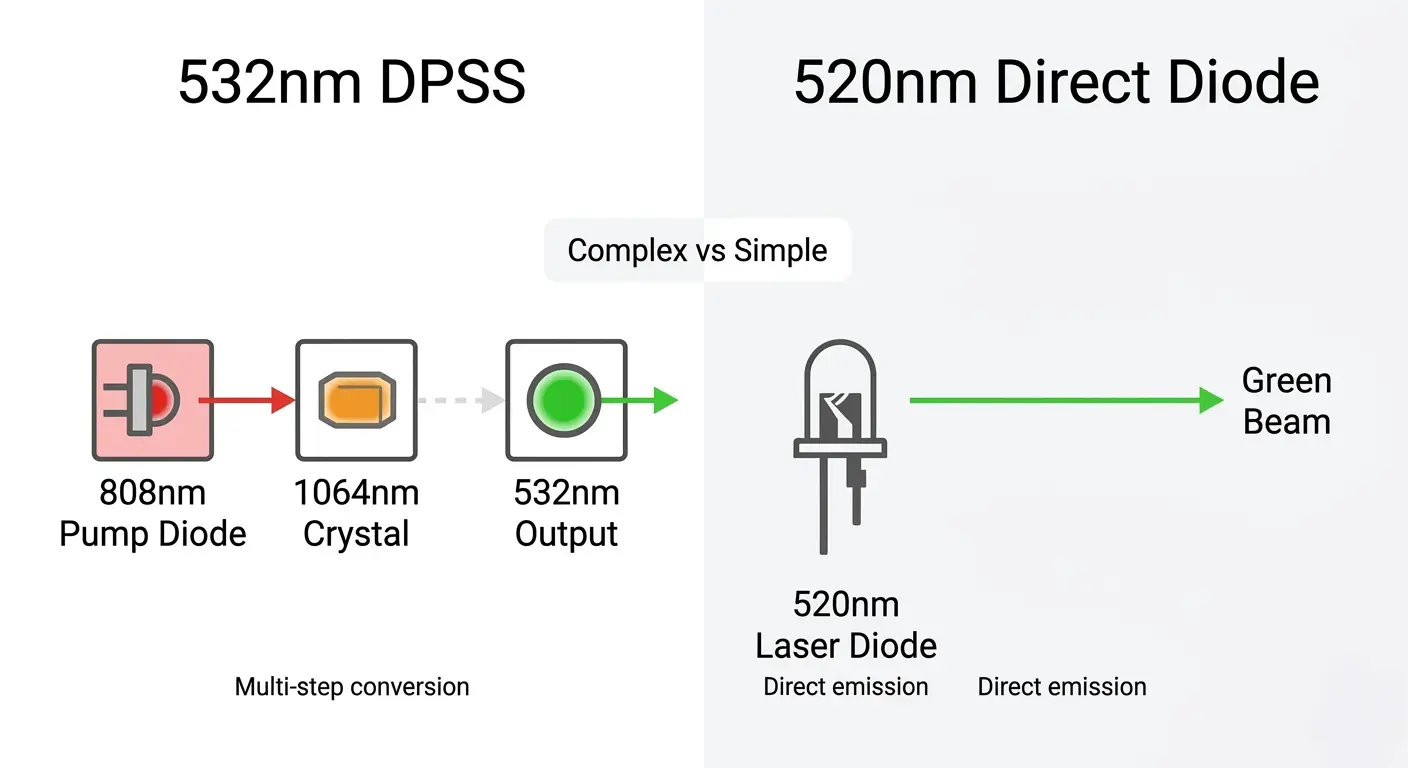
The 532nm wavelength is almost always produced using DPSS (Diode-Pumped Solid-State) technology. Here’s what’s happening inside — even if it’s rarely mentioned in product listings:
- A semiconductor pump diode emits 808nm infrared light
- This pumps a Nd:YAG crystal, generating 1064nm infrared light
- A nonlinear crystal (typically KTP) performs second-harmonic generation (SHG), converting 1064nm into 532nm green light
As RP Photonics explains, frequency doubling is a common way to generate visible wavelengths from infrared sources. This multi-stage process is why 532nm lasers are widely available and relatively inexpensive.
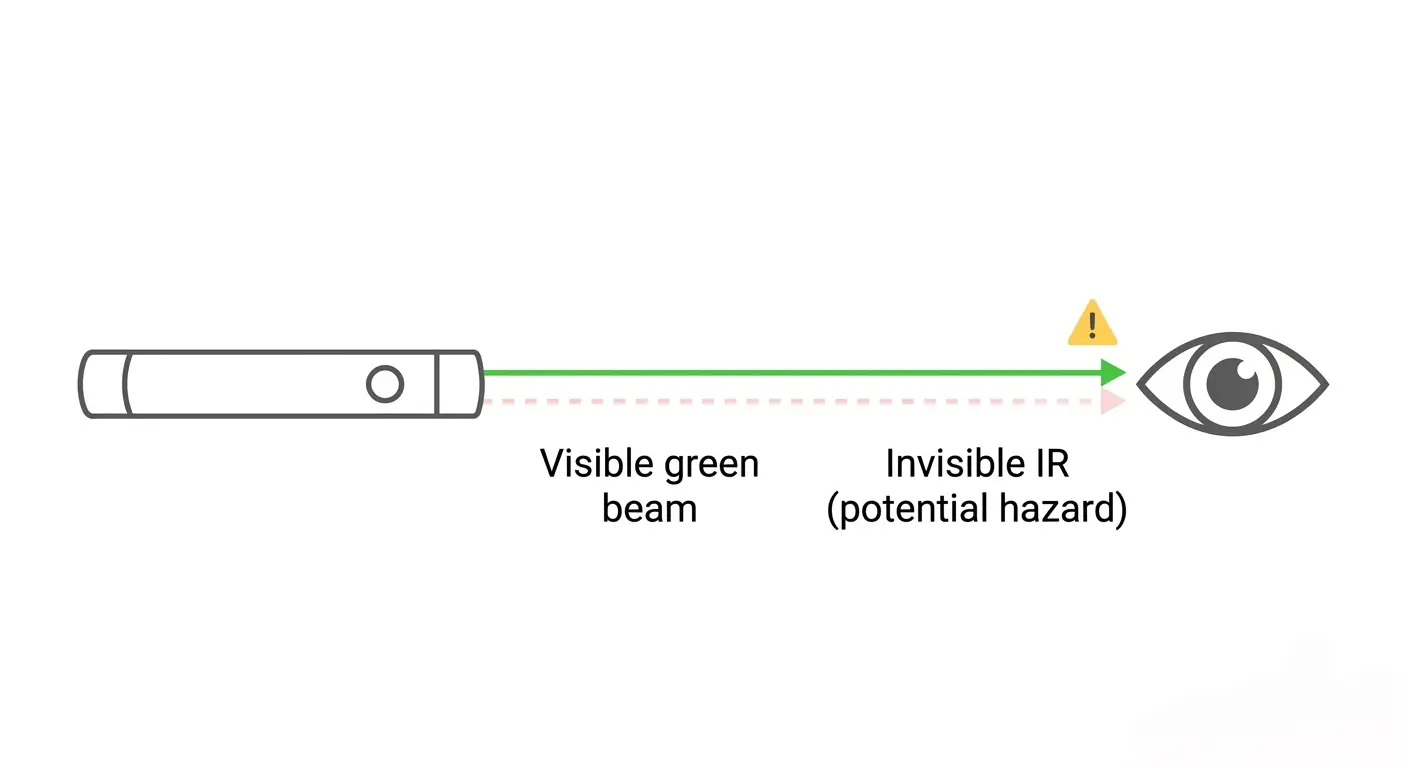
However, that same complexity introduces risk. If conversion efficiency is low — or if the IR filter is poorly implemented — invisible 808nm and 1064nm infrared radiation can leak alongside the green beam. A SPIE and NIST investigation found that some low-cost 532nm pointers emitted total IR power up to 10× higher than the visible output — an invisible hazard also flagged by the FDA. You can review the FDA laser pointer manufacturer requirements and the specific IR leakage warning in the FDA guidance document.
How 520nm Direct Diode Lasers Work
The 520nm wavelength comes from a much simpler source: a direct-emission green laser diode. Manufacturers like Nichia and OSRAM produce diodes that natively emit in the 515–525nm range. OSRAM, for example, labels their PL 520 as "True Green" with a 520nm peak.
Because there is no infrared pump stage, there is no IR leakage pathway. The diode outputs exactly what it specifies — visible green light at the stated wavelength. This simplicity directly translates into the performance advantages below. If you’re thinking about safety more broadly, our article on can a laser pointer blind you provides useful context.
Head-to-Head Comparison
This comparison data comes from Laser Components' technical comparison of 520nm laser diodes versus 532nm DPSS lasers.
Why 532nm Appears Brighter
Human vision peaks around 555nm, near the center of the green spectrum. Since 532nm sits closer to that peak than 520nm, it typically appears noticeably brighter at the same output power.
The CVRL (Colour Vision Research Lab) provides detailed sensitivity curves confirming this effect.
So yes — the brightness difference is real. But that doesn’t automatically make 532nm the better choice.
Real User Experiences
"Cheap 532nm lasers are notoriously dangerous"
On Reddit’s astronomy community, experienced users frequently warn against low-cost 532nm pointers. One user summarized it well: "Try to find a 515 or 520 nm laser from a reputable reseller. The cheap 532 nm lasers are notoriously dangerous with powers exceeding the listed value and no proper IR filters installed." The key concern is simple: you can’t always trust the label — and IR leakage is invisible.
"532nm is fragile — it will break if dropped"
On Laser Pointer Forums, many users report DPSS lasers failing after drops. The reason is structural: aligning the pump diode, gain crystal, and nonlinear crystal requires precision. That makes 532nm systems inherently more delicate. In contrast, 520nm diode lasers tend to be more robust in everyday use.
"Diode lasers have crappy divergence in one axis"
The most common criticism of 520nm lasers is beam shape. Compared to DPSS systems, diode beams often look wider or uneven in one axis. As one user described it: "A fat, pudgy beam in one axis indicates it is a diode." This isn’t a defect — it’s simply how semiconductor laser emitters behave.
Safety Considerations
The FDA limits visible laser pointers in the 400–710nm range to a maximum of 5mW output. Products exceeding this limit or lacking proper labeling may be subject to regulatory action under FDA Import Alert 95-04.
For 532nm DPSS lasers, the added concern is hidden infrared emission, which may not be obvious to the user. This is why proper IR filtering and manufacturer quality matter.
Bottom line:
- If you choose 532nm, buy from a source you trust
- If you want to eliminate IR-related uncertainty entirely, 520nm avoids that risk by design
Which Should You Choose?
Choose 532nm DPSS when:
- Beam aesthetics matter most (round, clean dot)
- You want maximum perceived brightness at low power
- You’re using it in a stable, controlled environment
- You trust the manufacturer’s build quality
Choose 520nm Direct Diode when:
- You need consistent performance across temperatures
- You want a direct-diode 520nm laser with a visual twist — the G019 green variant adds a transparent beam tube for a lightsaber effect while delivering stable 2W output across temperatures
- Durability and reliability matter more than beam perfection
- You want a simpler system with fewer failure points
- You need fast modulation for technical applications
Frequently Asked Questions
Why does 532nm often look brighter than 520nm?
Because 532nm is closer to the human eye’s peak sensitivity at 555nm, making it appear brighter at the same output power.
Is 520nm automatically safer than 532nm?
Not automatically — safety depends on actual output power and labeling. However, 520nm eliminates the specific IR leakage risk found in poorly designed 532nm DPSS systems.
Why do experienced users prefer 520nm for outdoor use?
Its wider operating temperature range and more stable output make it more reliable in real-world conditions.
What is the main weakness of 520nm lasers?
Beam shape. Direct diode lasers naturally produce elliptical beams, which some users find less visually appealing.
Conclusion
Both 532nm DPSS and 520nm direct diode lasers have their place. The right choice depends on what you value most.
If you care about brightness and beam aesthetics, 532nm delivers the classic green laser experience.
If you care about reliability, stability, and simplicity, 520nm is often the better long-term choice.
Before buying, always verify the seller’s reputation, confirm realistic power ratings, and ensure the product meets FDA safety guidelines.