
Blue Laser Pointer vs Green Laser Pointer Burning Test: Why the Brighter One Loses
Green lasers look up to 10–30× brighter than blue—but still lose in burning tests. This guide explains why, using real physics, power thresholds, and material absorption data.
Image Gallery
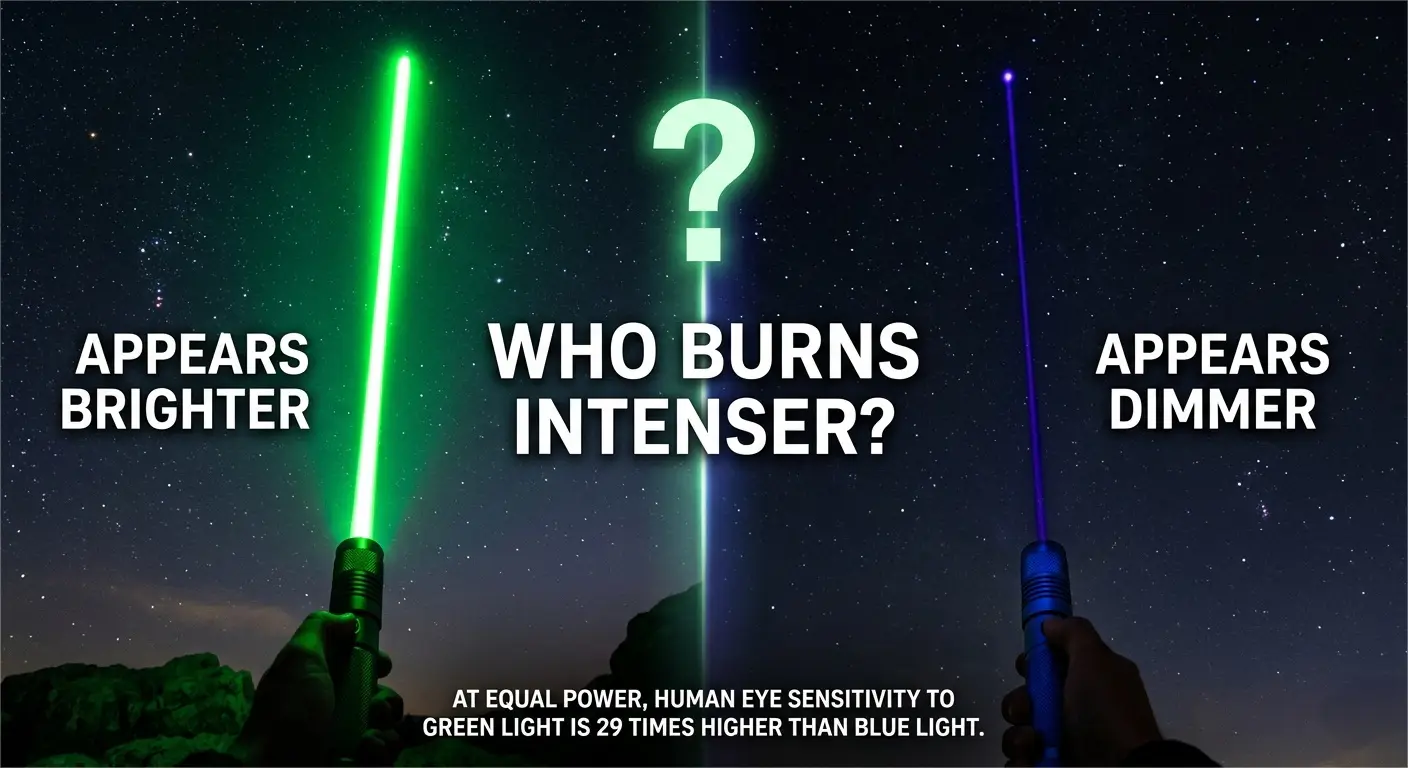
Most first-time buyers misunderstand a basic rule: the laser that appears brightest to the human eye is almost never the strongest performer in a burning test.
If you have watched a 1W blue laser slice through electrical tape while a 1W green laser barely leaves a mark, you have witnessed this paradox in action. It is not a trick of the camera. It is physics interacting with human biology.
This guide provides a practical breakdown of the blue vs green laser burning test. It is designed for enthusiasts and buyers who want to understand where real thermal performance comes from—and why visual brightness so often misleads.
The Visual Illusion: Why Green Looks Like a Lightsaber (But Isn't)
The confusion begins with a scientific standard called the Photopic Luminosity Function (Vλ) . This curve defines how the human eye converts electromagnetic radiation into the sensation of brightness.
How Human Vision Distorts Laser Perception
Human eyes evolved to be exceptionally sensitive to green light. This sensitivity peaks around 555nm and remains extremely high at 532nm, the standard wavelength for green laser pointers. At 445–450nm (deep blue), however, the eye's sensitivity drops dramatically.
- Perception Gap: At identical output power, a 532nm green laser appears approximately 29 times brighter than a 445nm blue laser (RP Photonics).
- The Burning Fallacy: Many buyers incorrectly assume that a brighter beam equals greater thermal energy. In reality, perceived brightness and thermal power are entirely separate metrics.
This is the central misconception that drives the blue laserpointer vs green laserpointer burning test debate.
Real-World Example: The 100mW Green Trap
Consider two handheld lasers operating side by side:
- Laser A: 100mW Green (532nm)
- Laser B: 1,600mW Blue (445nm)
Under a dark sky, Laser A produces a brilliant, solid beam that appears to stretch into the stratosphere. Laser B emits a dim, almost violet streak that seems far less impressive visually.
Yet, in terms of raw energy delivered to a target surface, Laser B possesses 16 times the thermal output of Laser A.
Community testing on Laser Pointer Forums consistently confirms this divergence: visibility and burning ability rarely align.
Why Blue Lasers Burn More Effectively: Photon Energy and Material Absorption
Burning performance is not determined by how many lumens reach the eye. It is determined by how efficiently energy transfers from the beam to the surface. Blue lasers excel on two critical fronts: Photon Energy and Absorption Efficiency.
Photon Energy Advantage (The 18% Rule)
According to Planck's equation (E = hc/λ), shorter wavelengths carry more energy per individual particle of light.
- Blue Light (450nm): Approximately 2.76 electron-volts (eV) per photon.
- Green Light (532nm): Approximately 2.33 eV per photon.
This represents an 18% higher energy payload delivered by every single blue photon. The cumulative effect of this difference becomes highly significant at watt-level outputs. The blue beam simply transfers more energy into heat at the point of contact.
Material Absorption: Why Blue Melts Metal Faster
Here is a less obvious but equally critical factor: most everyday materials absorb blue light far more efficiently than green light.
Industrial data published by leading manufacturers such as Laserline highlights a dramatic contrast in absorption rates:
- Copper: Absorbs approximately 80% of 450nm blue light, compared to only ~45% of 532nm green light.
- Aluminum and Steel: Blue wavelengths consistently demonstrate absorption rates 1.5× to 2× higher than green wavelengths.
Cognitive Correction: This explains why a 2W blue laser can melt solder almost instantly, while an equally powered green laser may only warm the metal slowly. The difference is not just power output—it is thermal acceptance versus reflection loss.
The Technology Gap: Why 1W of Green Costs More Than 1W of Blue
If blue lasers are demonstrably superior for burning applications, why are high-power green lasers often five to ten times more expensive? This is a critical question for any buyer evaluating a blue vs green laser burning test.
The answer lies in manufacturing architecture, not raw material quality.
The Complexity of Green Lasers (DPSS Architecture)
Green lasers operating at 532nm do not generate green light directly. They rely on a process called Diode-Pumped Solid-State (DPSS) frequency doubling. This process is a multi-stage conversion of light:
- Initial Stage: An 808nm infrared diode pumps energy into a crystal.
- Intermediate Stage: A Nd:YAG or Nd:YVO₄ crystal absorbs the 808nm light and emits invisible 1064nm infrared radiation.
- Final Stage: A KTP crystal halves the frequency of the 1064nm beam, producing visible 532nm green light.
This sequence is inherently inefficient. Energy dissipates at every crystal interface and through thermal losses. Typical electrical-to-optical efficiency for portable DPSS systems ranges from just 15% to 30%. The precise alignment of these microscopic crystals is both delicate and expensive to manufacture at scale.
The Efficiency of Blue Lasers (Direct Diode)
A 450nm blue laser, by contrast, is a Direct Diode system. It uses a Gallium Nitride (GaN) semiconductor.
- Input: Electrical current.
- Output: Blue light.
There is no intermediate crystal stage. Efficiency is a robust 35% to 40%. This direct conversion means less waste heat, simpler driver electronics, and dramatically lower production costs.
The Verdict for Buyers: When purchasing a 1.5W blue laser for under $200, you are paying for raw power and a simple, durable light engine. When purchasing a 1W green laser for over $500, you are paying for the engineering required to achieve that specific visible wavelength at that intensity. For a deeper technical breakdown of these internal components, refer to our guide on High Power Handheld Lasers.
Burning Test Data: Real Thresholds and Surprising Limitations
Theory is useful, but observed results determine real-world satisfaction. The following data represents community-verified performance thresholds achievable with a properly focused beam.
Practical Power Thresholds for Common Tasks
| Task | Minimum Power Required | Optimal Color Choice |
|---|---|---|
| Pop a Dark Balloon | 30mW – 50mW | Blue or Green (Equivalent) |
| Light a Match (Darkened Tip) | 50mW – 100mW | Blue (Significantly Faster) |
| Cut Black Electrical Tape | 200mW+ | Blue (Preferred) |
| Char or Burn White Paper | 800mW – 1,000mW (1W) | Blue (Essential) |
| Engrave Wood or Leather | 1,500mW+ (1.5W) | Blue (Faster Charring) |
The Counter-Intuitive Fact: The "Same Color" Shield
A critical piece of physics often overlooked by new users is the role of surface color reflection.
A laser performs poorly on surfaces that match its own wavelength due to high reflectivity.
- Test Condition: Aim a Green laser at a Green balloon.
- Observed Result: The balloon may take several seconds to pop, or it may not pop at all. The green pigment reflects the majority of the green light.
- Test Condition: Aim a Blue laser at a Green balloon.
- Observed Result: Immediate absorption and a near-instant pop.
For content creators and hobbyists conducting burning demonstrations, blue lasers offer greater material versatility. They interact effectively with a broader spectrum of colored targets, with the notable exception of deep blue or matte black surfaces.
Blue vs Green Laser: A Strategic Comparison Matrix
At this point, the science is clear. The next step is decision-making. Use this matrix to align the technology with your intended application.
| Feature | 🔵 Blue Laser (445-450nm) | 🟢 Green Laser (532nm) |
|---|---|---|
| Burning Performance | Excellent (High photon energy, high absorption) | Moderate (Requires higher wattage to match blue) |
| Beam Visibility (Night) | Low/Dim (Visible only in dark conditions) | Extreme (Solid beam visible even at dusk) |
| Cost per Watt | $ (Industry Value Leader) | $$$$ (Precision Crystal Premium) |
| Technical Architecture | GaN Direct Diode | DPSS Crystal Frequency Doubling |
| Ideal Use Case | Thermal interaction, engraving, material testing | Astronomy, long-range signaling, visual display |
When Green Is the Superior Tool
Green lasers retain an undisputed advantage in one specific domain: atmospheric visibility.
If your primary activity involves astronomy or pointing out distant landmarks, 532nm is the correct choice. Even a modest 50mW green laser will produce a more distinct and visible beam column than a 200mW blue laser. For applications where the beam itself is the tool, green is the standard.
When Blue Is the Only Logical Choice
If your interest centers on interaction with materials—lighting a campfire from a safe distance, etching a design into leather, or simply experiencing the satisfaction of a rapid balloon pop—blue is the only cost-effective path.
You receive more thermal watts per dollar and a more robust, solid-state light engine that is less sensitive to shock and temperature changes than DPSS crystals.
For those ready to explore high-output devices that deliver consistent, reliable performance without inflated marketing claims, we recommend reviewing our dedicated guide on selecting a High Power Laser Pointer.
Wondering which color to buy at each price point? Our blue vs green decision guide for under $200 breaks down exactly how much thermal capability or visibility you get per dollar.
Recommended Models: Tools for Specific Missions
Based on the physics outlined above, product selection should align with the task, not the price tag alone.
For the Tinkerer and Thermal Enthusiast (The Blue Workhorse)
If your goal centers on the blue vs green laser burning test—seeing a focused beam etch wood or pop a sequence of balloons—thermal efficiency is your priority. The B017USB platform operates in the 445nm range. It delivers the high photon density required for thermal work without the significant cost premium associated with DPSS green crystals. It represents an optimized balance of value per milliwatt and robust diode longevity.
View the Blue B017USB Model Details
For the Astronomer and Outdoor Purist (The Green Beacon)
If you navigate by constellations or require a long-distance visual reference point, the visual acuity of 532nm is non-negotiable. The B023 model is where practical field engineering meets reliable output. It produces the crisp, iconic green beam that cuts through atmospheric haze with minimal divergence, making it the definitive choice for applications where seeing the beam is the entire objective.
View the Green B023 Model Details
For the Visual Spectacle Seeker (The Laser Sword)
If neither pure burning nor pure visibility is your only goal, the G019 Professional Focusing Laser takes a different approach. It pairs a 4W blue or 2W green engine with a transparent beam extension tube — attach it for a lightsaber effect that glows along the full tube length, remove it for normal high-power laser use. Blue $209, green $319.
Frequently Asked Questions: Blue vs Green Laser Burning
The following answers are structured for clarity and optimized for search engine featured snippets.
Why does a 100mW green laser look brighter than a 1W blue laser?
The human eye's photopic response curve is maximized for green light (near 555nm). At 532nm, visual sensitivity is approximately 88% of peak. At 445nm, sensitivity drops to roughly 3.5%. This creates a 29-fold difference in perceived brightness, even though the 1W blue laser delivers ten times more thermal power to any target surface.
Which laser is actually better for lighting a match?
Blue. Under identical power conditions (for example, 500mW), the blue laser benefits from higher photon energy (2.76 eV vs 2.33 eV) and superior absorption by the red and brown compounds in a match head. A 1W blue laser will typically ignite a match in a fraction of a second, whereas a 1W green laser requires sustained, steady focus to achieve the same ignition temperature.
Why are high-power green lasers so much more expensive than blue?
Green lasers require a complex DPSS (Diode-Pumped Solid-State) process involving multiple crystals (Nd:YAG and KTP) to convert infrared light to visible green. This process has high energy loss and requires precise optical alignment. Blue lasers use a simple, direct GaN diode that emits blue light instantly when powered. The price difference reflects manufacturing complexity, not a difference in build quality.
Can a green laser burn white paper effectively?
Not efficiently. White surfaces reflect a significant portion of the green spectrum (500–565nm). While a 1W blue laser will cause white paper to smoke and char almost immediately, a 1W green laser will struggle to initiate burning unless the paper has dark ink or a black mark printed on it. For consistent paper burning, blue is the far superior choice.
Is a green laser safer than a blue laser for burning applications?
No. Both are capable of Class 4 output at the power levels required for burning. While the intense brightness of green light can trigger a slightly faster blink reflex, this is not a reliable safety mechanism. Furthermore, some poorly filtered high-power DPSS green lasers emit invisible 1064nm infrared leakage, which presents an additional ocular hazard not present in direct-diode blue systems.
Conclusion: Choose Based on Physics, Not Perception
The blue vs green laser pointer burning test resolves into a clear, data-driven conclusion once visual illusion is removed from the equation.
- Green lasers dominate in visibility due to the evolutionary tuning of the human eye.
- Blue lasers dominate in thermal performance due to higher photon energy and superior material absorption characteristics.
The decision rests on a single question: Do you need to see the beam, or do you need to use the beam?
Do not let the brightness of a green beam mislead you into purchasing a device unsuited for thermal work. Trust the physics of absorption and energy transfer over the subjective experience of visual brightness. With this understanding, you can select the correct tool with confidence and avoid the most common pitfall in the high-power laser hobby.