
Class 3R vs Class 4 Laser Safety: Complete Guide to Safe Use (2026)
A data-backed guide to safely using Class 3R and Class 4 laser pointers. Learn the critical differences between laser classes, exposure limits, reflection hazards, and why "looking safe" doesn't mean safe.
Image Gallery
Class 3R safety relies on a 0.25‑second aversion response.
Class 4 safety relies on engineering controls—not caution alone.
Most laser safety advice is too vague.
This guide gives you the actual numbers that separate harmless from hazardous:
👉 5 mW — legal limit for a consumer pointer
👉 0.25 seconds — natural blink/head‑turn time
👉 2.5 mW/cm² — maximum permissible exposure (MPE) at 0.25 s
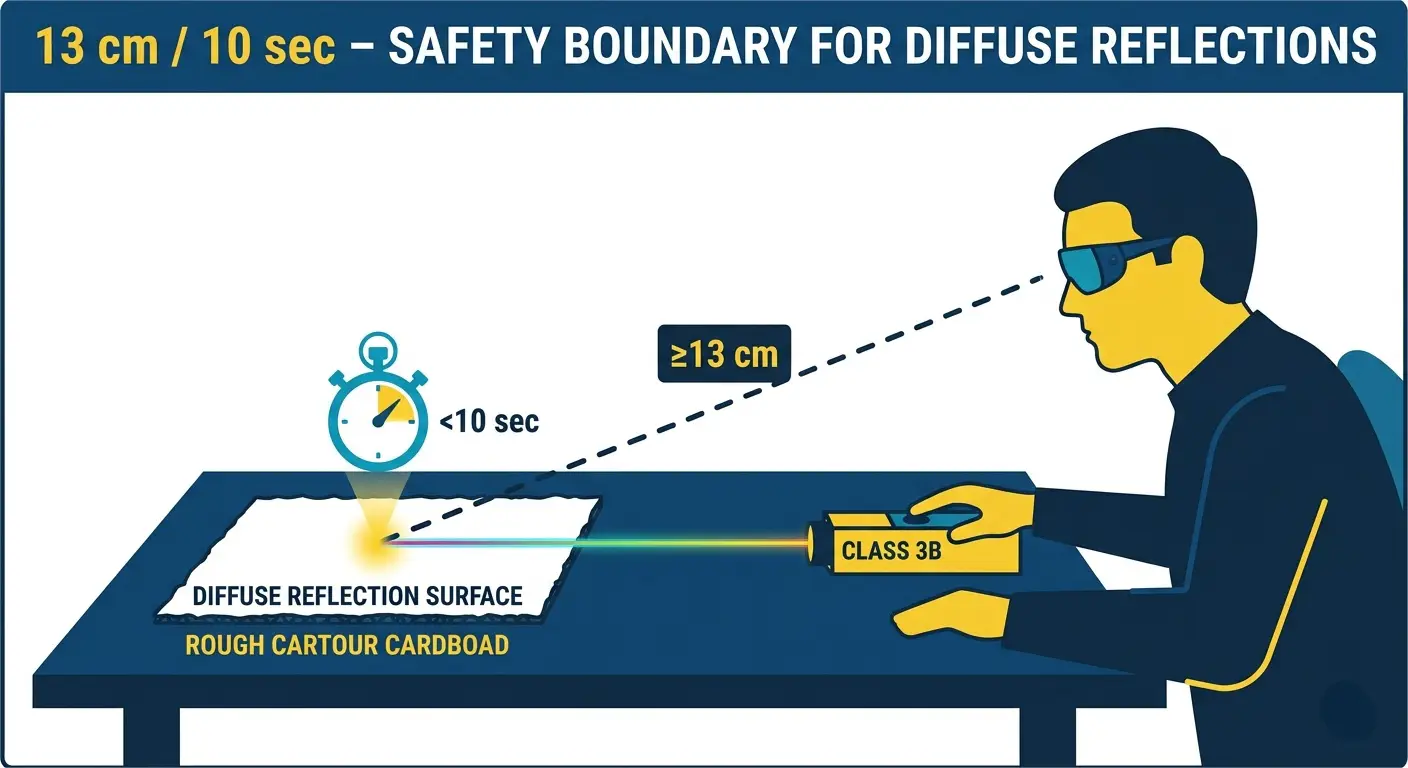
👉 13 cm / 10 seconds — safe distance/duration for Class 3B diffuse reflection
👉 555 nm / 507 nm — why green looks brighter than red
👉 808 / 1064 nm — invisible infrared in cheap green lasers
These numbers drive real risk assessment—not vague warnings.
TL;DR: Quick Answers
Can a Class 3R laser damage your eyes?
Yes, especially with intentional staring, extended viewing, or use with optical aids (binoculars, microscopes).
Are Class 4 lasers dangerous?
Yes. They can cause eye injury, skin burns, fire hazards, and even diffuse reflection can be hazardous.
Why are green lasers brighter than red?
Because the human eye is most sensitive near 555 nm (photopic) and 507 nm (scotopic). A green laser appears ~8× brighter at the same power.
Do I need laser safety glasses?
For Class 3R: generally no for casual use.
For Class 3B/4: mandatory unless the beam is fully enclosed.
My laser has no label—what class is it?
Treat it as potentially exceeding Class 3R until measured with a power meter.
For broader context, see our Laser Pointer Safety Guide: Eyes, Kids, & Pets.
1. What Is the Difference Between Class 3R and Class 4 Lasers?
Class 3R lasers (≤5 mW) are considered low‑risk under brief exposure due to the human aversion response.
Class 4 lasers (>500 mW) are high‑risk devices requiring controlled environments, protective eyewear, and fire safety precautions.
1.1 The Legal Definition of a Laser Pointer
The FDA is explicit: a handheld laser marketed for pointing or demonstration purposes is legally capped at ≤5 mW in the visible spectrum (400–710 nm). This is the regulatory boundary of a Class IIIa / IEC 3R laser pointer.
Anything above this threshold—whether marketed as a “high‑powered pointer,” “burning laser,” or “tactical laser”—is no longer a laser pointer under federal regulation. It is a controlled laser device.
1.2 Class Boundaries: The Numbers That Matter
| Class |
|---|
These boundaries derive from the Accessible Emission Limit (AEL) framework in 21 CFR 1040.11 and ANSI Z136 standards.
1.3 Why Class 4 Isn’t a “Stronger 3R”—It’s a Different Control Regime
The standard blog narrative frames Class 4 as “just a more powerful pointer.” The regulatory reality is different: Class 4 involves hazards from:
- Direct beam exposure to skin or eyes
- Reflected beam exposure (specular reflection from any shiny surface)
- Diffuse reflection that can still be hazardous
- Fire ignition from beam contact with flammable materials
OSHA and GOV.UK classify Class 4 under occupational laser safety programs—not consumer pointer etiquette.
2. Is a Class 3R Laser Safe for Eyes?
Class 3R (≤5 mW) presents low risk under unintentional, momentary viewing due to the 0.25‑second aversion response—the reflexive blink and head‑turn when exposed to bright light.
The FAA’s optical radiation analysis cites an MPE of 2.5 mW/cm² at 0.25 seconds for visible continuous‑wave lasers.
Risk increases with:
- Intentional staring
- Optical aids (binoculars, microscopes)
- Close distance
- Near‑infrared wavelengths
Per MIT’s laser safety guidelines, Class 3R lasers can present a hazard under direct or specular viewing with optical aids—and such use is explicitly prohibited.
Hard fact: There is no such thing as an “eyesafe” Class 3B or Class 4 laser. Research published in PMC (NIH) documents that these classes have the potential to damage the eye through both direct and reflected impact.
3. Why “Dim Light” Can Still Be Dangerous
3.1 The Brightness Illusion: Photopic vs. Scotopic Vision
A green laser pointer at 532 nm does not deliver more power than a red laser. It appears dramatically brighter because of how the human visual system works.
| Wavelength | Photopic Efficacy (lm/W) |
|---|---|
| 555 nm (peak) | 683 |
| 530 nm (green) | 588.746 |
| 650 nm (red) | 73.081 |
👉 The same optical power at 530 nm produces ~8× the subjective brightness as at 650 nm.
At night, the scotopic peak shifts to 507 nm, further enhancing green laser visibility.
3.2 Hidden Danger: Infrared Leakage in Cheap Green Lasers
Many consumer green lasers use DPSS (Diode‑Pumped Solid‑State) architecture:
808 nm pump → 1064 nm Nd:YAG oscillation → 532 nm frequency doubling.
NIST testing found that many products lack a proper infrared filter:
- Total output: 20 mW
- Invisible infrared (808/1064 nm) output >10× the visible green output
⚠️ You see a dim green spot while invisible IR radiation—far more hazardous to the retina—is flooding your eye.
NIST research indicates that IR wavelengths (1060–1064 nm) account for 49% of reported non‑medical laser eye injuries, despite being “invisible.”
3.3 FDA Warning on Blue/Purple Beams
The FDA explicitly warns: if a blue or violet beam appears as bright as a red or green beam, it is almost certainly higher‑power, and looking away may not be sufficient protection.
For more on eye damage risks, see our guide: Can a Laser Pointer Blind You?
4. Reflection Hazards and Safe Distance
4.1 Specular vs. Diffuse Reflection
- Specular reflection: Mirror‑quality reflection that preserves beam coherence. Any glossy surface—glass, TV screens, polished metal, tile—can produce a specular return.
- Diffuse reflection: Scattered reflection that reduces irradiance with distance.
4.2 The 13 cm / 10‑Second Rule for Class 3B
GOV.UK’s technical laser safety standard provides a quantitative boundary:
For Class 3B, diffuse reflection is typically safe only when the eye is ≥13 cm from the reflecting surface AND exposure is <10 seconds.
👉 This is not “diffuse reflection is safe.” This is “diffuse reflection has specific, measurable safe operating conditions.”
For Class 4, even diffuse reflection can present a hazard.
4.3 The NHZ Concept
The Nominal Hazard Zone (NHZ) is the entire 3D space where direct, reflected, or scattered radiation can exceed the MPE.
NHZ calculations must account for:
- Direct beam geometry
- Reflected/scattered radiation from all surfaces
- Retinal pupil aperture (7 mm for 400–1200 nm)
This is why responsible Class 3B/4 operation requires beam termination before any other consideration.
5. When You Need Laser Safety Glasses
5.1 Class 3R
For casual unaided viewing, dedicated laser glasses are generally not required.
However, they become necessary if:
- Using in environments with significant reflective surfaces
- Conducting alignment activities
- Using optical aids (binoculars, microscopes)
5.2 Class 3B / Class 4
Health Physics Society guidance:
“Laser‑protective eyewear is required to be worn by all personnel in an area where a Class 3B or Class 4 laser is operating unless the beam is totally enclosed and inaccessible or an individual is outside the nominal hazard zone (NHZ).”
5.3 What to Look For in Laser Safety Glasses
Regular safety glasses, prescription glasses, and sunglasses are not tested for laser‑specific optical density.
Proper laser eyewear must be labeled with:
- Wavelength (e.g., 532 nm, 445 nm)
- Optical Density (OD) at that wavelength
Using the wrong wavelength—or no glasses at all—provides a false sense of protection.
For comprehensive coverage, see our Laser Safety Glasses Guide.
6. How to Tell If Your Laser Is Safe
6.1 Verify Labeling
A legitimate Class 3R laser product should carry:
- 21 CFR 1040.11 compliance statement
- Manufacturer name and date
- Class designation
- Output power (mW)
- Wavelength (nm)
- Warning label
If any are missing: treat it as higher power than labeled.
6.2 The Amazon/eBay Problem
Buyers frequently purchase what they believe is a “5 mW laser pointer” and receive a device that outputs hundreds of milliwatts with no labeling.
If you did not buy from a reputable supplier with verifiable compliance documentation, assume it is not a Class 3R device until measured.
6.3 Power Measurement
A NIST‑traceable laser power meter is the only way to verify:
- Actual output vs. labeled output
- Correct eyewear OD requirements
- Whether a device falls within Class 3R or Class 3B/4 territory
7. Real User Pain Points
7.1 “I saw the beam in the air—is that dangerous?”
- Air scatter / diffuse scatter at low radiance is generally not a direct eye hazard at typical viewing distances
- Specular returns from particles are a different hazard class
- The key question: does scattered radiance exceed MPE?
7.2 “I got headaches even though I was at safe distance”
User reports from 1W+ 445 nm laser threads: even with theoretical safe diffuse viewing distances, users experienced headaches, eye dryness, and discomfort from side scatter.
Real environments with high‑albedo surfaces (white walls, ceilings, reflective floors) produce significantly higher scattered radiance than theoretical calculations assume.
7.3 “I want a simple rule: when do I need glasses?”
The honest answer: there is no single universal rule.
The requirement depends on:
- Laser class and output power
- Wavelength
- Viewing geometry (distance, angle, aided or unaided)
- Surface reflectance
- Duration of exposure
8. The Professional Safety Framework
8.1 The Safety Hierarchy
FDA and university EHS programs present safety as a control hierarchy:
- Engineering Controls: Enclose beam path; use beam shutters; install beam blocks
- Administrative Controls: Training, SOPs, warning signs, restricted access
- PPE (Last Resort): Laser safety eyewear
8.2 Alignment Operations
Beam alignment represents the highest exposure risk.
UC Berkeley guidance: alignment operations require laser protective eyewear anytime the viewed beam could exceed MPE.
During alignment, eyewear is mandatory.
8.3 When It’s No Longer Consumer‑Safe
If you need:
- Power measurement
- Eyewear calculation
- Reflection analysis
- Institutional safety program
👉 The device has moved beyond safe consumer use.
FAQ
Can a Class 3R laser damage your eyes?
Class 3R (≤5 mW) presents low risk under unintentional, momentary viewing due to the 0.25‑second aversion response. However, risk increases significantly with intentional staring, extended viewing, or use with optical aids (binoculars, microscopes). It is not “eyesafe” under all conditions—it is “relatively low risk” under specific, constrained conditions.
Why does my green laser seem brighter than my red laser even at the same power?
The human visual system has peak sensitivity at 555 nm (photopic) and 507 nm (scotopic). A 5 mW green laser appears approximately 8× brighter subjectively than a 5 mW red laser at the same power. This is a vision science effect—not a power difference.
Can a cheap green laser be dangerous even if it looks dim?
Yes. NIST testing found that many consumer DPSS green lasers produce >10× more invisible infrared (808/1064 nm) than visible green due to missing IR filters. You may see a dim green dot while receiving significant invisible IR exposure to the retina. “Looking dim” does not mean “safe.”
How close is too close for diffuse reflection from a Class 3B laser?
GOV.UK specifies: ≥13 cm distance AND <10 seconds exposure for Class 3B diffuse reflection to be considered typically safe. For Class 4, even diffuse reflection can exceed safe exposure limits.
Do I need laser safety glasses for Class 3R?
For Class 3R unaided viewing in a non‑industrial environment, dedicated laser glasses are generally not required for casual use. However, if you are using Class 3R in an environment with significant reflective surfaces, or you are conducting alignment activities, protective eyewear becomes necessary.
What’s the difference between laser safety glasses and regular safety glasses?
Regular safety glasses, prescription glasses, and sunglasses are not tested for laser‑specific optical density and do not provide reliable laser eye protection. Laser safety glasses must be wavelength‑specific and OD‑rated.
Can a Class 4 laser start a fire?
Yes. Class 4 lasers (>500 mW) present a fire hazard when the beam contacts flammable materials. This is one of the key distinctions from Class 3B and the reason Class 4 requires formal safety controls including beam termination, not just eye protection.
My laser has no FDA label. What class is it?
Without proper labeling, you cannot determine the laser class from the device itself. Treat any unverified laser as potentially exceeding Class 3R until measured. Purchase a NIST‑traceable laser power meter or use a qualified testing service to verify output power before establishing safety procedures.
Conclusion
Class 3R and Class 4 laser pointers operate under fundamentally different safety frameworks—one based on casual use assumptions, the other on occupational engineering controls.
The critical numbers that drive real safety decisions are not “low power” vs. “high power.” They are:
- 5 mW (Class 3R legal ceiling)
- 0.25 s (aversion response window)
- 2.5 mW/cm² (visible CW laser MPE)
- 13 cm / 10 s (Class 3B diffuse reflection safe boundary)
- 555 nm / 507 nm (photopic/scotopic peaks)
- 808 / 1064 nm (hidden IR wavelengths)
For Class 3R pointers: respect the 0.25‑second assumption, avoid optical aids, and never assume “dim looking” means “low power.”
For Class 3B/4: engage with your institution’s laser safety program, use proper eyewear, and understand that “pointer etiquette” is not the applicable framework.
The goal is not to fear laser technology. It is to operate at the appropriate level of control for the actual hazard—not the perceived one.
For a real-world example of a Class 4 laser built with safety in mind, the G019 includes wavelength-matched goggles, a dual 26650 platform for stable output, and a precision focus mechanism — the transparent beam tube is a visual bonus, not an excuse to skip safety.