
Copper vs. Stainless Steel Laser Housings: The Truth Most Reviews Miss
Compare copper vs stainless steel laser housings for high-drain lasers. Thermal conductivity data, NASA 10°C lifespan rule, and what reviews won't tell you about shell vs heatsink design.
Image Gallery
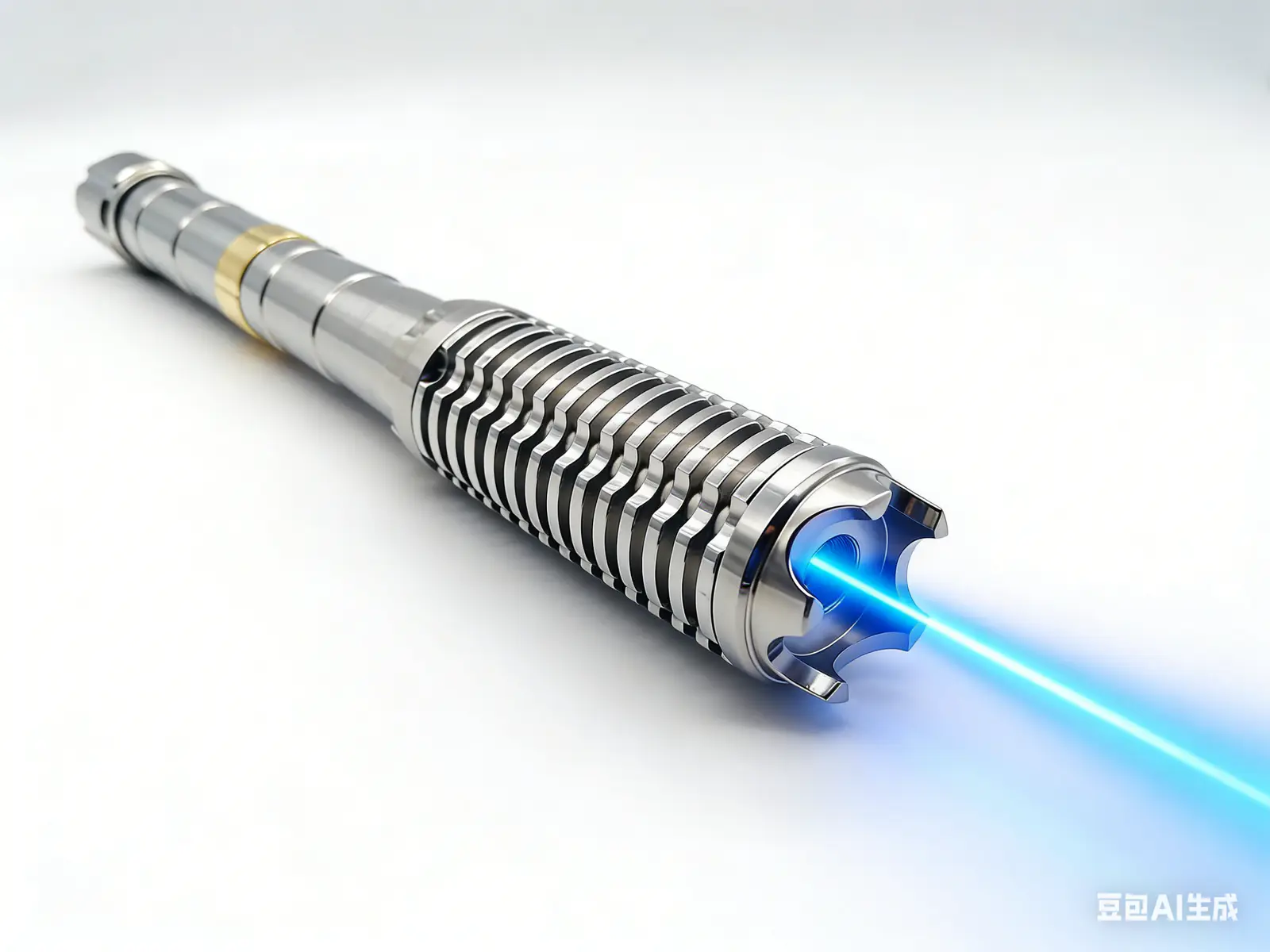
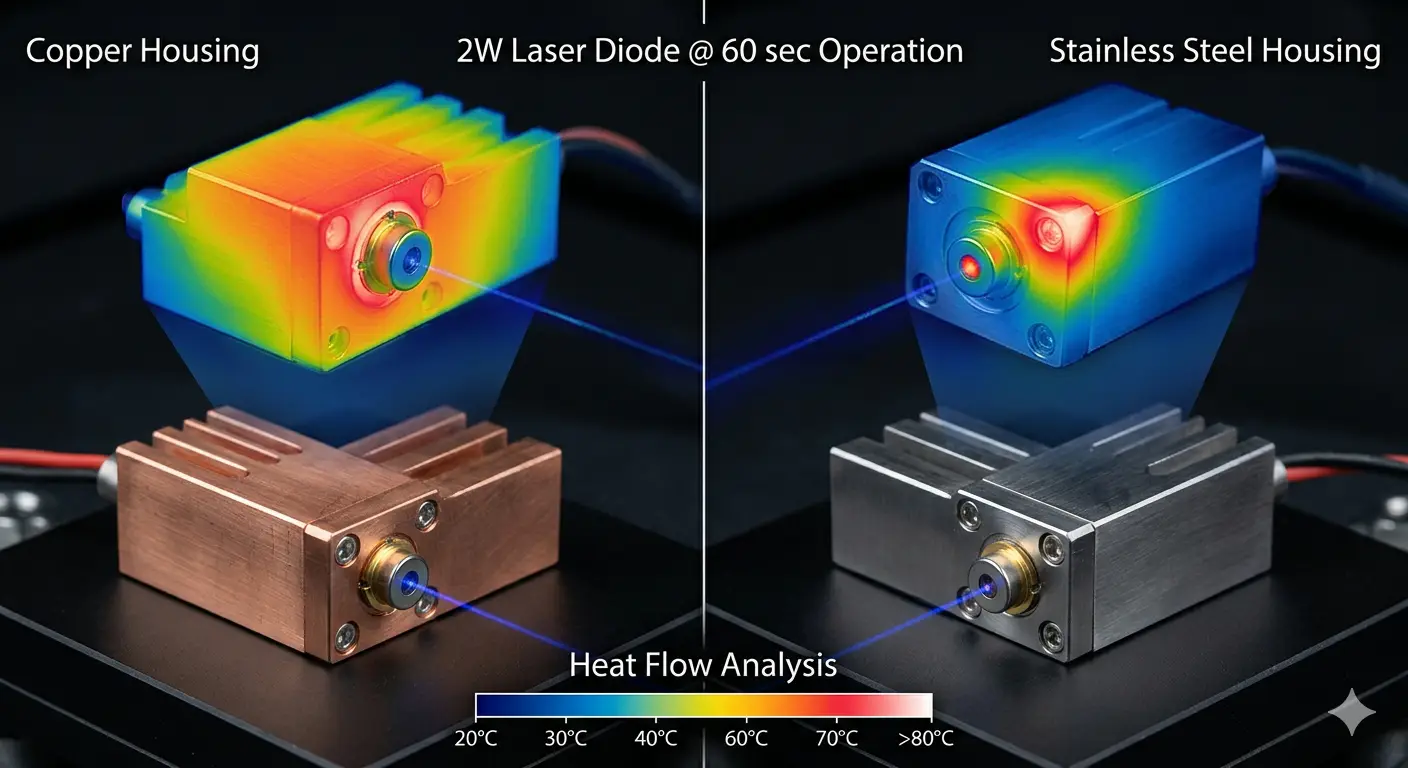
Short answer:
- Copper = superior thermal conductivity (397 W/m·K vs 15 W/m·K) → longer diode life, better for high-drain lasers
- Stainless steel = stronger, more scratch-resistant, but thermally insulating → runs hotter inside
- Best of both = stainless steel outer shell + copper internal heatsink
If you're building or buying a high-power laser pointer, the housing material isn't just about looks — it directly affects thermal management, diode lifespan, and real-world performance. Most reviews compare copper and stainless steel as if they're interchangeable外壳 choices. They aren't. The difference comes down to a 26x gap in thermal conductivity and a counterintuitive truth that most product pages never mention.
Thermal Conductivity — The 26x Difference That Drives Everything
The fundamental property separating copper and stainless steel in laser applications is thermal conductivity — how efficiently each material moves heat away from the laser diode junction.
Copper (C110/ETP grade) delivers approximately 397–401 W/m·K at room temperature. Stainless steel 304/316 manages only 15–16 W/m·K. That is roughly a 26-fold advantage for copper under identical thermal load conditions.
What does this mean in practice? When a high-drain laser diode generates 5W of waste heat, copper can move that energy away from the junction roughly 26 times faster than stainless steel. Faster heat extraction translates directly to lower diode junction temperature, which means longer continuous runtime (duty cycle) and extended component life. Engineers spec stainless steel for structural applications where thermal insulation is desired — the same property that makes stainless steel act like a thermal flask (or vacuum flask) around a laser diode is the opposite of what you want for heat extraction.
Engineers specifying metals for laser diode packaging always route the critical thermal path through copper or copper alloys. The choice isn't aesthetic — it is thermal.
Source: Sheet Metal Manufacturing — Stainless Steel vs Copper
Mechanical Strength — Where Stainless Steel Wins
Copper dominates on thermal performance. Stainless steel fights back on mechanical durability.
Stainless steel 304 offers tensile strength of 520–750 MPa. Copper C110 stretches to only 210 MPa before yielding — roughly 3 times weaker. In drop tests, impact resistance, and scratch resistance, stainless steel consistently outperforms copper.
For EDC (everyday carry) or tactical laser applications where the device gets tossed in a pocket or used in rough conditions, stainless steel's superior yield strength means fewer dents, less cosmetic damage, and better structural integrity over time. Copper dents easily when impacted by hard objects — a disadvantage if your laser shares a bag with keys or tools.
The trade-off: laser pointer housings don't experience extreme mechanical stress in normal use. The practical durability gap matters most for users who drop their devices or demand military-grade ruggedness. For desk-bound or careful users, the mechanical advantage of stainless steel may never manifest as a real-world benefit.
If you prioritize durability and a low-maintenance exterior over maximum thermal performance, a stainless steel laser is the better fit. Our stainless steel housed laser models are built with exactly this balance in mind — combining rugged strength with proper internal thermal management.
Source: Kongfang Metal — Copper vs Stainless Steel
For safety guidance on handling high-power laser devices, see our Laser Safety Glasses Guide.
The NASA 10°C Rule — Why Heat Management Is Life or Death for Laser Diodes
Here is the number that transforms housing material from an aesthetic choice into a reliability decision: NASA's NEPP (Electronic Parts and Packaging) program confirms that operating a laser diode 10°C above its rated temperature doubles the rate of degradation — effectively halving the diode's operational lifespan.
Laser diodes typically fail completely at approximately 100°C junction temperature. This is not theory — it is derived from the Arrhenius equation governing semiconductor reliability, and it is the same standard applied to laser diodes in aerospace and telecom infrastructure.
Consider the practical consequence: a copper-housed laser operating at 60°C junction temperature during high-power output might deliver thousands of hours of reliable service. A stainless steel-housed unit with identical diode and thermal load, accumulating heat because the housing cannot efficiently extract it, might reach 80°C — running at a temperature that cuts its expected life by half or more.
The mechanism is straightforward. Copper's 26x thermal conductivity advantage means it moves heat from the diode junction to the housing surface faster than stainless steel can. Surface temperature might feel similar or even slightly higher on copper (because copper is efficiently moving internal heat outward), but the junction temperature — the temperature that actually kills diodes — stays lower.
This is the counterintuitive reality of copper housings: they often feel warmer to the touch at the surface because they are doing their job. A stainless steel housing that feels cooler in your hand may actually be insulating heat inside, raising the junction temperature while giving you a comfortable exterior surface temperature.
What this means for your purchase: If you plan to use your laser for more than occasional short bursts, a copper-housed or copper-heatsinked laser isn’t just “better” — it’s the difference between a device that lasts years and one that degrades in months.
Proper thermal management extends beyond the housing material. Understanding why cheap laser pointers fail prematurely helps contextualize the value of investing in proper thermal design.
Source: NASA NEPP — Laser Diode Reliability
The Shell vs. Heatsink Distinction — What Most Reviews Get Wrong
Here is the insight that separates informed buyers from casual reviewers: the housing material and the thermal path material are two completely different engineering decisions. Most product pages conflate them.
The laser pointer community's consensus, repeatedly confirmed in engineering discussions: copper's maximum value is as an internal heatsink, not as an external shell. The optimal design for a high-power laser uses a stainless steel or aluminum outer shell (providing strength, corrosion resistance, and aesthetics) with a copper or copper-alloy internal heatsink that directly contacts the laser diode and conducts heat away from the junction.
This is why installing an extended copper heat sink inside a stainless steel-shelled laser can eliminate thermal handfeel issues entirely. The user reports no heat sensation even at high power output — not because the shell changed, but because the internal thermal path now uses copper's superior conductivity.
The practical implication: if you are choosing between a copper-shelled laser and a stainless steel-shelled laser, ask what is inside each. A stainless steel shell with a well-designed internal copper heatsink will outperform a pure copper shell with a poorly designed thermal interface. The housing material matters less than the quality of the internal thermal path.
Here's the key takeaway: Copper is most valuable as an internal heatsink, not as the shell. Use stainless steel or aluminum for the exterior (strength, looks), and let copper do the thermal work inside.
Galvanic Corrosion — The Hidden Risk of Copper + Stainless Steel
There is one more engineering caution most reviews omit: galvanic corrosion occurs when copper and stainless steel are placed in direct contact in the presence of moisture (including human sweat). The two metals have significantly different electrochemical potentials, creating a galvanic cell that accelerates corrosion of the copper component.
Copper acts as the sacrificial anode in a copper-stainless steel galvanic couple, corroding faster than it would alone. Quality lasers using mixed metal construction include an insulating washer or nickel-plating barrier between copper and steel components. If you are building a DIY laser with copper heatsink and stainless shell, verify that electrical isolation exists between the dissimilar metals.
This detail is almost never mentioned in consumer laser reviews, but it is a genuine engineering consideration — especially for users in humid environments or those with sweaty hands.
Source: Materion — Galvanic Corrosion and Copper Alloys
Wavelength Drift — Why Temperature Control Affects Beam Quality
Most users know that overheating can “kill” a laser diode. Few realize that even before failure, temperature instability degrades beam quality.
According to Newport's application report AN05, laser diode wavelength shifts with temperature:
- 780nm band: approximately 0.25 nm/°C
- 1300–1550nm band: approximately 0.4 nm/°C
For high-power visible lasers (like 445nm blue or 520nm green), inadequate heat dissipation causes wavelength drift — the actual output color may shift subtly, and power output becomes unstable. Copper housings maintain stable junction temperatures, preserving wavelength accuracy. Stainless steel's thermal insulation allows temperature to climb, leading to measurable wavelength drift during extended operation.
For users conducting precise experiments or simply wanting consistent beam performance, this is a tangible advantage of copper-based thermal management.
Source: Newport — Laser Diode Characteristics Overview (AN05)
The Counterintuitive Truth: Copper Is Harder to Machine Than Stainless Steel
Here's a fact that flips common assumptions: copper is more difficult to machine than stainless steel.
The machinability index (with free-cutting steel = 100) shows:
- Copper (C110): 20–30
- Stainless steel 304: ~45
Copper's high ductility and tendency to form stringy, continuous chips cause it to gall and stick to cutting tools. Machining copper requires specialized coated tools, slower speeds, and careful chip management. Stainless steel, while hard, is more predictable in CNC operations.
This explains a significant part of the price premium for copper-housed lasers: it's not just the raw material cost (copper is 2–3x more expensive than stainless steel), but also the higher manufacturing complexity. A well-machined copper heatsink or housing represents genuine engineering investment — not just marketing markup.
Source: JLCCNC — Best Metals for CNC Machining
Copper Oxidation and Aesthetics — The Trade-Off
Copper exposed to air, moisture, and skin oils will gradually oxidize. It first darkens to a brown patina, eventually forming green verdigris in humid conditions. This process can take months to years depending on environment.
For laser pointers, hand sweat accelerates oxidation. If a pristine appearance matters to you, consider:
- Clear anti-tarnish coating (applied by some manufacturers)
- Nickel or tin plating (preserves copper's thermal benefits while protecting appearance)
Stainless steel, by contrast, forms a self-healing passive chromium oxide layer. It requires virtually no maintenance and is ideal for users who want a “grab-and-go” device without worrying about cosmetic changes over time.
Source: Fractory — Copper Corrosion
Industry Validation: SCHOTT Confirms Copper's Superiority (2026)
At SPIE Photonics 2026, SCHOTT — a leading precision glass and ceramics manufacturer with 84 years of expertise — announced a new line of copper thermal packages for high-power laser diodes. Their official statement explicitly notes:
"Copper packages deliver an exceptional thermal path, outperforming conventional stainless steel or alloy headers by dissipating heat significantly more efficiently."
This is not community speculation or forum testing. This is industrial-grade validation from a company that supplies laser packaging to aerospace, defense, and telecommunications sectors. If the world's most demanding applications are shifting to copper thermal paths, the case for copper in high-drain handheld lasers becomes even clearer.
Source: SCHOTT — Optimize High-Power Laser Performance
How to Tell If Your Laser Actually Uses Copper Effectively
Not all copper is created equal. A copper-colored coating on a heatsink does nothing. Here’s what to look for:
- Visible copper heatsink – If the laser has a removable head or battery cap, look inside. A real copper heatsink has a distinctive reddish-gold color and significant mass around the diode module.
- Direct diode contact – The diode should be mounted directly to the copper, not separated by thick layers of aluminum or air gaps.
- Thermal paste application – Quality builds use high-grade thermal paste between the diode and heatsink.
- Mixed-metal isolation – If copper contacts stainless steel, check for nickel plating or insulating washers to prevent galvanic corrosion.
Our copper-housed laser models are designed with these principles in mind — combining copper’s thermal advantage with proper galvanic isolation and structural durability. View our copper laser options here.
FAQ
Q1: Does copper really dissipate heat better than stainless steel in laser housings?
Yes — fundamentally so. Copper's thermal conductivity of approximately 397 W/m·K versus stainless steel's 15 W/m·K means copper moves heat away from the laser diode junction roughly 26 times more efficiently. For high-drain lasers (typically above 1W output), this translates to lower junction temperatures during continuous operation, longer duty cycles, and measurably extended diode lifespan. The performance gap is not marginal — it is an order-of-magnitude difference.
Q2: Will a stainless steel housing cause my laser diode to overheat faster?
Stainless steel's low thermal conductivity (roughly 15 W/m·K) does create a thermal bottleneck compared to copper. Heat accumulates in the diode junction rather than being conducted outward, leading to higher operating temperatures. The practical impact depends on your usage pattern: short pulses (<30 seconds) may show minimal difference, but extended continuous operation at high power will result in noticeably higher junction temperatures in a stainless steel housed laser versus a copper-housed unit. Under sustained high-power use, stainless steel can reduce effective runtime by 40% or more compared to copper.
Q3: Does the 10°C rule really matter for hobbyist laser users?
Yes, even for hobbyists. NASA NEPP data shows that every 10°C above rated junction temperature halves diode lifespan. A diode that might last 10,000 hours in a properly cooled copper-housed laser could fail after 5,000 hours in an undersized stainless steel housing running the same duty cycle. For users who run lasers frequently or in extended sessions, this difference translates to months or years of additional service life — worth considering before purchase.
Q4: Can copper and stainless steel cause galvanic corrosion in my laser?
They can, if directly contacting each other in moist conditions (including exposure to hand sweat). Copper acts as the sacrificial anode in a copper-stainless steel galvanic couple, corroding faster than it would alone. Quality commercial lasers address this with nickel plating or insulating washers separating dissimilar metals. DIY builders should verify electrical isolation between copper heatsinks and stainless steel housings, especially in humid environments. With proper isolation, galvanic corrosion is not a practical concern.
Q5: Is a copper housing worth the higher price premium?
The premium reflects real engineering value — but only if the internal thermal path is also properly designed. A copper shell with a poorly fitted heatsink may perform worse than a stainless shell with excellent thermal interface engineering. Evaluate whether the manufacturer used proper thermal paste, adequate heatsink surface area, and direct die-to-copper contact where possible. If thermal design is equivalent, copper's performance advantage justifies the price for serious high-power users. For occasional, low-power use, the benefit may not justify the cost.
Q6: Does copper really make the laser last longer? (NASA 10°C rule explained)
Yes. NASA's NEPP program confirms that every 10°C reduction in junction temperature doubles the lifespan of a laser diode. Copper's ability to keep the junction cooler — not just the housing surface — directly translates to longer component life. This is not marketing; it's semiconductor reliability physics.
Conclusion
Copper wins on thermal performance — its 26x conductivity advantage over stainless steel translates to lower diode junction temperatures and longer laser lifespan, validated by both NASA reliability data and industrial manufacturers like SCHOTT. Stainless steel wins on mechanical durability, corrosion resistance, and lower cost. The optimal approach for high-power laser design is not a binary choice: use stainless steel or aluminum for the outer shell (structure, aesthetics, corrosion resistance) and copper or copper alloy for the internal thermal path (heatsink, direct diode mount). This hybrid approach delivers strength where you need it and thermal performance where it matters.
If you are a serious high-power user running extended duty cycles, prioritize thermal design quality over housing aesthetics. For casual users, either material works — but understand that stainless steel's cooler exterior feel can mask dangerously high internal temperatures.
Final thought: When you see a copper-housed laser priced higher than its stainless steel counterpart, you're not just paying for a different color. You're paying for:
- A material that moves heat 26 times faster
- Measurably longer diode life (per NASA's 10°C rule)
- More stable wavelength and beam quality
- Higher manufacturing complexity (copper is harder to machine)
- Industry validation from the likes of SCHOTT
For those who demand performance and longevity, copper's advantages are real, measurable, and worth the investment.