
Green vs. Blue vs. Red Laser: How Physics Changes Beam Visibility
Discover why green lasers appear brighter, how Rayleigh scattering differs from Mie, and why beam visibility depends on more than just color. Data-backed guide.
Image Gallery
Green vs. Blue vs. Red: How Physics Changes the Way You See the Beam
When you point a laser into the night sky, the difference between red, green, and blue is immediately obvious—but not for the reasons most people think.
In real-world use:
- A 5 mW green laser produces a clearly visible beam
- A 5 mW red laser often looks almost invisible
- A 5 mW blue laser sits somewhere in between
Same power. Completely different experience.
The key insight: a 1 mW green laser does not "travel farther" than red. It is weighted differently by your visual system and the atmosphere—and that weighting changes from day to night.
This article explains the full picture—from human vision to atmospheric physics—so you can understand not just what looks brighter, but why.
Why "Brightness" Is Not Laser Power
One of the biggest misconceptions in the laser market is:
“Brighter = more powerful”
In physics terms, this is incorrect.
- 100 mW is 100 mW regardless of color
- Red, green, and blue deliver the same energy at equal power
But if your goal is to see the beam in the air, power is only one piece of the equation.
What actually matters is:
How much scattered light reaches your eye × how sensitive your eye is to that wavelength
That’s why two lasers with identical output can look dramatically different.
Photopic vs. Scotopic Vision: Why Green Dominates
Daytime Vision (Photopic)
Under bright conditions, the human eye is most sensitive to green light (~555 nm).
| Wavelength (nm) | Color | Relative Perceived Brightness |
|---|---|---|
| 450 |
According to NASA research, a 1 mW green laser can appear as bright as ~3 mW red in daylight.
👉 Practical takeaway:
If you need visibility in bright environments, green is the most efficient choice per milliwatt.
Night Vision (Scotopic) and the Purkinje Shift
When your eyes adapt to darkness, sensitivity shifts toward 507 nm (blue-green).
Data from FAA laser safety guidance and HyperPhysics shows:
- Green can appear up to 30× brighter than red
- Red drops to ~0.08% of green sensitivity
👉 This explains a common confusion:
“Why does my red laser disappear at night?”
It’s not weaker—the human eye simply stops responding efficiently to red in dark-adapted conditions.
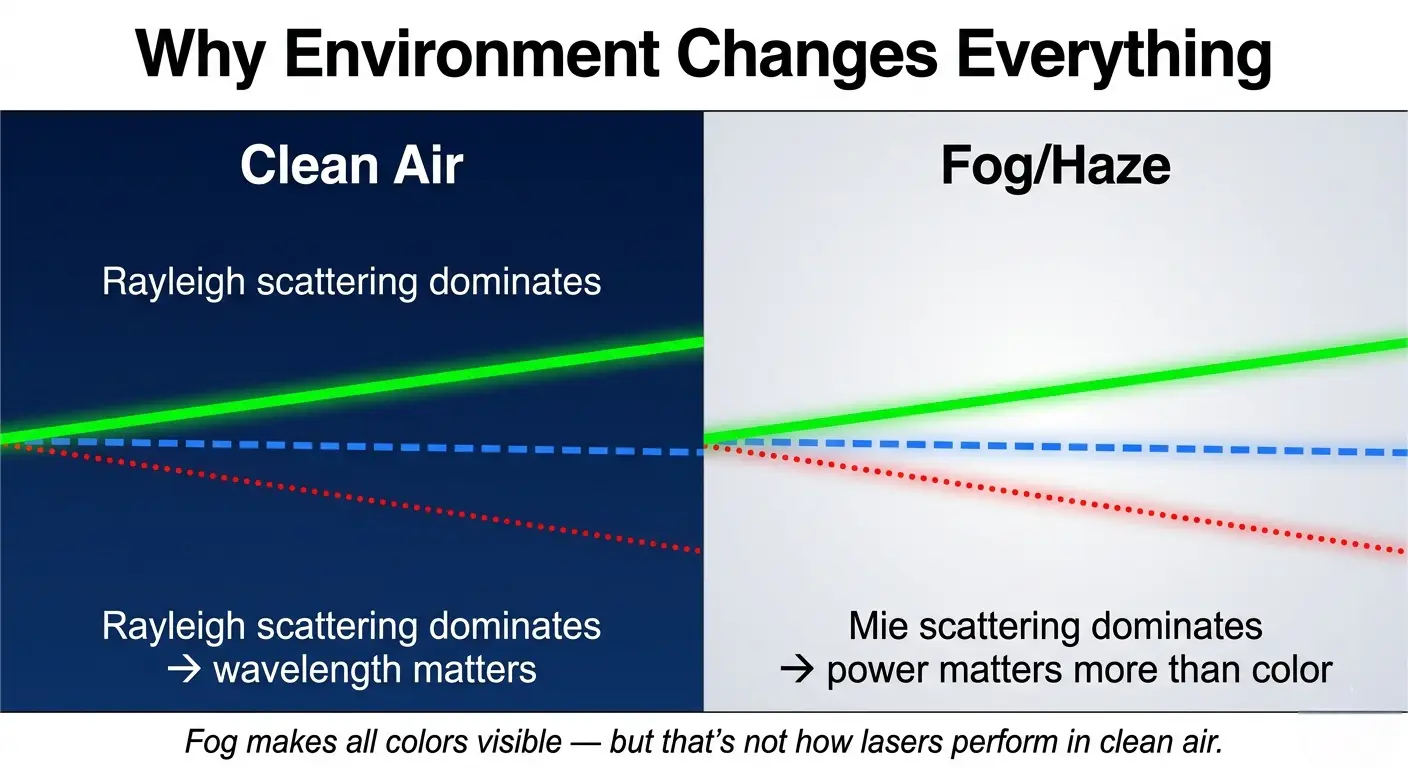
Rayleigh vs. Mie Scattering: Why Environment Changes Everything
Rayleigh Scattering (Clean Air)
In clear air, light scatters off tiny molecules following:
Intensity ∝ 1 / λ⁴
From PMC research:
- Blue scatters ~4.35× more than red
- Green scatters ~2.2× more than red
Important insight
Blue scatters more than green—but still looks dimmer.
Why?
Because:
Visibility = scattering × eye sensitivity
Green wins because your eyes are far more sensitive to it.
Mie Scattering (Fog, Smoke, Dust)
In real-world environments like fog or haze:
- Particle size becomes large
- Scattering becomes less dependent on wavelength
According to PMC aerosol studies:
In fog, laser power matters more than color
Why online comparisons are misleading
Many videos show lasers in fog and conclude “all colors look similar.”
But in reality:
- Fog artificially amplifies visibility
- Cameras distort brightness perception
- Clean-air performance is completely different
Beam Visibility vs. Spot Sharpness (The Hidden Tradeoff)
A critical distinction most users miss:
- Beam visibility = how well you see the light in the air
- Spot sharpness = how tight the dot looks at distance
Real-world observation
Users often report:
- “Green looks bright but thick”
- “Red looks sharper”
This is correct.
- Green → more scattering → visible beam
- Red → less scattering → cleaner, tighter dot
👉 These are different optical behaviors, not contradictions.
If you want to understand how this affects long-distance performance, see:
👉 how far a laser pointer can go
Real-World Threshold: When Beams Become Visible
From practical testing and observational data:
- Around 3 mW → most beams are hard to see in clean air
- Around 10–15 mW → green and blue become clearly visible
- Red often remains faint even at higher power
👉 This is why many users are disappointed:
They expect a “light sword” effect—but buy a laser that simply doesn’t produce enough scattered light.
If you want the actual light sword effect, the G019 uses a transparent beam extension tube that glows along its full length — a real 4W blue or 2W green focusing laser with a removable visual mode.
Visible Does Not Mean Safe
One of the most dangerous myths:
“If I can see it, it must be safe”
Retinal Hazard Region (400–1400 nm)
According to ICNIRP guidelines:
- These wavelengths pass through the eye
- The lens focuses them onto the retina
- Even low-power lasers can exceed safe limits
The Blink Reflex Problem
Safety standards assume:
- ~0.25 second reaction time
But in reality:
- Users may stare
- Reflections may occur
- Exposure can exceed safe limits
👉 Even a 5 mW laser can exceed exposure limits during blink response
Blue Light Considerations (400–550 nm)
Blue wavelengths introduce:
- Photochemical risk (not just heat damage)
- Risk increases with prolonged exposure (>10 seconds)
👉 Important:
Brighter does NOT mean more dangerous—but risk depends on how the light interacts with your eye.
Decision Matrix: Which Color Should You Choose?
Based on Real Use Cases
The Complete Visibility Equation
Beam visibility is not determined by color alone:
Perceived Visibility ≈ Radiant Power × Spectral Sensitivity (Vλ) × Scattering × Beam Quality
This explains why:
- A well-built 50 mW green can outperform
- A fake “2000 mW red”
For a breakdown of misleading power claims, see:
👉 50000 mW laser scams
Frequently Asked Questions
Why does green look brighter than red?
Because green (~532 nm) aligns with peak eye sensitivity, while red (~650 nm) does not. See data from HyperPhysics.
Is a brighter laser more dangerous?
Not necessarily. Risk depends on exposure duration, wavelength, and beam focus—not just brightness.
Why can I see beams in fog but not clean air?
Because fog introduces large particles (Mie scattering), dramatically increasing visible scattering. See PMC aerosol research.
Does green ruin night vision more than red?
Yes. Green strongly stimulates dark-adapted vision, while red minimally affects it.
Why does a “5000 mW” laser look dim?
Because power ratings are often exaggerated or fake, and brightness depends on wavelength and optics—not just labeled output.
Conclusion
Laser color is not just a visual choice—it is the result of human biology, atmospheric physics, and optical engineering working together.
- Green dominates because of eye sensitivity
- Blue scatters more but appears dimmer
- Red preserves night vision but sacrifices visibility
Understanding these interactions allows you to choose the right laser for your actual use case—not just based on marketing claims.
For deeper technical insights, explore: