
The Hidden Dangers of High-Power Blue Lasers: Why Class 4 Safety Isn’t Optional
High-power blue lasers can burn materials, engrave wood, and travel hundreds of meters — but they also carry serious safety risks. This guide explains why Class 4 lasers are hazardous, how blue light damages the retina, and what safety precautions every laser user must understand.
Image Gallery
TL;DR – Key Takeaways
- A 5W 450 nm blue laser can cause permanent retinal damage faster than the human blink reflex (~0.25 seconds).
- Class 4 lasers are hazardous not only through direct beams, but also specular reflections and diffuse reflections.
- High-power lasers can ignite fires, damage skin tissue, and produce toxic fumes when cutting certain materials.
- Many online “laser safety glasses” offer zero real protection because they lack proper Optical Density (OD) ratings.
High-power blue lasers look impressive in videos. They can burn paper, engrave wood, and cut plastic with precision. For hobbyists and DIY makers, that power feels almost magical.
But the same beam that ignites a match in a split second can also cause permanent retinal damage before you even realize what happened.
A powerful blue laser is not a toy. In fact, most high-power blue lasers fall into Class 4 — the highest hazard classification for lasers. These devices are treated as industrial equipment in laboratories and manufacturing environments.
Understanding the hidden risks of Class 4 lasers is essential for anyone who wants to use them responsibly.
What Makes a Laser “Class 4”?
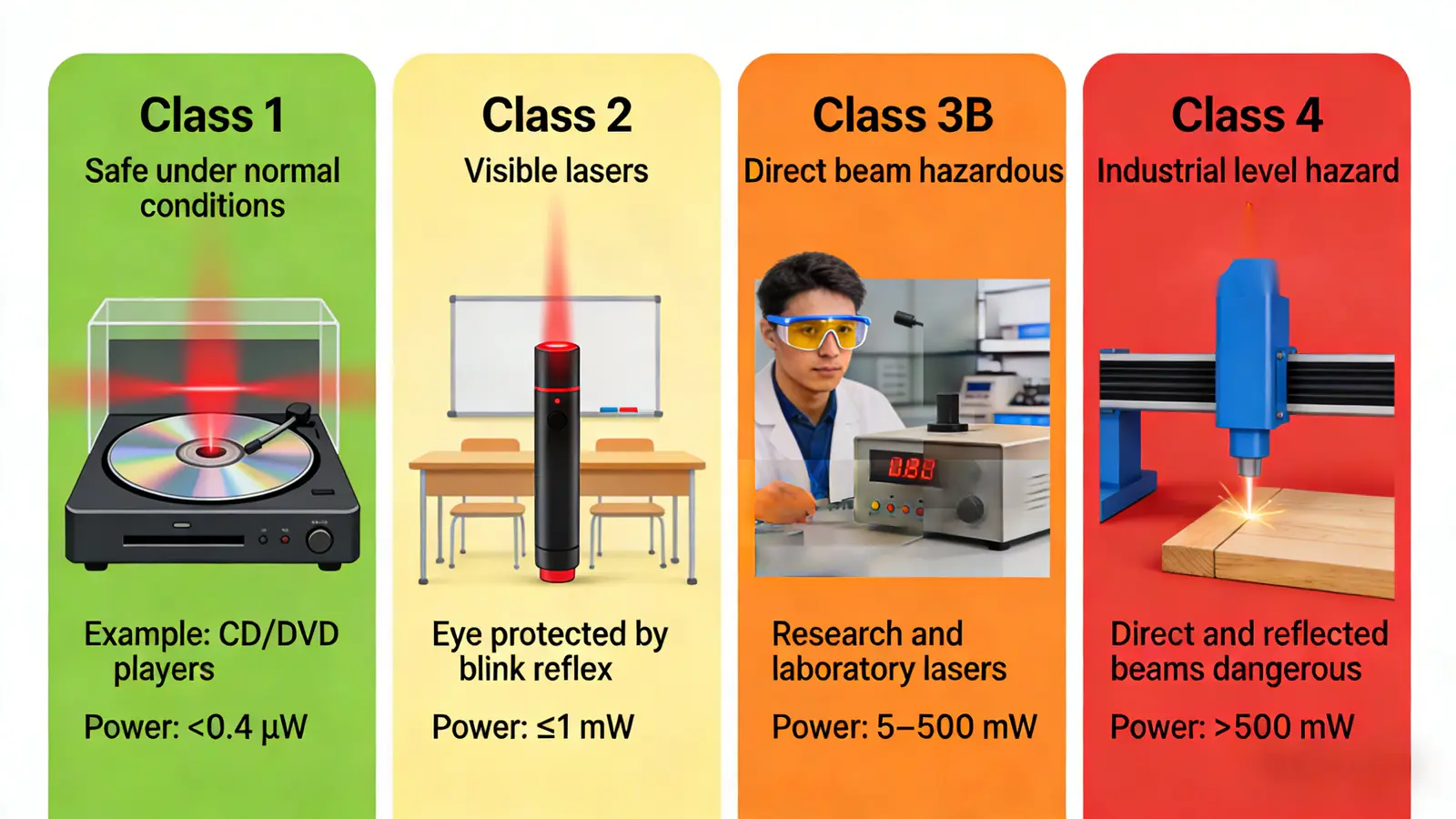
The International Electrotechnical Commission (IEC 60825-1) classifies lasers according to their potential hazard.
| Laser Class | Power Range | Risk Level | Typical Applications |
|---|---|---|---|
| Class 1 | <0.4 µW | Safe under all conditions | CD players |
| Class 2 | ≤1 mW | Blink reflex protects eye | Presentation pointers |
| Class 3R | 1–5 mW | Low risk but not safe to stare into | Alignment tools |
| Class 3B | 5–500 mW | Direct beam hazardous | Research lasers |
| Class 4 | >500 mW | Direct, reflected, and diffuse exposure hazardous | Laser cutters, engravers |
Source: IEC 60825-1 Laser Safety Standard
Unlike lower classes, Class 4 lasers pose danger even when you are not looking directly at the beam.
Reflections from metal tools, mirrors, or glossy surfaces can redirect the beam toward the eye with nearly the same intensity.
For a deeper explanation of laser power levels and their real-world implications, see:
Source: How Powerful is a Laser Pointer? Understanding Power Levels, Safety, and Applications
Why Blue Lasers (≈450 nm) Are Especially Dangerous
Blue lasers operate around 445–455 nm, which lies in the high-energy portion of the visible spectrum.
Shorter wavelengths carry more energy per photon, meaning blue light can cause both thermal and photochemical damage to retinal tissue.
According to ophthalmology research published in the International Journal of Ophthalmology:
High-energy short-wave blue light between 415–455 nm is particularly harmful because it penetrates deeply into the retina and can cause irreversible photochemical injury.
Source
https://www.ncbi.nlm.nih.gov/pmc/articles/PMC6288536/
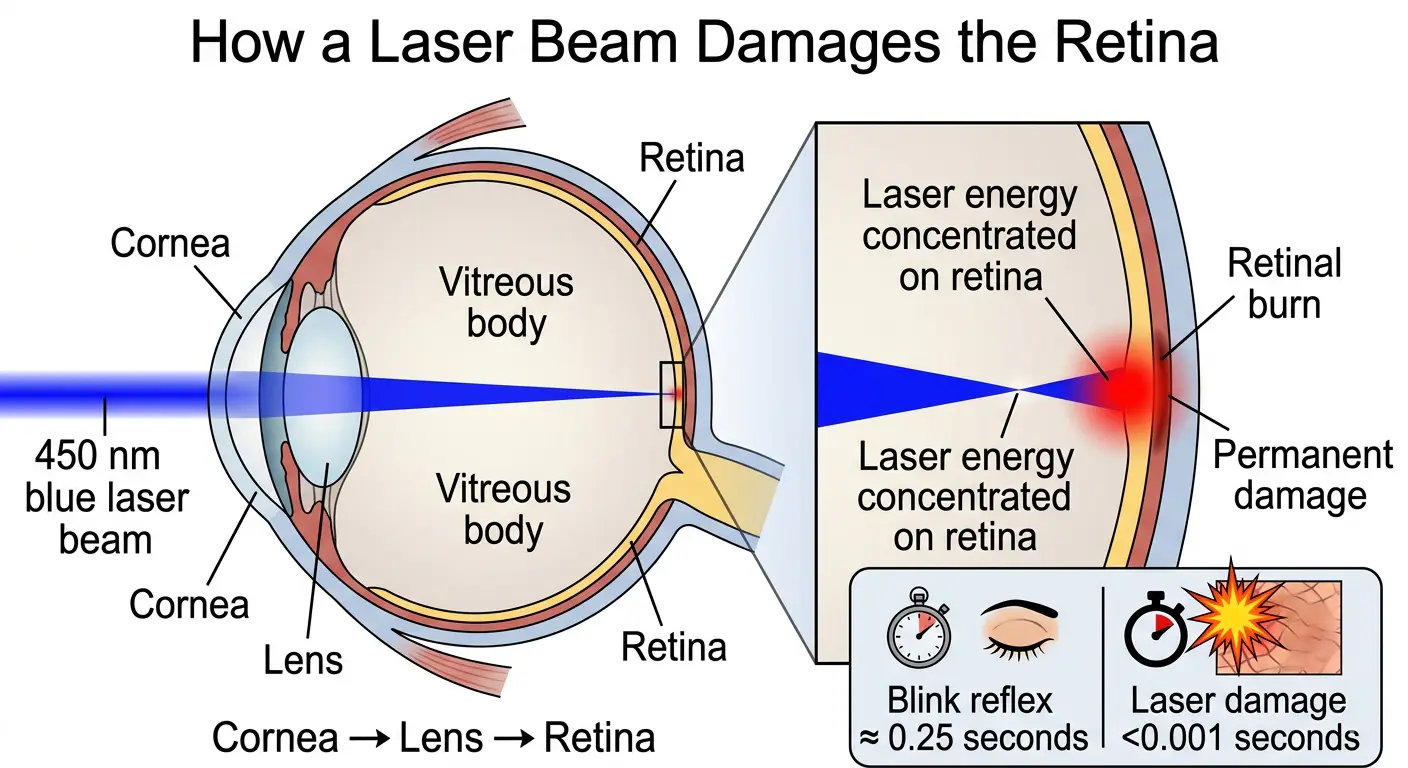
Inside the eye, the lens focuses incoming light onto a tiny area of the retina. A powerful laser beam concentrated onto such a small point can create extreme energy density, effectively burning retinal cells.
Unlike skin burns, retinal burns are painless and irreversible.
Key Safety Metrics Most Users Don’t Know
Blink Reflex vs Laser Damage
| Parameter | Time |
|---|---|
| Human blink reflex | ~0.25 seconds |
| Retinal injury threshold (Class 4 laser) | <0.001 seconds |
This means the eye cannot react fast enough to protect itself.
Nominal Ocular Hazard Distance (NOHD)
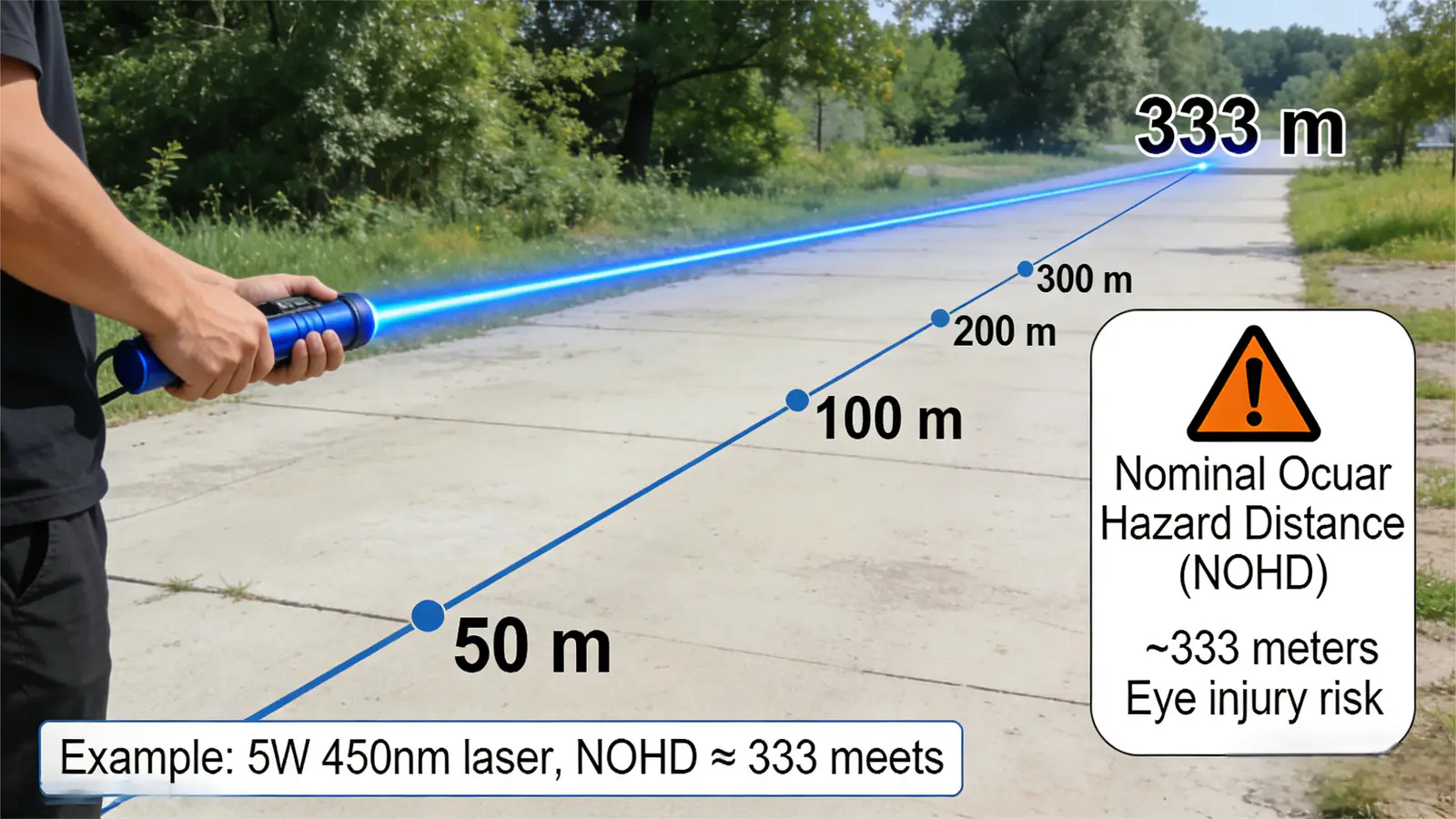
NOHD defines the distance where laser exposure exceeds the Maximum Permissible Exposure (MPE).
For a typical 5W blue laser pointer:
| Laser Power | NOHD Distance |
|---|---|
| 1W | ~150 m |
| 5W | ~333 m |
| 40W | ~942 m |
Source
https://www.laserpointersafety.com/safetycalcs/index.html
Even a beam leaving a garage workshop can travel hundreds of meters while remaining hazardous.
Three Hidden Risks Most Laser Users Ignore
1. Diffuse Reflections
Many users believe that the laser becomes safe once it hits a wall.
This is incorrect.
Even the scattered light from a Class 4 laser can exceed safe exposure limits at short distances.
According to Laser Safety Facts:
Viewing the diffuse reflection of a high-power laser on a wall can still cause eye injury within several feet.
External source
https://www.lasersafetyfacts.com/4/
2. Fire Hazards
Class 4 lasers have enough power to ignite many materials.
Common ignition risks include:
- paper
- wood dust
- fabric
- plastic
- cardboard packaging
A stray beam can quickly turn into a workshop fire hazard.
3. Toxic Fumes from Laser Cutting
When lasers cut or engrave materials, they often produce hazardous gases.
| Material | Toxic Byproducts |
|---|---|
| PVC / Vinyl | Chlorine gas, hydrochloric acid |
| ABS plastic | Hydrogen cyanide |
| Polycarbonate | Thick toxic smoke |
| Fiberglass | Irritating particles |
Source
https://www.fumeclear.com/blogs/health-safety/toxic-materials-you-should-never-laser-cut
Proper ventilation and fume extraction are essential when operating powerful lasers.
The Eyewear Trap: Why Cheap “Laser Glasses” Don’t Work
Many online sellers advertise “blue laser safety glasses.”
However, true laser protection depends on Optical Density (OD).
OD measures how much light is blocked.
| Eyewear Type | OD Rating | Protection Level |
|---|---|---|
| Sunglasses | <1 | None |
| Computer blue-light glasses | 0.1–0.5 | None |
| Basic laser glasses | OD 3–4 | Limited |
| Professional laser goggles | OD 6+ | Required for Class 4 |
Most inexpensive glasses on marketplaces do not provide verified OD ratings.
Laser safety organizations report that incorrect eyewear is responsible for the majority of laser injuries.
For a deeper look at eye injuries caused by lasers, read:
Can a Laser Pointer Blind You? The Real Science of Laser Eye Damage
Class 4 Laser Safety Checklist
Hardware Safety (FDA 21 CFR 1040.10)
Professional laser systems must include:
- Key switch
- Remote interlock connector
- Emission indicator
- Protective housing
- Warning labels
Source
https://www.law.cornell.edu/cfr/text/21/1040.10
Safe Workspace Practices
- Remove reflective surfaces
- Keep the beam below or above eye level
- Install emergency stop buttons
- Restrict access to trained users
- Maintain proper ventilation
Personal Safety Habits
- Always wear wavelength-specific laser goggles
- Never rely on the blink reflex
- Assume all reflections are hazardous
- Keep pets and children away from the beam path
For a full safety guide, see:
The Complete Guide to Laser Pointer Safety: Protecting Eyes, Kids, Pets, and More
Frequently Asked Questions
Can a 5W laser pointer really blind someone?
Yes. A 5W laser can cause permanent retinal damage almost instantly, far faster than the human blink reflex.
Are blue lasers more dangerous than green lasers?
Both can cause eye injury, but blue lasers often produce stronger photochemical damage due to shorter wavelength energy.
Is it safe to look at the laser dot on a wall?
Not with Class 4 lasers. Even diffuse reflections may exceed safe exposure levels at close range.
Final Thoughts
High-power blue lasers are incredible tools, capable of precision cutting and engraving in small workshops.
But their power also demands respect, knowledge, and proper safety equipment.
The difference between a successful project and a lifelong eye injury can come down to a single moment of carelessness.
Always treat a Class 4 laser as industrial equipment — not a gadget.
References
- https://www.fda.gov/radiation-emitting-products
- https://www.osha.gov/otm/section-3-health-hazards/chapter-6
- https://www.lasersafetyfacts.com
- https://www.ncbi.nlm.nih.gov/pmc/articles/PMC6288536/
- https://www.laserpointersafety.com
- https://www.fumeclear.com/blogs/health-safety/toxic-materials-you-should-never-laser-cut