
High Power Handheld Laser Pointers Guide: What You Need to Know Before Buying (2026)
A data-driven guide to high power handheld laser pointers covering architecture differences, duty cycle constraints, compliance failure rates (74% of lasers fail tests), and a decision matrix for choosing between DPSS and direct diode technologies.
Image Gallery
If you’re searching for a “high power handheld laser pointer,” you probably want to know two things:
- Which one should I buy?
- What’s actually safe to use?
The problem is: in today’s market, labeled power, visible brightness, and actual risk are often completely disconnected.
This guide gives you the real data — not marketing hype — so you can make an informed decision.
1. The Compliance Crisis: Why Most “High Power” Laser Pointers Are Misleading
According to testing by the National Institute of Standards and Technology (NIST) , the consumer laser market has a serious compliance issue:
- Only 26% of tested lasers met legal limits
- 74% exceeded the allowed output
- 48% exceeded limits by more than 2×
👉 Source: NIST Technical Report: Accurate & Inexpensive Testing of Handheld Laser Pointers
Even more alarming:
- 91.7% of tested green laser pointers were non-compliant
- A separate test of 24 Amazon listings found 100% were non-compliant — average actual power was 41 mW despite being labeled “5 mW” (8× over the legal limit)
👉 LaserPointerSafety.com: Illegal Pointers
Why does this happen?
Manufacturers often:
- Remove IR filters (cost-saving)
- Overdrive laser diodes to make the visible beam appear brighter
- Mislabel output power intentionally
“5 mW” Is Almost Never 5 mW
Independent measurements show:
- A typical “5 mW” laser pointer measured 41 mW on average
- Some violet (405 nm) units exceeded 87 mW — 17× the legal limit
This creates a critical misconception:
“Legal” does NOT mean safe — and “labeled” does NOT mean real.
(To understand what different mW ratings actually mean in real‑world use — from classroom laser pointers to industrial laser pointers — see our detailed guide: Laser Pointer Power Guide: What mW Really Means.)
Legal Power Thresholds (What the Numbers Actually Mean)
| Power Range | Class | What It Means |
|---|---|---|
👉 FDA full guidance: Important Information for Laser Pointer Manufacturers
📘 IEC 60825‑1 classification details: Laser Classification Requirements (EHS Wisconsin)
2. DPSS vs Direct Diode: The Real Difference That Matters
Most buying guides compare wattage. That’s misleading.
The real difference is laser architecture — it determines how much heat the device makes, how long you can run it, and whether it hides invisible dangers.
DPSS (532 nm Green Laser)
- Uses a 3‑stage process:
808 nm pump diode → 1064 nm infrared → converted to 532 nm green - Wall‑plug efficiency: ~10–20%
(For every 1 W of electricity, only ~0.19 W becomes green light; 0.81 W turns into heat) - Can leak invisible infrared (IR) if the IR filter is missing
- Very temperature sensitive (fails in cold weather)
Direct Diode (445 nm Blue Laser)
- Single‑stage emission: electricity directly to blue light
- Wall‑plug efficiency: 50–70% (much less heat)
- No hidden IR stage
- Stable across a wide temperature range
Duty Cycle: The Hidden Performance Limit
| Architecture | Typical Behavior | Why |
|---|---|---|
| DPSS (green) | 30s ON / 30s OFF | ~80% of energy becomes heat in the crystal stack |
👉 Two “1W” lasers can behave completely differently in real use. A 1W green DPSS will overheat much faster than a 1W blue direct diode.
(For a deeper dive into why blue lasers — despite appearing dimmer — produce stronger visible thermal effects in applications like burning and engraving, see our guide: Why Blue Lasers Produce More Visible Thermal Effects Than Green Lasers.)
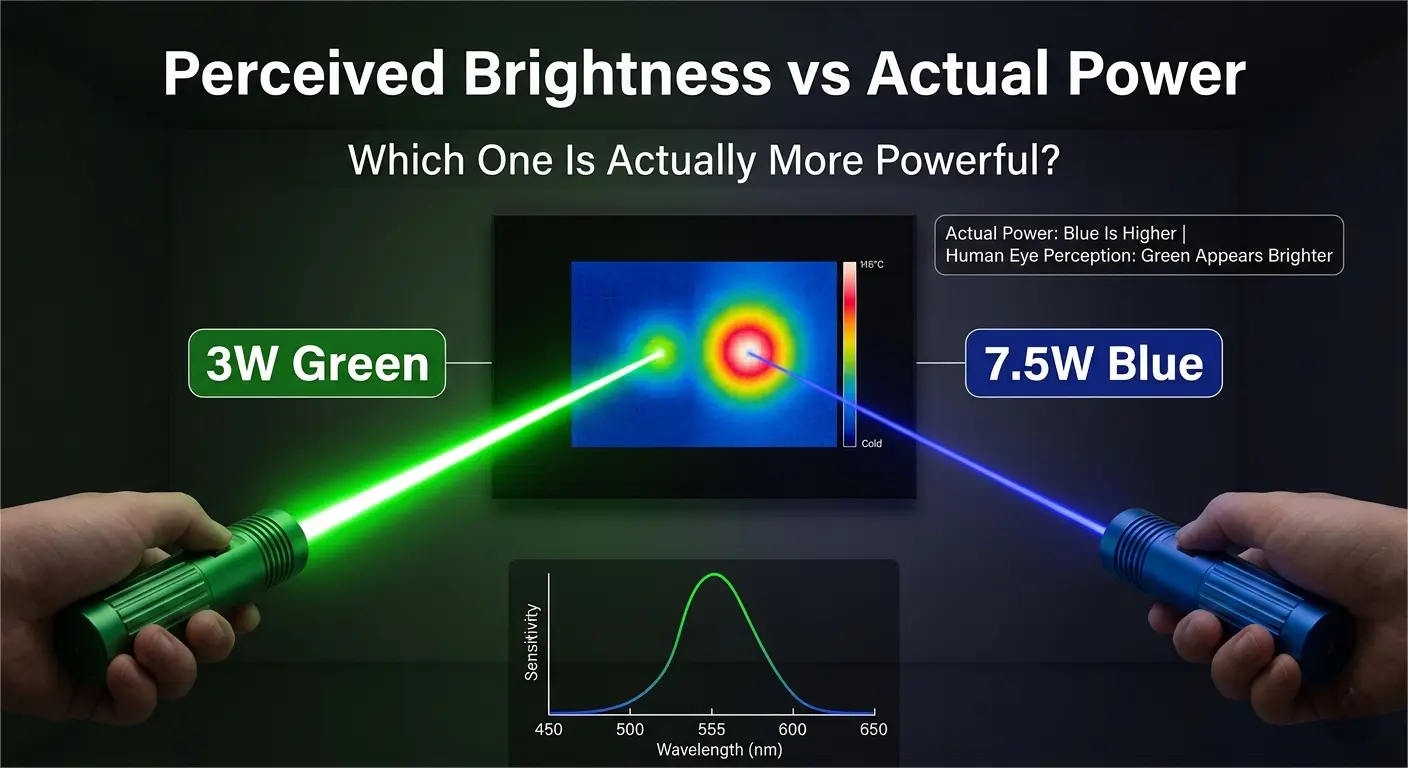
Brightness vs Power (Critical Insight)
Human eyes are far more sensitive to green light. According to the CIE 1931 photopic luminosity function:
- 532 nm green: relative sensitivity ~0.88
- 445 nm blue: relative sensitivity ~0.04
At equal power, 532 nm green appears about 22× brighter than 445 nm blue.
That means:
A 3 W green laser looks roughly as bright as a 60 W+ blue laser to the human eye — even though the blue has far more raw power.
Quick Decision Guide
| If your goal is… | Choose… |
|---|
3. The Most Overlooked Risk: Invisible Infrared (IR) Leakage
This is where most users underestimate danger — and where many “laser safety” guides fail.
Why a Dim Green Laser Can Still Be Dangerous
In a DPSS system:
- If the KTP crystal misaligns, the green output drops (the laser looks weak)
- But the invisible 1064 nm infrared (IR) may still be emitted at full power
NIST documented this in 2010:
They tested three low‑cost green pointers. One appeared dimly green but was actually emitting nearly 20 mW of 1064 nm IR — enough to cause permanent retinal damage before the user even realized the laser was dangerous.
👉 Source: NIST: Beware of Dim Laser Pointers — High Infrared Power Measured
📘 Technical explanation: SPIE: The dangerous dark companion of bright green lasers
The Biggest Safety Mistake
Many users buy “green laser safety glasses” that block only 532 nm.
These glasses are transparent to 808 nm and 1064 nm IR.
If your green laser has IR leakage, wearing green‑only glasses gives you a false sense of protection — while your eyes remain fully exposed to the invisible hazard.
How to Choose the Right Safety Glasses
For a green DPSS laser, your glasses must provide optical density (OD) protection at all three wavelengths:
- 532 nm (visible green)
- 808 nm (pump diode)
- 1064 nm (infrared fundamental)
(For a comprehensive overview of laser safety — including how to protect eyes, kids, and pets from accidental exposure — read our complete guide: The Complete Guide to Laser Pointer Safety: Protecting Eyes, Kids, Pets, and More.)
👉 Learn more about eye injury mechanisms: Can a Laser Pointer Blind You? The Real Science of Laser Eye Damage
4. How to Verify What You Actually Bought
Because labels are unreliable, verification matters.
Basic Compliance Checklist
A legitimate laser pointer product should include:
- Output power (in mW)
- Wavelength (in nm)
- Manufacturer name
- Laser class (e.g., Class 3R, 3B)
- 21 CFR 1040.11 compliance statement (for US)
If any of these are missing, treat the device as potentially non‑compliant.
Simple Power Verification (No Lab Required)
NIST published an inexpensive testing protocol using:
- A consumer laser power meter
- A bandpass filter
- An adjustable aperture
- Lens tube assembly
Measure the peak power during the first 10–20 seconds of operation. Compare with the labeled value.
Red Flags to Avoid
- Listings claiming “5000 mW” for a single‑diode product — physics doesn’t support that at consumer prices
- No manufacturer information
- No wavelength specification
- Missing safety classification
- For green laser pointers: no mention of IR filtering
For community‑verified vendor recommendations, consult enthusiast forums like Laser Pointer Forums — their members maintain updated lists of reliable manufacturers.
5. Extreme Claims: Are 100W+ Handheld Laser Pointers Real?
You may see listings for 50 W, 100 W, or even 250 W handheld laser pointers.
What’s actually happening:
- These systems use multiple laser diodes combined with knife‑edge beam combiners (industrial technique)
- The 250 W unit built by independent laser engineer Styropyro in 2025 uses this approach — it’s a genuine engineering achievement
- But it’s not a typical consumer device: it costs thousands in components, has extreme thermal constraints, and is not legally usable as a pointer
👉 Most cheap “high‑power” listings are fraudulent or dangerously under‑engineered.
6. Real‑World Questions (Answered)
Can a high power laser burn things?
Yes — but burning depends on:
- Focus quality (tight focus = higher power density)
- Material absorption (some colors absorb certain wavelengths better)
- Power density (mW per mm²)
Burning ability ≠ safety. A laser pointer that burns cardboard at close range may still be legal for pointing — but many “burner” laser pointers are far above legal limits.
Why is my green laser pointer weaker in cold weather?
DPSS lasers rely on precise crystal alignment. When temperatures drop, the KTP crystal drifts out of its phase‑matching window, green output collapses — but the invisible 808 nm and 1064 nm IR may still be emitted.
This is documented in astronomy forums: Cloudy Nights discussion.
Are high power handheld laser pointers legal?
In the US:
- ≤5 mW allowed for pointer use (Class 3R)
- >5 mW sold as pointers = federal violation
- Using any laser to point at an aircraft = up to $250,000 fine + 20 years imprisonment
👉 FBI warning
In the EU: since September 2024, EN 50689 restricts consumer laser pointers to ≤1 mW (Class 1 or 2).
👉 German Federal Office for Radiation Protection (BfS)
👉 Always check local laws before purchase.
Final Buying Checklist
Before you buy, ask yourself:
If you cannot confidently answer “yes” to all four, the safest path is to stay within the ≤5 mW Class 3R range — and insist on proper labeling and compliance documentation before moving to higher power categories.