
High Power Laser Pointer: The Complete 2026 Safety & Buying Guide
Summary: Discover what constitutes a high power laser pointer, how dangerous each class really is, and what safety measures actually work. Includes green vs blue vs red comparison, legal limits, and buying guide.
Image Gallery
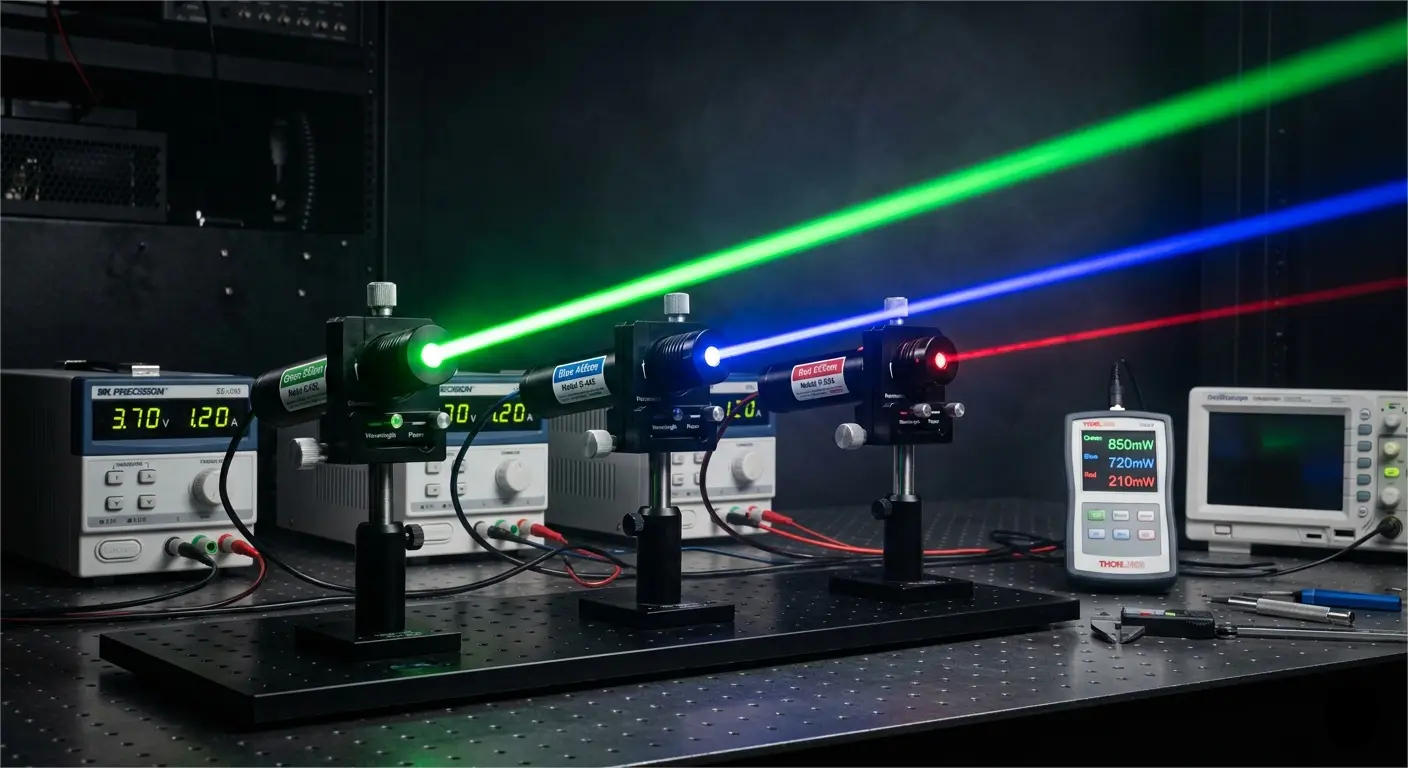
High Power Laser Pointer: Everything You Need to Know Before Buying
Every year, thousands of people buy laser pointers labeled "1W" or "5W" without understanding that these devices can cause permanent eye damage in milliseconds—and that the number on the label often has little relationship to reality.
🔎 Quick Answer: What Is a High Power Laser Pointer?
A high power laser pointer is generally any laser exceeding 5 milliwatts (mW) output.
- ≤5mW → Consumer-safe range (Class 2 / Class 3R)
- 5–500mW → Class 3B (eye injury risk)
-
500mW → Class 4 (burn + fire hazard)
👉 In practical terms:
- 100mW+ = genuinely dangerous
- 1000mW (1W)+ = industrial-level hazard
⚡ Quick Comparison: Green vs Blue vs Red
| Wavelength | Perceived Brightness | Main Risk | Hidden Risk | Best Use |
|---|---|---|---|---|
| Green (532nm) | Extremely high | Thermal | ⚠ IR leakage (DPSS) | Astronomy |
| Blue (445nm) | Very low | Photochemical (highest) | None | Burning |
| Red (635nm) | Medium | Low | None | Basic pointing |
👉 Key takeaway:
- Green looks brightest
- Blue is often more dangerous than it appears
- Red is safest but least visible
1. What Is a High Power Laser Pointer? (Laser Class Explained)
The FDA classifies laser products into four categories based on hazard level.
-
Class 2 / 3R (≤5mW)
Safe for brief exposure (blink reflex protection) -
Class 3B (5–500mW)
Direct exposure = immediate retinal damage -
Class 4 (>500mW)
Capable of:- Skin burns
- Fire ignition
- Severe eye injury
👉 Important:
Consumer laser pointers are supposed to be ≤5mW.
Source: FDA – Frequently Asked Questions About Lasers
⚠ Why Brightness Misleads Buyers
Brightness is not power.
- Human eyes peak at ~555nm (green)
- Blue (445nm) appears only ~3.5% as bright
👉 Result:
A 1W blue laser looks weak—but is extremely dangerous
2. Green vs Blue vs Red: Real Danger Differences
🔹 Green Lasers (532nm)
- Very bright → ideal for astronomy
- Uses DPSS structure
⚠ Major issue:
Infrared leakage (1064nm)
👉 Cheap units may emit:
- Up to 10× more IR than visible light
Source: NIST – Beware of “Dim” Laser Pointers
➡️ IR is:
- Invisible
- No blink reflex
- Highly dangerous
🔹 Blue Lasers (445nm)
- Direct diode → no IR leakage
- Appears dim → often underestimated
⚠ Real risk:
Photochemical retinal damage
- Peak sensitivity: ~440nm
Source: ICNIRP Guidelines on Visible & Infrared - No pain during exposure
- Damage can appear hours later
🔹 Red Lasers (635nm)
- Lowest hazard
- No hidden risks
- Limited brightness
👉 Best for:
- Presentations
- Indoor use
3. How Laser Eye Damage Actually Happens
Laser injury occurs through two mechanisms:
🔥 Thermal Damage
- Happens in milliseconds
- Caused by high power
- Burns retinal tissue instantly
👉 Typical with:
- Green / Blue high-power lasers
⚗ Photochemical Damage
- Slower (seconds to minutes)
- No pain
- Causes oxidative damage
👉 Most dangerous aspect:
Users don’t realize exposure happened
Source: PMC – Laser Pointer Retinal Injury in Children
For a deeper dive into laser eye damage mechanisms, see our guide on laser pointer eye damage risks.
⚠ Key Insight
A laser that:
“doesn’t feel painful”
may still be causing permanent damage
📏 NOHD: The Most Misunderstood Concept
Laser danger distance does not scale linearly.
- 100mW → ~70m NOHD
- 1000mW → ~224m NOHD
👉 10× power ≠ 10× distance
👉 Only ~3× increase
Detailed hazard distance charts: LaserSafetyFacts.com – NOHD & Hazard Distance
4. Legal Boundaries (US, EU, Global)
🇺🇸 United States
- Limit: ≤5mW for consumer sales
- Must comply with:
- 21 CFR Chapter I
⚠ Aircraft targeting:
- Federal crime
- Up to $30,800 fine
Source: FAA – Laser Laws & Reporting
🇪🇺 European Union
- Limit: ≤1mW
- Standard: EN 60825-1
🇨🇭 Switzerland
- Full ban >1mW
🌍 International
Many countries lack enforceable standards.
For country‑by‑country rules: LaserPointerSafety.com – International Laser Laws
🌍 Reality
- Enforcement varies
- Online marketplaces flooded with:
- Mislabelled products
- Non-compliant imports
5. How to Buy a High Power Laser (Without Making a Mistake)
✔ Before You Buy
- Check Class rating (must be declared)
- Verify FDA compliance statement
- Avoid:
- “1W / 5W” listings without certification
👉 For green lasers:
- Ensure IR filter present
🛡 Essential Safety Equipment
- Laser safety goggles (wavelength-specific)
- Proper OD rating
Learn more:
→ Laser Safety Glasses Guide
Good reference for protection standards:
Dartmouth EHS – Laser Pointer Awareness
⚠ Safe Usage Rules
-
Never point at:
- People
- Animals
- Vehicles
- Aircraft
-
Avoid reflective surfaces
-
Store away from children
Full safety practices:
→ Laser Pointer Safety Guide
🎯 What Should You Actually Choose?
This is where most guides fail—so let’s make it simple.
If your goal is:
🌌 Astronomy / Star pointing
→ Choose:
- 5mW green laser (Class 3R)
→ Best visibility + legal safety
🔥 Burning / experiments
→ Choose:
- Blue laser + full safety setup
⚠ This is not a beginner use case
FAQ
Q1: How many mW is considered high power?
Any laser above 5mW exceeds consumer safety limits.
Above 100mW, risk becomes serious.
Q2: Can a green laser damage your eyes?
Yes. Even at 5mW:
- Direct exposure can cause damage
- Cheap models may emit invisible IR radiation (NIST)
Q3: Is it legal to own high power lasers?
- US: Gray area for ownership
- EU: Strict limits (1mW)
- Switzerland: Ban
Q4: Why are cheap green lasers dangerous?
Because of DPSS design:
- 808nm → 1064nm → 532nm
- Poor filtering → IR leakage
Q5: Blue vs Green: which is more dangerous?
- Green → brighter + IR risk
- Blue → dimmer but higher photochemical damage
👉 Blue is often more dangerous than it looks
Conclusion
High power laser pointers sit in a gray zone between consumer gadget and industrial tool.
Key realities:
- Labels are often inaccurate
- Hidden risks (IR leakage, photochemical damage) are underreported
- Legal consequences are real
👉 For most users:
A certified 5mW green laser remains the safest and most practical option.
👉 For anything beyond that:
You are no longer in “consumer product” territory—you are handling a hazardous optical device.