High-Power Laser Pointer: 1000mW vs 5000mW vs 10000mW Guide (2026)
Blog / High-Power Laser Pointer Guide: 1000mW vs 5000mW vs 10000mW — What's the Real Difference?
High-Power Laser Pointer Guide: 1000mW vs 5000mW vs 10000mW — What's the Real Difference?
4/22/202615 min read
Confused about high-power laser pointers? This in-depth guide compares 1000mW, 5000mW, and 10000mW lasers across real-world performance, color differences (green vs blue vs red), wavelength choices (520nm vs 532nm), practical use cases from astronomy to burning experiments, and critical safety and legal regulations. Whether you're a beginner or an experienced enthusiast, find out exactly which laser is right for your needs — backed by FDA guidelines and CIE photometric data.
#high power laser pointer#laser pointer guide#1000mw laser#5000mw laser#10000mw laser#green laser pointer#blue laser pointer#laser burning test#520nm vs 532nm#laser safety class 4#fda laser regulations#laser pointer for astronomy#strongest laser pointer#laser pointer comparison#handheld laser
Image Gallery
If you've been searching for a high-power laser pointer, you've probably run into a wall of confusing specs, inflated claims, and zero real-world context. What does 1000mW actually do? Is 5000mW overkill? And is 10000mW even legal?
This guide cuts through the noise. We'll compare three major power tiers — 1000mW, 5000mW, and 10000mW — across real-world performance, color and wavelength differences, practical use cases, and the safety and legal rules you must know before buying.
Whether you're an astronomy enthusiast, an outdoor adventurer, or a hobbyist who wants to understand what these lasers can truly do, this is the only guide you need.
1. What Does "mW" Actually Mean?
Before diving into comparisons, let's establish a baseline. stands for , a unit of optical output power. It measures how much energy the laser beam emits per second — not how bright it looks, but how much raw energy it carries.
mW
milliwatt
This distinction matters enormously:
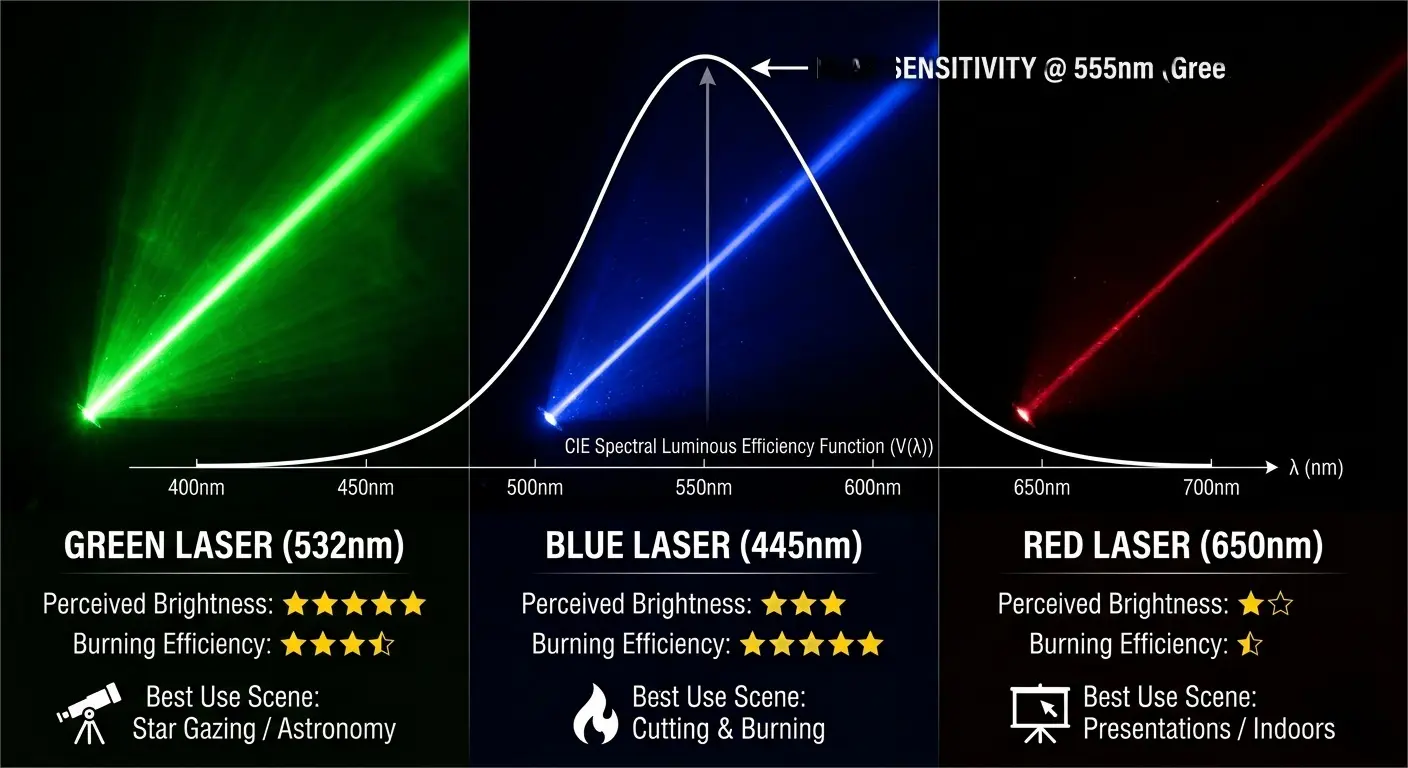
A 5mW green laser can appear brighter than a 50mW red laser to the human eye, because our eyes are far more sensitive to green wavelengths (~555nm peak sensitivity).
A 1000mW blue laser may look dimmer than a 100mW green laser in daylight, yet it will burn through materials far more effectively.
The key insight: mW determines capability (burning, distance, hazard level). Perceived brightness is a function of both power and wavelength.
Understanding this is the first step to making a smart purchase decision. For a deeper explanation of how power levels translate to real-world performance, see our guide on how powerful is a laser pointer.
2. Power Tier Breakdown: 1000mW vs 5000mW vs 10000mW
This is the core question most buyers have. Let's be direct and data-driven.
🔋 1000mW (1 Watt) — The Entry Point for High Power
A 1W laser is where "high power" truly begins. This is the minimum threshold for serious burning capability and long-range beam visibility.
What it can do:
✅ Light matches within 1–3 seconds
✅ Pop dark-colored balloons instantly
✅ Cut through black electrical tape
✅ Produce a clearly visible beam at night (visible for several miles under clear conditions)
✅ Engrave very soft materials (foam, dark paper) with sustained exposure
❌ Struggles to ignite lighter-colored or reflective materials
❌ Daytime beam is faint and difficult to see beyond 50–100 meters
Best for: Hobbyists stepping into high-power lasers for the first time, outdoor enthusiasts who want a capable signaling tool, and users who want burning capability without extreme risk.
⚡ 5000mW (5 Watts) — The Power User's Choice
At 5W, you're dealing with a laser that demands serious respect. Performance jumps dramatically compared to 1W.
What it can do:
✅ Instantaneous ignition of dark paper, cardboard, and wood
✅ Light engraving on soft wood and dark plastics
✅ Visible beam in daylight (under ideal conditions)
✅ Extremely long-range night beam — visible for tens of miles in clear air
✅ Can pop balloons of any color (including white/light-colored)
⚠️ Produces significant heat — housing can become warm during extended use
❌ Requires mandatory laser safety goggles at all times
Best for: Experienced laser enthusiasts, researchers, and professionals who need serious burning or cutting capability in a handheld form factor.
A 10W handheld laser is at the absolute frontier of what's commercially available. This is not a toy, a novelty, or a casual purchase.
What it can do:
✅ Rapid ignition of wood, paper, and fabric within fractions of a second
✅ Can cut through thin dark plastics and foam
✅ Blindingly bright beam — visible in broad daylight
✅ Capable of popping balloons, lighting cigarettes, and melting certain materials
⚠️ Generates substantial heat — requires active cooling or duty-cycle management
❌ Instant, permanent eye damage from any direct or reflected exposure
❌ Classified as a Class 4 laser — subject to strict regulations in most countries
Best for: Advanced researchers, industrial hobbyists, and professionals with proper training and safety equipment. Not recommended for general consumer use.
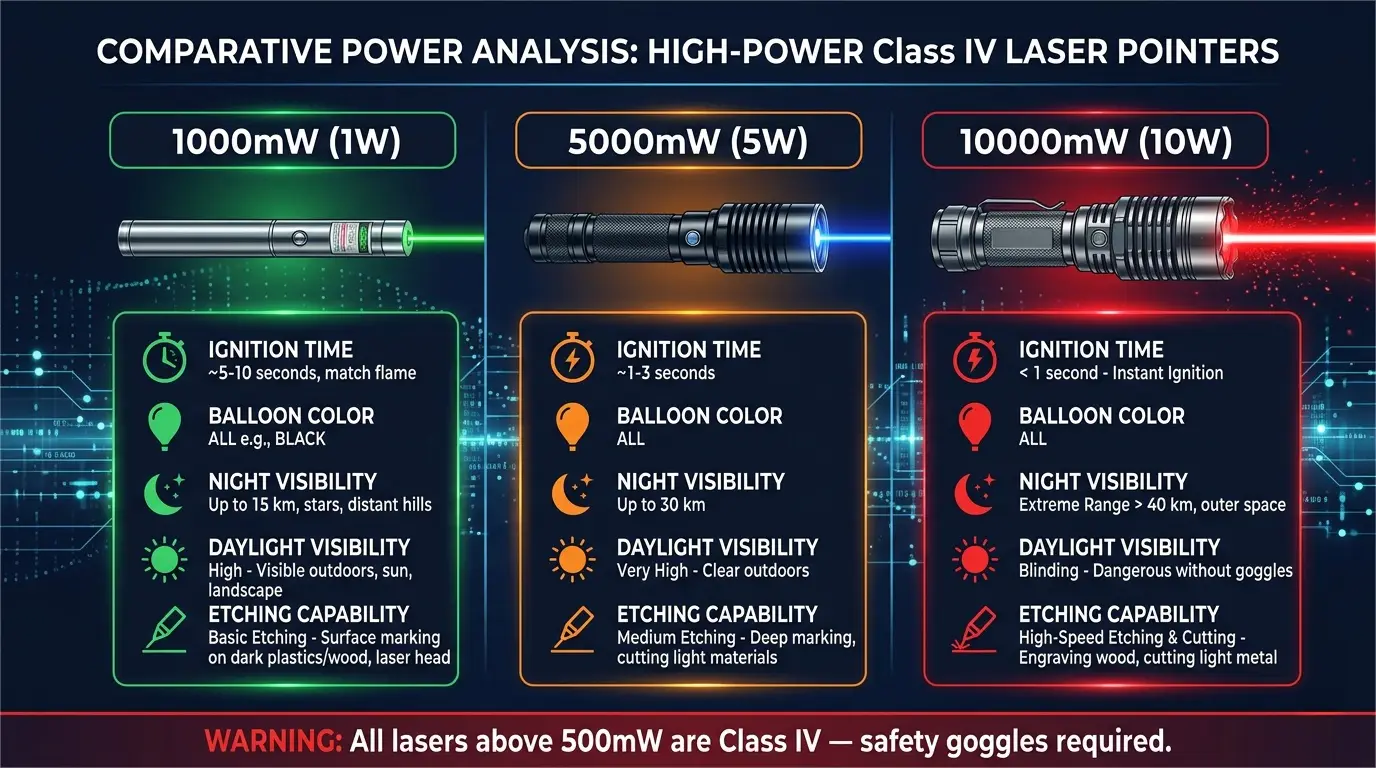
📊 Quick Comparison Table
Feature
1000mW (1W)
5000mW (5W)
10000mW (10W)
Light a match
1–3 seconds
Instant
Instant
Pop dark balloon
Instant
Instant
Instant
Pop light balloon
3–5 seconds
Instant
Instant
Night beam visibility
Several miles
Tens of miles
Extreme range
Daytime beam
Faint
Visible
Clearly visible
Engraving capability
Minimal
Light engraving
Moderate engraving
Laser Safety Class
Class 4
Class 4
Class 4
Safety goggles required
3. Color Comparison: Green vs Blue vs Red
Power level is only half the equation. The color (wavelength) of your laser dramatically affects both its perceived brightness and its burning efficiency. This is one of the most misunderstood aspects of laser pointer selection.
🟢 Green Lasers (~520nm / 532nm)
Green is the brightest color to the human eye at any given power level. This is because the human eye's peak photopic sensitivity sits at approximately 555nm — right in the green range. According to the CIE (International Commission on Illumination) spectral luminous efficiency data, which documents the V(λ) function describing average human visual sensitivity across wavelengths, a green laser appears roughly 5–6x brighter than a red laser of identical power, and approximately 2–3x brighter than a blue laser.
Green is best for:
Astronomy and stargazing (beam visibility in the night sky is unmatched)
Long-distance pointing and signaling
Presentations in large or bright venues
Any application where seeing the beam is the primary goal
🔵 Blue Lasers (~445–450nm)
Blue lasers are the burning champions. Despite appearing dimmer to the human eye than green lasers of the same power, blue lasers (particularly at 445–450nm) are absorbed more efficiently by most materials. This is because many organic and dark materials have higher absorption coefficients at shorter wavelengths.
As we explored in our detailed blue vs green laser burning test, a 1000mW blue laser consistently outperforms a 1000mW green laser in burning tasks — igniting materials faster and producing more visible thermal effects.
Blue is best for:
Burning experiments and hobbyist applications
Engraving dark materials
Users who prioritize thermal output over beam visibility
🔴 Red Lasers (~630–670nm)
Red lasers are the most common and most affordable. However, they are the least visible to the human eye and have the weakest burning capability at equivalent power levels. For high-power applications, red is rarely the optimal choice.
Red is best for:
Indoor presentations and classroom use
Budget-conscious buyers who need basic pointing capability
Applications where power and visibility are secondary concerns
📊 Color Comparison Table
Factor
Green (520/532nm)
Blue (445–450nm)
Red (630–670nm)
Perceived brightness
⭐⭐⭐⭐⭐ Highest
⭐⭐⭐ Medium
⭐⭐ Lowest
Burning efficiency
⭐⭐⭐ Good
⭐⭐⭐⭐⭐ Best
⭐⭐ Poor
Night beam visibility
⭐⭐⭐⭐⭐ Best
⭐⭐⭐ Good
⭐⭐ Fair
Daytime beam visibility
⭐⭐⭐⭐ Good
⭐⭐⭐ Fair
⭐ Poor
Best use case
Astronomy, signaling
Burning, engraving
Presentations
Relative cost
Medium
Medium-High
Low
4. Wavelength Deep Dive: 520nm vs 532nm Green Lasers
If you've decided on a green laser, you'll quickly encounter a choice between 520nm and 532nm variants. This is a technical distinction that has real-world implications, and it's worth understanding before you buy. We cover this in depth in our 532nm vs 520nm comparison guide.
532nm — The Classic DPSS Green
Technology: Diode-Pumped Solid-State (DPSS). An infrared diode pumps a Nd:YAG or Nd:YVO4 crystal, which is then frequency-doubled by a KTP crystal to produce 532nm green light.
Pros:
Produces a very bright, vivid "lime green" beam
Widely available and well-understood technology
Generally lower cost at equivalent power levels
Cons:
Temperature-sensitive: output power can drop significantly in cold weather (below ~10°C)
More complex internal structure = more failure points
Requires warm-up time in cold environments
Can emit residual infrared (IR) radiation if IR filter is absent or damaged — a hidden safety hazard
520nm — The Modern Direct Diode
Technology: Direct diode. The laser diode itself emits green light at 520nm without requiring intermediate crystals.
Pros:
Highly stable output across a wide temperature range (-20°C to +50°C)
More durable and shock-resistant (simpler internal structure)
No IR leakage risk
Faster startup — no warm-up required
Cons:
Slightly less "vivid" green (more of a pure/forest green vs. lime green)
Typically more expensive at equivalent power levels
Less widely available in very high power configurations
The verdict: For outdoor use, cold climates, or any application requiring reliability, 520nm direct diode is the superior choice. For indoor use where maximum perceived brightness is the priority, 532nm DPSS remains a strong option.
5. Real-World Use Cases: Which Power Level Is Right for You?
🔭 Astronomy & Stargazing
Recommended: Green laser, 50mW–200mW (or even 5mW in dark sky locations)
For pointing out constellations, guiding telescope alignment, or leading a star party, a green laser is the undisputed choice. The beam cuts through the night sky like a finger pointing directly at stars — an effect that red or blue lasers simply cannot replicate at equivalent power.
Important note: For casual stargazing, you do not need 1000mW+. A well-made 50–100mW green laser provides more than enough beam visibility in dark conditions. Higher power is unnecessary and increases safety risks. For a complete breakdown of astronomy-specific recommendations, see our best laser pointer for astronomy guide.
Power recommendation: 50mW–200mW green for most users; 1000mW only for experienced users in specific conditions.
🏕️ Outdoor Survival & SOS Signaling
Recommended: Green or blue laser, 1000mW+
In a survival scenario, a high-power laser can serve as a long-range distress signal visible to aircraft and rescue teams. Green lasers are preferred for maximum visibility, while blue lasers offer the added benefit of fire-starting capability. Green light at approximately 532nm is widely recognized in photometric research as having the highest visibility efficiency in the visible spectrum under standard atmospheric conditions — a principle supported by the CIE's spectral luminous efficiency data.
Power recommendation: 1000mW minimum for effective daytime signaling; 500mW+ for nighttime.
🔬 Burning & Hobbyist Experiments
Recommended: Blue laser, 1000mW–5000mW
If burning is your primary goal — lighting matches, popping balloons, light engraving — blue lasers at 445–450nm are your best tool. The shorter wavelength means more energy is absorbed by target materials rather than reflected.
Power recommendation: 1000mW for casual burning; 3000mW–5000mW for engraving and more demanding tasks.
🐦 Bird & Pest Deterrence
Recommended: Green laser, 200mW–1000mW
Green lasers have been used effectively for deterring birds (particularly geese and gulls) from airports, agricultural areas, and commercial properties. The moving green beam triggers an avoidance response without causing harm. This application is discussed in detail in our laser pointers for bird deterrence guide.
Power recommendation: 200mW–500mW for most deterrence applications.
6. Safety & Legal: What You Must Know Before Buying
This section is not optional reading. High-power lasers are genuinely dangerous tools, and understanding the regulatory and safety landscape is essential.
Laser Safety Classifications (FDA 21 CFR Part 1040)
The United States regulates laser products through the FDA's Center for Devices and Radiological Health (CDRH) under 21 CFR Part 1040. According to the FDA's official Laser Products and Instruments page, laser products are classified as follows:
Class
Power Range
Risk Level
Examples
Class I
Inherently safe
Safe under all conditions
DVD players, laser printers
Class II
<1mW visible
Low risk
Basic red pointers
Class IIIa
1–5mW
Low-moderate risk
Standard laser pointers (legal limit for "pointers" in the US)
Class IIIb
5–500mW
Hazardous
Direct beam viewing dangerous
Class IV
>500mW
Most hazardous
All lasers 1000mW and above
⚠️ Critical fact: Every laser in this guide — 1000mW, 5000mW, and 10000mW — is a Class IV laser. This is the highest hazard category. Class IV lasers can cause instant, permanent eye damage from direct beam exposure, specular reflections, and even diffuse reflections at close range. They are also a fire hazard.
The 5mW Legal Limit in the United States
Under 21 CFR 1040.11(b), the FDA limits laser pointers marketed for pointing and demonstration purposes to a maximum of Class IIIa (5mW). As stated directly on the FDA's laser pointer manufacturer guidance page: "Laser products promoted for pointing and demonstration purposes are limited to hazard Class IIIa by FDA regulation."
Lasers above 5mW are legal to own in most US states, but they must be sold for specific purposes (research, industrial use, etc.) and are subject to additional labeling and safety requirements.
If you own or plan to own a laser above 500mW, these rules are non-negotiable:
Always wear certified laser safety goggles matched to your laser's specific wavelength and power level. Standard sunglasses provide zero protection. The Laser Institute of America (LIA) provides a free online Laser Safety Hazard Calculator to help users assess exposure risks and determine appropriate protective measures.
Never point at people, animals, or vehicles — especially aircraft. Illuminating an aircraft with a laser is a federal crime in the US, punishable by up to 5 years in prison and $250,000 in fines under 18 U.S.C. § 39A.
Be aware of reflective surfaces. Mirrors, glass, and polished metal can redirect a Class IV beam unpredictably.
Store securely away from children and unauthorized users.
Use in a controlled environment — outdoors in open areas, away from bystanders.
7. Final Recommendation Table
Your Primary Use Case
Recommended Color
Recommended Power
Key Consideration
Astronomy / Stargazing
Green (520nm or 532nm)
50–200mW
Beam visibility; safety in public
Burning / Experiments
Blue (445–450nm)
1000–3000mW
Absorption efficiency; safety goggles mandatory
Outdoor Signaling / Survival
Green (520nm)
1000mW+
Reliability in cold; 520nm preferred
Bird / Pest Deterrence
Green
200–500mW
Consistent output; weatherproofing
Advanced Engraving
Blue (445nm)
3000–5000mW
Duty cycle management; heat dissipation
Maximum Power / Research
Blue or Green
5000–10000mW
Full safety setup required; not for beginners
8. Frequently Asked Questions
Q: Is a 1000mW laser pointer legal?
A: In the US, lasers above 5mW cannot be marketed as "laser pointers" for general consumer use under FDA regulations (21 CFR Part 1040.11). However, owning a 1000mW laser is legal in most US states when purchased for legitimate purposes. Always check your local and state laws.
Q: Can a high-power laser pointer blind you?
A: Yes. A Class IV laser (500mW+) can cause instant, permanent retinal damage from direct beam exposure. Even a brief, accidental exposure can result in a permanent blind spot. Certified laser safety goggles are mandatory.
Q: Which is better for burning — green or blue?
A: Blue (445–450nm) is consistently more effective for burning at equivalent power levels. The shorter wavelength is absorbed more efficiently by most materials. However, green lasers are far more visible as a beam, making them better for applications where you need to see the laser rather than use it as a heat source.
Q: What's the difference between 520nm and 532nm green lasers?
A: 532nm (DPSS) is brighter and more vivid but temperature-sensitive and less durable. 520nm (direct diode) is more stable, reliable in cold weather, and more durable — making it the better choice for outdoor use. See our full 532nm vs 520nm guide for a complete comparison.
Q: How far can a 1000mW laser pointer reach?
A: The beam of a 1000mW green laser can theoretically travel for miles in clear air. However, the effective range for practical applications (burning, signaling) is much shorter. The dot remains visible on a surface at distances of 1–2km under ideal conditions. Atmospheric conditions (humidity, dust, fog) significantly reduce effective range.
Conclusion
Choosing the right high-power laser pointer comes down to three questions: What do you need it to do? What color serves that purpose best? And are you prepared to use it safely?
For visibility and astronomy, green is king — and you don't need more than 200mW.
For burning and thermal applications, blue at 445nm is the most efficient choice.
For reliability and outdoor use, a 520nm direct diode green laser outperforms 532nm DPSS in real-world conditions.
And regardless of power level, Class IV laser safety is not optional — it's the difference between an incredible tool and a life-altering accident.
Armed with this knowledge, you're ready to make an informed decision. Browse our full selection of high-power laser pointers, organized by power level and use case, to find the right tool for your needs.