
How Far Can a Laser Pointer Go? Distance, Visibility, and the Science Explained
How far can a laser pointer go? The answer depends on several scientific factors including wavelength, beam divergence, atmospheric conditions, and human eye sensitivity. In this guide, we explain the real distance a typical laser pointer beam can travel, why green lasers appear brighter than red ones, and how visibility changes at night or in clear air. Using insights from optics research and educational resources, this article explores the physics behind laser beam distance and what affects how far the beam can be seen in real-world conditions.
Image Gallery
Laser pointers are widely used in classrooms, presentations, and astronomy demonstrations. One question that often comes up is simple but surprisingly interesting:
How far can a laser pointer actually go?
The answer depends on several scientific factors, including beam divergence, wavelength, atmospheric conditions, and how sensitive the human eye is to different colors of light.
In this guide, we’ll explore the physics behind laser pointer distance and visibility, using information from optical research and educational resources.
Key Takeaways
- Laser light can theoretically travel indefinitely in space.
- Most handheld laser pointers produce a visible beam ranging from several hundred meters up to about 1–2 km at night.
- Green lasers appear brighter than red or blue lasers because human eyes are most sensitive to green wavelengths.
- A laser beam does not actually stop in the sky — it simply becomes too faint to see.
How Far Can a Laser Pointer Go in Theory?
From a physics perspective, a laser beam does not have a strict maximum distance.
In a vacuum such as outer space, light can theoretically continue traveling indefinitely unless it encounters an object or is absorbed by matter.
However, the practical or visible range of a handheld laser pointer is much shorter because of several physical limitations:
- Beam divergence
- Atmospheric scattering
- Energy spreading over distance
- Limits of human eye detection
Research discussed by NASA shows that even powerful scientific lasers used in lunar ranging experiments spread out significantly over long distances.
This spreading effect is why a handheld laser pointer cannot maintain a narrow beam across extremely large distances.
Typical Visible Distance of a Laser Pointer
Under clear nighttime conditions, the beam from a typical consumer laser pointer can remain visible for a considerable distance.
Actual visibility varies depending on the surrounding environment and the design of the laser device.
Additional explanations about laser beam visibility can be found at LaserPointerSafety.com.
Why Green Laser Pointers Appear Brighter
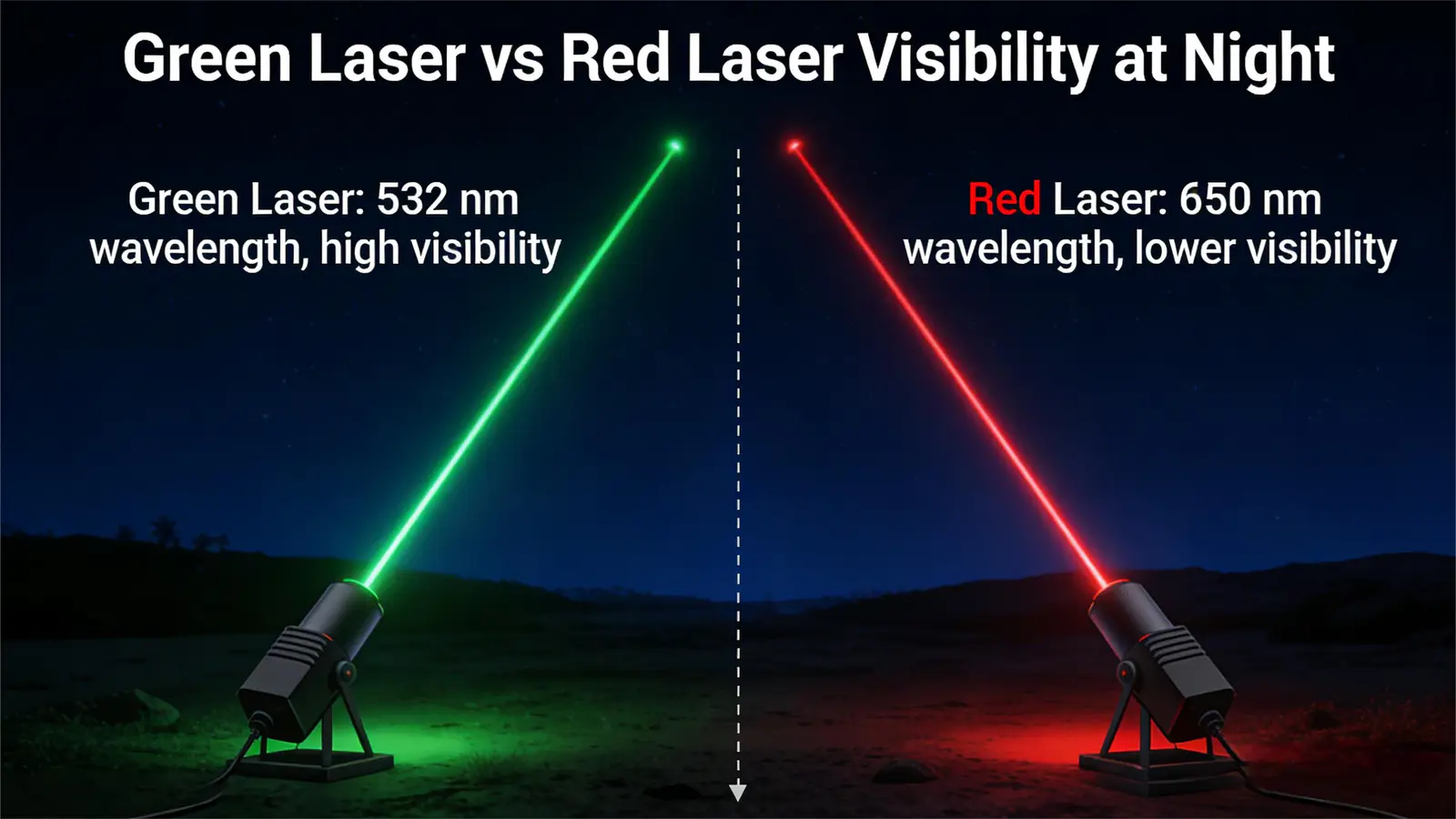
The human eye is most sensitive to wavelengths around 555 nanometers, which lies within the green portion of the visible spectrum.
This value corresponds to the peak of the human eye’s photopic sensitivity curve, a concept commonly explained in optics research and educational resources.
Because of this biological sensitivity, green lasers can appear significantly brighter than red or blue lasers with the same power output.
Educational optics resources such as GameOn Optics explain that green lasers may appear several times brighter to the human eye compared with red lasers of similar power.
Scientific discussions about visible light sensitivity can also be found through resources from the American Physical Society.
Factors That Affect Laser Pointer Distance
1. Beam Divergence
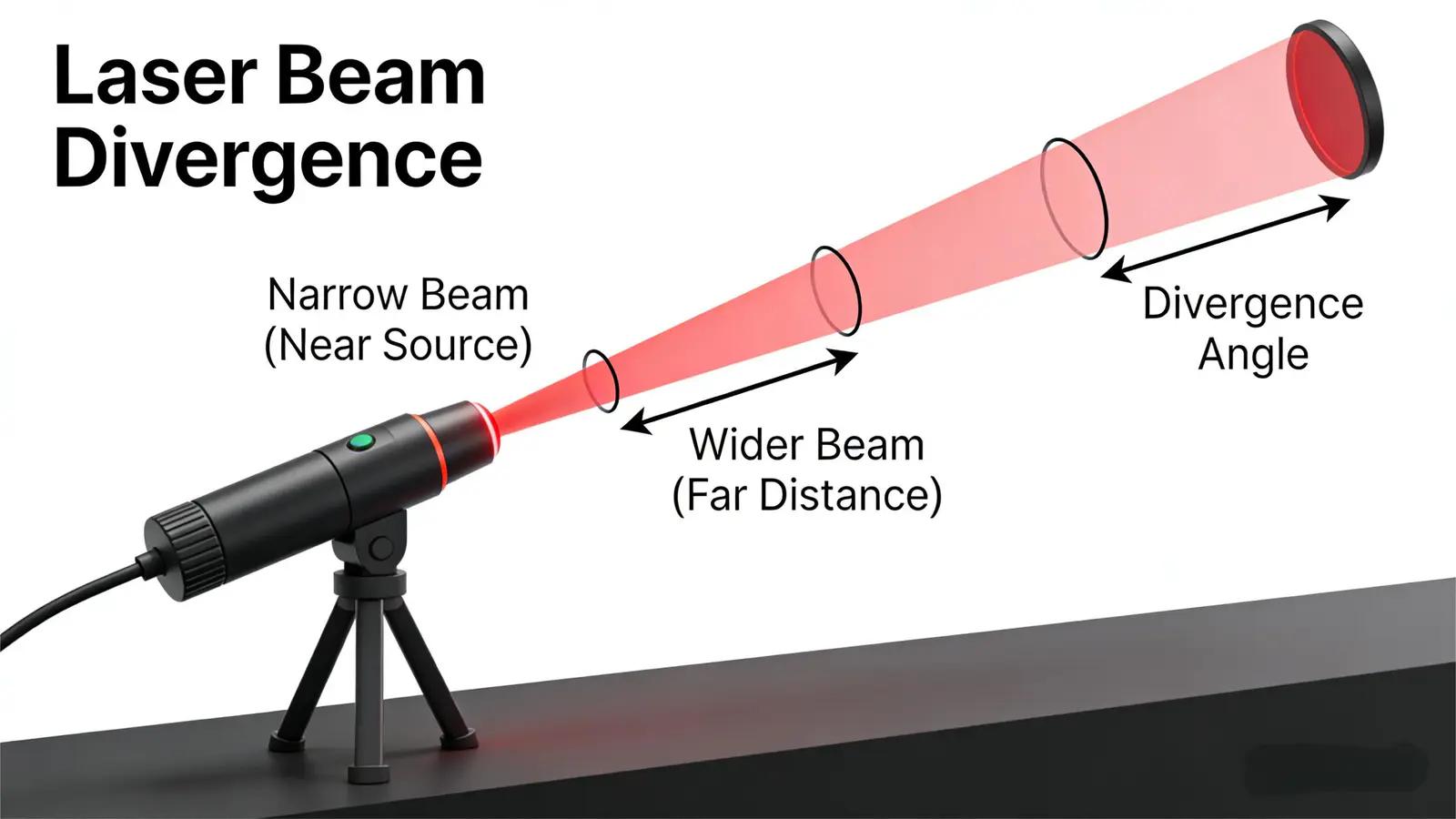
Beam divergence describes how quickly a laser beam spreads as it travels.
Even a very small divergence angle will cause the beam to expand significantly over long distances. As the beam spreads out, its energy is distributed over a larger area, reducing brightness.
This behavior is widely discussed in laser physics references and optical measurement studies published by organizations such as the National Institute of Standards and Technology.
This is one of the main reasons handheld laser pointers cannot maintain a tight beam across very large distances.
2. Wavelength (Laser Color)
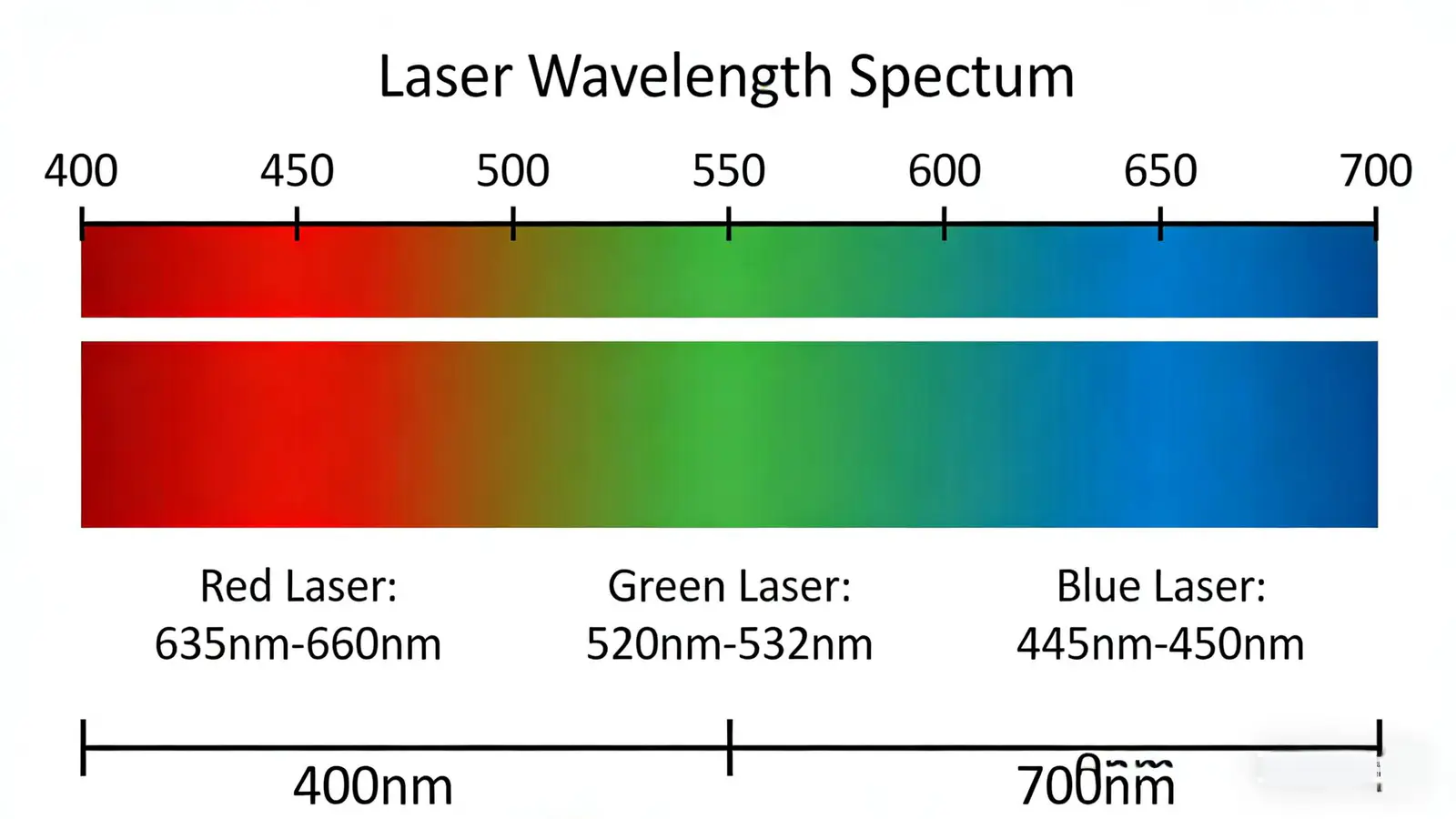
Different colors correspond to different wavelengths of light, and the human eye responds differently to each wavelength.
- Green lasers → highest perceived brightness
- Red lasers → moderate visibility
- Blue lasers → slightly lower eye sensitivity
Because of this difference in visual sensitivity, two lasers with identical power can appear dramatically different in brightness.
3. Atmospheric Conditions
A laser beam becomes visible in the air because tiny particles scatter a small portion of the light toward the observer.
These particles include:
- Dust
- Water droplets
- Aerosols
- Smoke
According to explanations from LaserPointerSafety.com, cleaner air can actually make the beam harder to see because fewer particles are available to scatter the light.
4. Ambient Light
Laser beams are much easier to see at night than during the day.
In daylight, sunlight overwhelms the faint scattered light from the beam, making it almost invisible in the air. At night, the darker background allows even small amounts of scattered light to become visible.
Can a Laser Pointer Reach the Moon?
This is one of the most common questions about laser pointers.
Technically, photons emitted from a laser pointer could travel the entire distance to the Moon if nothing blocked the beam.
However, because the beam spreads out over distance, it becomes extremely wide and faint long before reaching the lunar surface.
According to information published by NASA, professional lunar laser ranging experiments begin with extremely powerful lasers and precise optical systems, yet the beam still spreads to several kilometers wide by the time it reaches the Moon.
For this reason, a handheld laser pointer would not produce a visible spot on the lunar surface.
Why Laser Beams Sometimes Look Like They Stop in the Sky
When pointing a laser toward the sky, the beam may appear to end after a certain distance.
This visual effect occurs because the lower atmosphere contains more particles that scatter light.
As the beam travels higher into cleaner air, fewer particles scatter the light toward the observer. The beam therefore appears to fade away even though the light continues traveling.
Real-World Uses of Laser Pointers
Astronomy Education
Green laser pointers are frequently used by astronomy educators to indicate constellations and celestial objects during group stargazing sessions.
Presentations and Teaching
Laser pointers allow presenters to highlight information on projection screens, slides, and whiteboards.
Outdoor Demonstrations
In educational demonstrations or field activities, laser beams can be used to indicate direction or illustrate optical concepts.
Frequently Asked Questions
How far can a 5mW laser pointer go?
Under clear nighttime conditions, a typical 5 mW green laser pointer can produce a visible beam of roughly 1 mile (about 1.6 km), although actual visibility depends on atmospheric conditions.
Why are laser beams easier to see at night?
At night there is less background light, allowing scattered laser light in the air to stand out more clearly.
Do green lasers travel farther than red lasers?
Not necessarily. Green lasers simply appear brighter to human vision, which makes them easier to see at longer distances.
Does humidity affect laser visibility?
Yes. Humidity and airborne particles can increase light scattering, making the beam easier to see but sometimes reducing apparent distance.
Conclusion
Laser pointer beams can travel extremely long distances from a physics perspective, but their visible range depends on real-world conditions.
Factors such as beam divergence, wavelength, atmospheric particles, and ambient lighting all influence how far the beam appears to extend.
Under clear night skies, handheld laser pointers can produce visible beams extending hundreds of meters or even over a kilometer, while the light itself continues traveling far beyond what the human eye can detect.
References
- NASA – Lunar Laser Ranging Research https://science.nasa.gov
- Laser Pointer Safety – Beam Visibility https://www.laserpointersafety.com
- American Physical Society – Optics and Photonics Resources https://www.aps.org
- National Institute of Standards and Technology – Optical Measurement https://www.nist.gov
- GameOn Optics – Green vs Red Laser Visibility https://gameon.eu/blogs/blog-articles/green-vs-red-laser-which-is-best