
Flying with a Laser Pointer? Here’s How to Carry It Safely (Without Costly Mistakes)
Learn TSA and FAA rules for carrying laser pointers, how to prevent accidental activation that burns bags, and safe long-term storage—backed by real user stories and official guidelines.
Image Gallery
Flying with a Laser Pointer? Here’s How to Carry It Safely (Without Costly Mistakes)
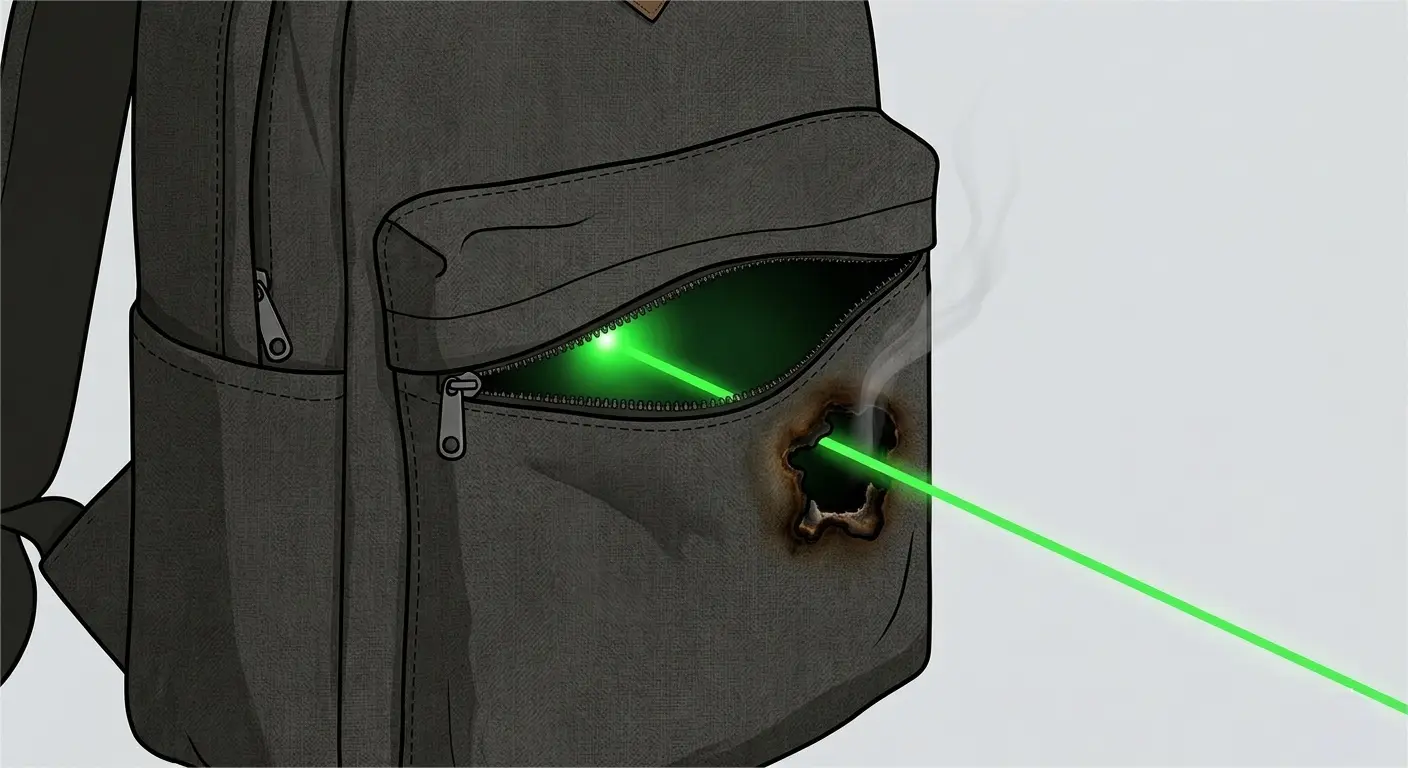
You toss your laser pointer into a bag, zip it up, and forget about it. Hours later, you smell burning plastic—and find a melted hole through your pouch. This isn't a warning; it's what actually happened to one laser user. Here's how to make sure it never happens to you.
1. The Risk: Accidental Activation Is Not a Theory
Most people treat laser pointers like ordinary pens. But an accidentally activated laser can cause serious damage in seconds—and the risk isn't just burned bags.
A Laser Pointer Forums user described a frightening experience:
“the laser was on and so freakin hot that it instantly burned my hands.”
— Laser Pointer Forums
The laser melted a clean hole through the pouch. The user needed an ice pack for an hour to treat burns. Another traveler discovered upon arrival:
“a new hole was pierced through the case and the side of my bag in the inside was also marked by heat.”
— Laser Pointer Forums
The risk isn't just property damage. Under Public Law 112-95, pointing a laser at an aircraft is a federal crime. The FAA imposes civil penalties of up to $32,646 per violation—and accidental activation near airports can create exactly the kind of momentary distraction that endangers aircraft.
If you own a high-power laser (Class 3B or 4), the stakes are even higher. For a deeper understanding of eye risks, see {{内链:Can a Laser Pointer Blind You? The Real Science of Laser Eye Damage}}.
2. Air Travel Regulations: What TSA and FAA Actually Say
The official rules are more nuanced than "just put it in your bag."
According to the TSA, laser pointers are permitted in both carry-on and checked bags. However, the TSA officer at the checkpoint has final say.
The critical nuance is batteries. The FAA's lithium battery rules state:
- Spare (uninstalled) lithium batteries must be carried in carry-on baggage only.
- Battery terminals must be protected to prevent short circuits (tape over contacts or individual cases).
- If you gate‑check a bag, all spare batteries and power banks must be removed and kept with you.
For devices with installed batteries placed in checked luggage, the FAA requires that they be completely powered off and protected to prevent unintentional activation or damage.
The IATA passenger guidance adds that each person may carry up to 20 spare batteries (with higher‑capacity batteries limited to 2), and that spares must be individually protected—either in original packaging, with terminals taped, or in a protective pouch.
3. Step‑by‑Step: How to Disassemble Before Transport
Experienced laser users have developed a practical disassembly routine that goes beyond minimum legal requirements.
One frequent flyer describes their process:
“taking the batteries out, tailcap off, focusing lenses off & even the head separated from the body if you can do this.”
— Laser Pointer Forums
Here’s a checklist:
If you're unsure about your laser’s power class, check our {{内链:The Complete Guide to Laser Pointer Safety}} before packing.
4. Battery Protection: Preventing Short Circuits and Leaks
Even with batteries removed, they need protection. According to Duracell’s official battery care guidelines:
- Do not carry batteries loose in a pocket or purse—they can contact metal objects, leading to leakage, overheating, or rupture.
- Extreme temperatures reduce battery performance and may cause leakage.
- Store batteries in a dry place at normal room temperature.
Practical protection methods include:
- Wrapping each battery’s terminals with electrical tape.
- Using individual battery cases or small zip‑lock bags.
- Keeping all spare batteries in your carry‑on, never in checked luggage.
If a battery shows signs of swelling or corrosion—like the one described in this Reddit thread where a user found “the battery has swollen and leaked”, Reddit—do not attempt to use it. Corrosion can permanently damage the laser’s contact points; in some cases, the device cannot be restored even after battery replacement.
5. Long‑Term Storage: The Mistake That Kills Lasers
For lasers that won’t be used for weeks or months, the most common failure is simple: batteries left inside.
Even when powered off, batteries can slowly leak or swell, destroying the laser’s electronics. Celestron’s official manual for its green laser pointers specifies an operating temperature range of -5°C (23°F) to 35°C (95°F). Storage outside that range may cause erratic behavior. Duracell recommends storing batteries at room temperature in a dry place.
When storing your laser for more than a few weeks:
- Remove all batteries.
- Store at room temperature—avoid cars, garages, or sheds with temperature swings.
- Use a protective case to prevent accidental button presses and physical damage.
- Check periodically for corrosion or leakage.
A forum member summed up the principle well:
“Yes you should [remove batteries]. Not only is it a safe thing to do, but it also keeps the batteries charged longer.”
— Laser Pointer Forums
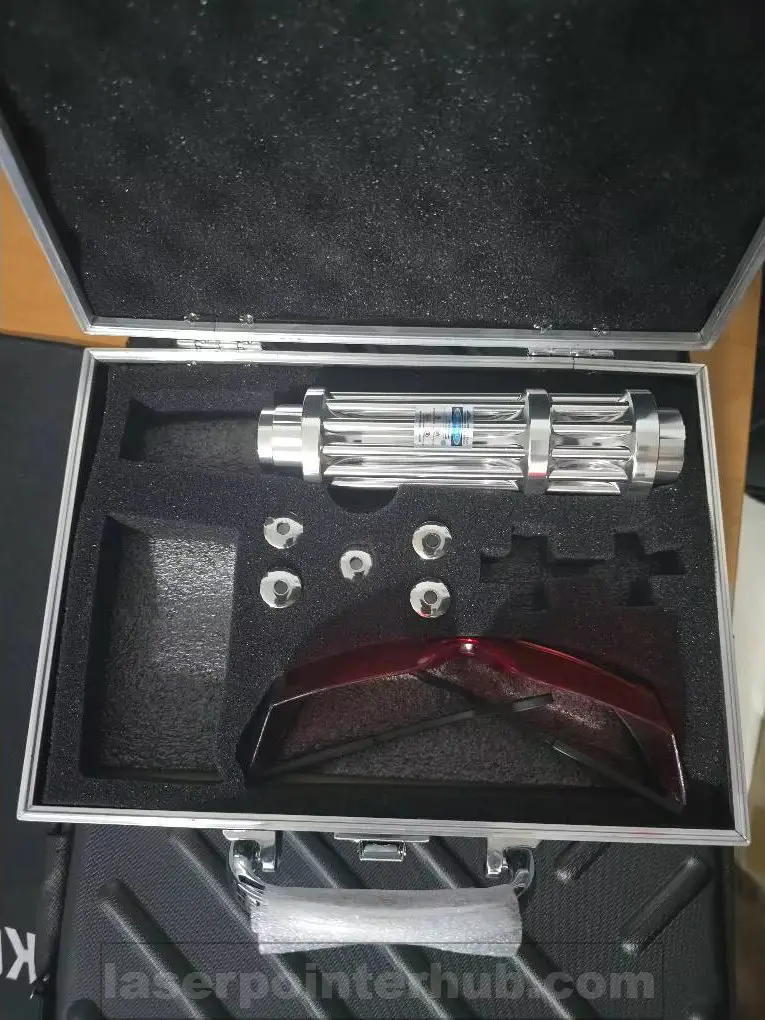
For complete protection during travel or storage, a dedicated hard case is the simplest upgrade.
👉 {{内链:Laser Pointer Hard Case / Safety Box (with case)}}
6. FAQ
Can I bring a laser pointer on a plane?
Yes. According to TSA, laser pointers are permitted in both carry-on and checked bags. However, spare lithium batteries must always be in your carry-on luggage, never checked.
Is it safe to put a high-power laser in checked luggage?
It is permitted but not recommended. Even a brief accidental activation during cargo handling can damage your bag, start a fire, or cause burns. The safest approach: remove batteries, tape terminals, and carry the device (disassembled) in your carry-on.
What happens if a laser activates inside a bag?
Real user experiences show it can burn through soft pouches, melt plastic compartments, and cause skin burns. High‑power lasers (Class 3B/4) are especially dangerous, but even lower‑power models can cause damage at close range.
Should I remove batteries when storing my laser long‑term?
Absolutely. Leaving batteries in a laser for months invites leakage, swelling, and corrosion that can permanently destroy the device. Remove them and store separately at room temperature.
Are there temperature limits for laser storage?
Official guidelines vary by manufacturer. Celestron, for example, specifies -5°C to 35°C for their green lasers. As a rule, store at room temperature in a dry place, and always consult your specific model’s manual.
Conclusion
Safe laser pointer handling comes down to three principles: disassemble before transport, protect all batteries from short circuits, and remove batteries before long‑term storage. These steps are backed by official regulations from TSA, FAA, and IATA, and by the real‑world experiences of laser users who have dealt with burned bags, corroded contacts, and near‑misses.
When in doubt, treat your laser like a precision instrument—because it is one. And for the ultimate protection, consider a dedicated hard case designed for safe transport and storage.