
How to Read a Laser Safety Label: Class, Wavelength & Power
Confused by laser labels? Learn how to decode Class, wavelength (nm), and power (mW) to assess real safety risks and spot red flags before you buy.
Image Gallery
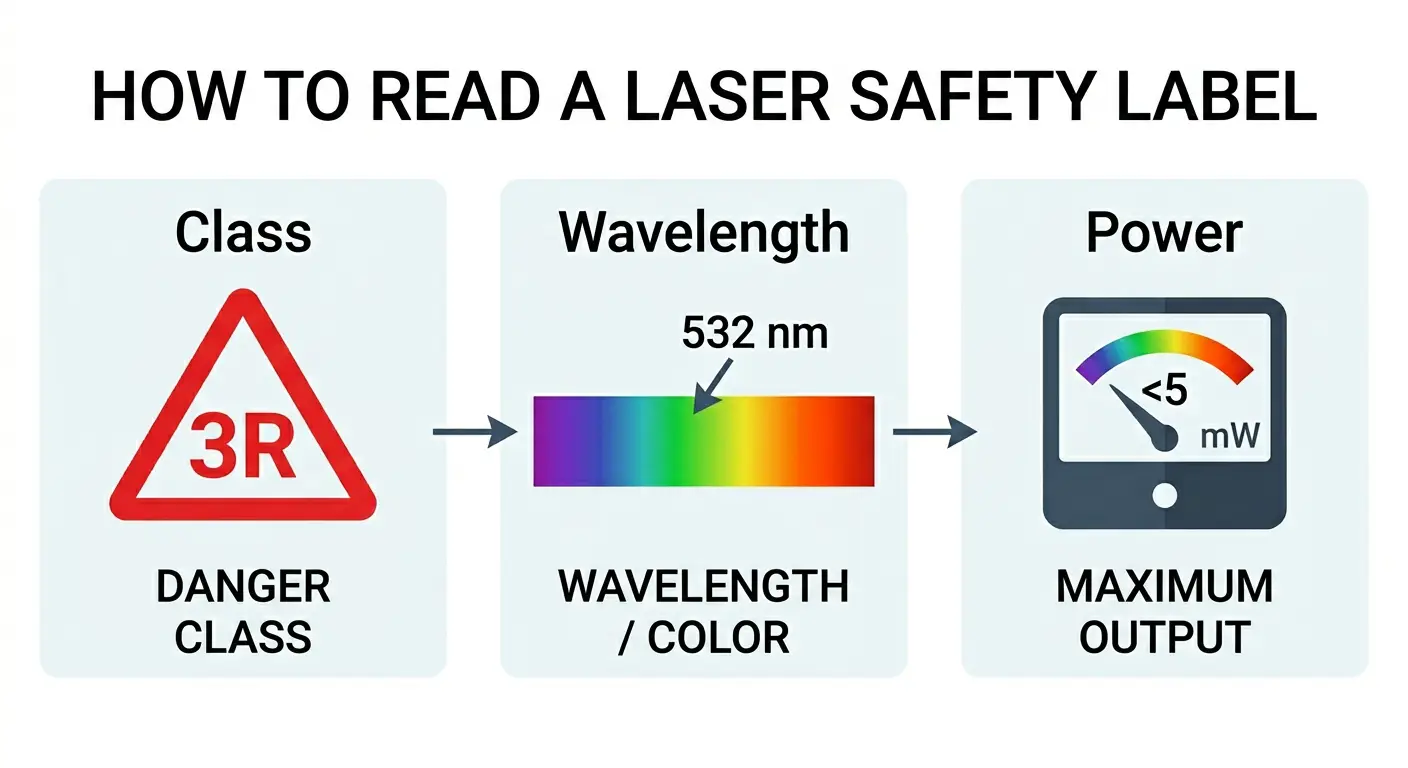
If you have ever picked up a laser pointer and wondered whether that tiny label with "Class 3R," "532nm," and "<5mW" actually means anything real, you are not alone. In 2024, the U.S. Food and Drug Administration (FDA) reported that a significant portion of consumer laser products carried labels that did not accurately reflect the device's actual output — with some devices labeled as Class 3R (typically capped at 5 milliwatts) found to emit levels far exceeding their marked specifications. The same year, the National Institute of Standards and Technology (NIST) went further, warning that many laser pointers also emitted wavelength ranges not disclosed on the label at all. (FDA source / NIST PDF)
That label on your laser pointer is not just a sticker — it is the primary document that tells you how dangerous the device could be under the wrong conditions. This guide teaches you exactly how to decode it, step by step, so you can assess any laser product before you buy or use it.
What the Three Key Label Fields Actually Mean
Most people start reading a laser label at the wrong end — they look at the color description first (the "nm" number) or fixate on the milliwatt figure, and treat the Class rating as almost an afterthought. That ordering leads to exactly the kind of misjudgment that gets people hurt.
The correct sequence is this: Class first, wavelength second, power third.
Class tells you which regulatory and hazard tier the laser falls into — it is a summary judgment made by the manufacturer based on testing against standards like the IEC 60825-1 classification system. Wavelength, measured in nanometers (nm), tells you whether the laser output is visible to the human eye, invisible (infrared or ultraviolet), or somewhere in between — and this directly affects whether you have any natural protective response (like the blink reflex) working in your favor. Power, expressed as maximum radiant output in milliwatts (mW), tells you the ceiling of what the device can push out under worst-case conditions — it is a technical specification, not a brightness rating.
The FDA explicitly requires that labels for Class II through Class IV laser products display both the class designation and the output power prominently, because those two pieces of information together are what allow a user to assess risk. Treating power as a measure of how bright something looks is a common mistake — we will come back to why in the section on power below.
Laser Class Explained: Why Class 2, 3R, and 3B Are Not Equal
The word "Class" on a laser label is not a quality rating or a brightness tier. It is a hazard classification — and the difference between Class 2, Class 3R, and Class 3B represents fundamentally different risk profiles.
Class 2 lasers are capped at 1 milliwatt of continuous-wave output in the visible spectrum (400–700 nm). The defining safety assumption is the natural human blink reflex, which typically operates within 0.25 seconds of unexpected bright light exposure. As long as you are dealing with an unintentional, momentary exposure, Class 2 is considered safe for ordinary consumer use without specialized protective equipment.
Class 3R (sometimes labeled Class IIIa) allows up to 5 milliwatts — five times the output of a Class 2 device. The additional power sounds small, but the risk math changes significantly. At 3R levels, temporary visual disturbance after exposure is a real concern, and repeated intentional exposure should be avoided. For an existing article on this site covering the practical differences, see our Class 3R vs Class 4 laser safety guide.
Quick comparison: Class 2 (<1mW) relies on blink reflex; Class 3R (up to 5mW) requires active caution; Class 3B (up to 500mW continuous-wave, or 0.125 J per pulse for pulsed lasers) demands mandatory protective eyewear.
Class 3B jumps dramatically to a maximum of 500 milliwatts for continuous-wave devices — a level at which direct beam exposure can cause permanent eye damage almost instantly, and for which appropriate laser safety glasses rated for the specific wavelength are mandatory. (For pulsed lasers, Class 3B also limits single‑pulse energy to 0.125 J within 0.25 seconds.)
A critical detail many buyers miss: many Class 3R and even some Class 3B laser pointers sold online are mislabeled. NIST testing found that many devices claiming to be Class 3R visible laser pointers were actually emitting well in excess of the 5 mW limit. You will also sometimes see a letter suffix on laser labels — Class 2M, Class 3R, or Class 3B. The "M" stands for "Magnifying optics," meaning the beam is considered safe only for direct naked-eye viewing. If the beam is viewed through magnifying optics (microscopes, telescopes, binoculars), the hazard classification can jump significantly, because those devices concentrate the beam and eliminate the natural protective responses that make the base class rating meaningful.
What Wavelength (nm) Really Tells You Beyond Color
The nanometer (nm) value on a laser label does determine the color of the beam — 405 nm appears violet, 532 nm appears bright green, 450 nm appears blue. But if you stop your analysis at "this is a blue laser," you are missing the part that could get you hurt.
The visible light spectrum for human vision runs roughly from 400 nm at the violet end to 700–710 nm at the deep red end. Within this range, the eye's blink reflex and aversion responses provide some measure of natural protection against unexpectedly bright exposures — you squint, you look away, you blink. These responses typically engage within 0.25 seconds.
Now consider what happens outside that range. Infrared wavelengths above 700 nm — such as the 780 nm, 808 nm, or 1064 nm outputs common in many pointer-style handheld lasers — are invisible to the human eye. There is no visual cue that tells you a beam is hitting your retina. A 1064 nm infrared laser at a given milliwatt level can be far more dangerous than a visible laser at the same power, precisely because you have no natural warning system working to make you look away. The same applies to ultraviolet wavelengths below 400 nm.
⚠️ Special warning: Invisible lasers are extra dangerous
If the label shows a wavelength above 700 nm (infrared) or below 400 nm (ultraviolet), you will not see the beam at all. You cannot rely on blinking or turning away. Even a few milliwatts of invisible laser can cause unexpected retinal damage. Always wear wavelength‑specific safety goggles when using such devices.
This is why laser safety documentation emphasizes that eye protection is wavelength-specific — eyewear that provides protection for a CO2 laser (typically 10,600 nm) will not necessarily protect against an Nd:YAG laser at 1064 nm, and neither will protect against a 450 nm blue laser. When purchasing safety glasses for laser work, you need to match both the wavelength range and the optical density (OD) rating to the specific laser you are using — not just any "laser safety glasses" will do. (Source: Princeton University EHS)
Reading Power Output — Why mW Is Not Brightness
The milliwatt (mW) figure on a laser label represents the maximum radiant power output of the device — the ceiling of what the laser can emit under laboratory test conditions. It is a technical specification, and interpreting it as a brightness rating is one of the most common and most potentially dangerous mistakes a laser user can make.
Here is why: brightness perception is heavily wavelength-dependent. The human eye does not respond equally to all wavelengths. At 555 nm — a yellow-green tone the eye is most sensitive to — a 1 mW laser appears dramatically brighter than a 1 mW red laser at 650 nm. A green laser at a given milliwatt rating will consistently appear brighter to the human eye than a red or blue/violet laser at the same power. This is not opinion — it is a function of the photopic luminosity function, the standardized model of human visual sensitivity across wavelengths.
This creates a specific, concrete danger: a blue-violet laser that looks comparable in brightness to a green laser at the same power is very often doing so because it is actually emitting at a higher power level than its label claims. If a blue-violet laser looks almost as bright as a typical green laser pointer, that visual cue is telling you something may be wrong — green pointers at legitimate power levels (1–5 mW) are substantially brighter than visible blue devices at equivalent power. For a deeper breakdown of what different milliwatt levels actually mean in practice, see our laser pointer power guide (mW meaning).
FDA guidance explicitly cautions against using perceived brightness as a proxy for power or hazard level. Their published materials note that the brightness of a visible laser is not an indicator of its potential for eye damage — two lasers at the same brightness can have very different power ratings depending on their wavelength.
5 Red Flags That Your Laser Label Might Be Lying
The uncomfortable truth is that the laser safety label on a consumer product is only as trustworthy as the manufacturer. Regulatory testing of consumer laser products in the United States is largely a post-market affair — the FDA does not pre-approve every individual product before it hits the market. This means buyers need a framework for evaluating label credibility on their own.
NIST's testing program specifically found that many laser pointers labeled and sold as Class 3R visible devices were in fact emitting laser radiation at levels far greater than the 5 mW claim on the label, and that some devices additionally emitted wavelength ranges not disclosed on the label. This is not a marginal or rare problem — it is systematic enough that a government testing body devoted formal attention to it.
Here are five specific red flags to check every time you evaluate a laser label:
1. No mention of 21 CFR compliance. The U.S. laser product regulation is 21 CFR Part 1040. A legitimate consumer laser product should reference this standard on its label or in accompanying documentation. If you see no regulatory citation at all, that is a yellow flag.
2. No manufacturer or distributor name, or no date of manufacture. FDA labeling requirements for laser products include the identity of the responsible party and the date of manufacture. A label with no company name and no date is a compliance red flag.
3. Vague power descriptions like "high power" or "super bright" without specific mW values. Regulatory-compliant labels must state the actual maximum radiant power output. If a product markets itself purely on impressions of brightness without a stated milliwatt figure, the actual output may be well outside what the marketing tone implies. For more on why "high power" claims without specific values are a major warning sign, see our analysis of why 50,000mW laser pointers are a scam.
4. Class 3R or Class 3B power claims paired with consumer-pointing-product marketing. FDA regulations limit laser pointers — products marketed for pointing and demonstration purposes — to a maximum of Class IIIa (3R) and 5 milliwatts in the visible spectrum. If a product is marketed as a "laser pointer" but claims Class 3B power, that is a direct regulatory contradiction.
5. Observable behavior that does not match the label. If a pointer marketed as "<5mW" can ignite matches, light cigarettes, or pop balloons at any reasonable distance, the label is almost certainly understating the actual output. Community testing videos have repeatedly documented this phenomenon with blue-violet laser products in particular.
✅ Buyer’s Checklist: What a Trustworthy Laser Label Should Include
Beyond the five red flags, here is a positive checklist to help you spot a compliant and credible label:
- Laser class (e.g., Class 2, 3R, 3B)
- Wavelength in nanometers (e.g., 532nm ±10)
- Maximum output power in mW (or J for pulsed)
- Manufacturer or distributor name
- Date of manufacture
- Regulatory reference: “21 CFR 1040.10” or “IEC 60825-1”
- Warning phrase like “Avoid direct eye exposure”
If any of these are missing, treat the label with extra skepticism.
FAQ
Q1: Is a laser labeled <5mW or Class 3R always safe for casual use?
Not automatically. The FDA itself acknowledges that many products sold as Class 3R have been found to exceed the 5 mW limit in actual testing. Class 3R is considered safe only for unintentional, brief exposures — intentionally staring into the beam or exposing yourself to reflections from optically concentrated views (through binoculars, microscopes, or similar devices) carries real risk even at the labeled power level. Treat the label as a starting point, not a guarantee.
Q2: Does a brighter-looking laser always mean it is more powerful and dangerous?
No. Human eye sensitivity varies dramatically by wavelength — a green laser at 1 mW will typically appear far brighter than a red or blue-violet laser at the same power. FDA guidance explicitly warns against using perceived brightness as a power or danger indicator. A blue-violet laser that looks unusually bright for its marketed class is more often a sign of mislabeling than of genuine high performance.
Q3: Are wavelengths just about color, or do they affect safety too?
Wavelength affects both. Within the visible range (roughly 400–700 nm), different wavelengths trigger different eye sensitivity responses, and the natural blink reflex provides some protective function. Outside that range — infrared above 700 nm or ultraviolet below 400 nm — the beam is invisible, meaning you lose the natural aversion response entirely. Additionally, laser safety glasses are wavelength-specific: the same pair of glasses will not protect against different wavelength ranges.
Q4: What should I check on laser safety goggles — OD, wavelength range, or power rating?
All three, but wavelength range first. The optical density (OD) rating tells you how much attenuation the glasses provide at a given wavelength — higher OD means more protection — but OD ratings are only meaningful when the glasses are rated for the specific wavelength you are using. Glasses rated for 1064 nm (Nd:YAG lasers) offer essentially no protection at 450 nm (blue lasers) and vice versa. Always verify that the wavelength range on the glasses label matches the wavelength of your laser before use.
Q5: Can reflected light, glass, or viewing through a telescope make a "safe" laser actually dangerous?
Absolutely. This is one of the most underestimated risks in consumer laser use. Mirror-like reflections from flat surfaces can redirect a Class 2 or Class 3R beam into someone's eyes at angles the original label's hazard assessment did not anticipate. Viewing a laser beam through binoculars, a telescope, or a microscope concentrates the beam dramatically and can push an otherwise Class 2 exposure into the range of permanent retinal damage. Even a "low power" laser pointer can cause serious eye injury when viewed through optical aids, which is why you will sometimes see Class 2M or 3R/M designations — the M specifically warns against viewing through magnifying optics.
Conclusion
Reading a laser safety label correctly is not complicated once you know the right sequence: Class first, then wavelength, then power. Class tells you the hazard tier; wavelength tells you whether your natural protective reflexes even apply; power tells you the technical ceiling, not the visual brightness. Never use brightness as a power or safety proxy — the eye's sensitivity to green light at 555 nm is roughly 20 times greater than its sensitivity to violet at 405 nm at the same irradiance level.
Beyond the numbers themselves, watch for label credibility signals: regulatory citations, manufacturer identity, specific stated values rather than marketing language. When a label cannot tell you what standard it complies with, or when a "pointer" product claims Class 3B power, treat that as a serious red flag. For a comprehensive overview of laser safety principles, see our laser pointer safety guide.