
Inside the Beam: How Does a High-Power Laser Pointer Actually Work?
Most consumers believe a high-power laser pointer is simply a brighter version of a standard model. The reality is far more complex—and dangerous—than the packaging suggests.
Image Gallery
Inside the Beam: How Does a High-Power Laser Pointer Actually Work?
A high-power laser pointer may look like a simple handheld device—but internally, it works very differently from a flashlight.
What most users don’t realize is that the visible beam is only part of the output. In many cases, especially with green lasers, a significant portion of the energy may be invisible.
Quick Answer: How a High-Power Laser Pointer Works
A high-power laser pointer works by converting electrical energy into a highly focused beam of light through a laser diode or a multi-stage optical system (such as DPSS in green lasers). The process involves:
- Energy input (battery → diode)
- Light generation (laser diode or IR pump)
- Wavelength conversion (in DPSS systems)
- Beam shaping (collimation optics)
This produces a narrow, high-intensity beam capable of traveling long distances with minimal spread.
The Full Process: From Electricity to Laser Beam
Regardless of type, most laser pointers follow this basic chain:
- Electrical energy from the battery powers a diode
- The diode generates light (directly or via pumping)
- Optical components amplify or convert the light
- Lenses collimate the beam into a narrow output
Different laser types (red, blue, green) implement this process differently, which is why their behavior varies in brightness, stability, and efficiency.
Why a Laser Is Not Just a “Stronger Flashlight”
Most users intuitively compare lasers to flashlights. That comparison fails for one reason: physics.
LASER stands for Light Amplification by Stimulated Emission of Radiation. Unlike a flashlight:
- Light is coherent (waves aligned)
- Light is collimated (minimal spread)
- Energy is highly concentrated
Real-world implication
In practical use:
- A flashlight spreads energy → safe even at close range
- A laser concentrates energy → dangerous even at distance
A 5mW laser can still form a focused retinal image tens or even hundreds of meters away. That’s why even “low-power” devices are regulated.
👉 If you want a deeper breakdown of how beam distance actually works, see our guide to
laser beam distance, visibility, and real-world limits
Inside a Green Laser: The Hidden Three-Stage System (DPSS)
Here’s what most people don’t realize:
Green laser pointers do NOT directly produce green light.
Most use DPSS (Diode-Pumped Solid-State) technology—a multi-step conversion process documented by SPIE and NIST researchers.
What Happens When the System Loses Efficiency
Each stage in a DPSS system introduces:
- Energy loss (converted to heat)
- Alignment sensitivity
- Temperature dependence
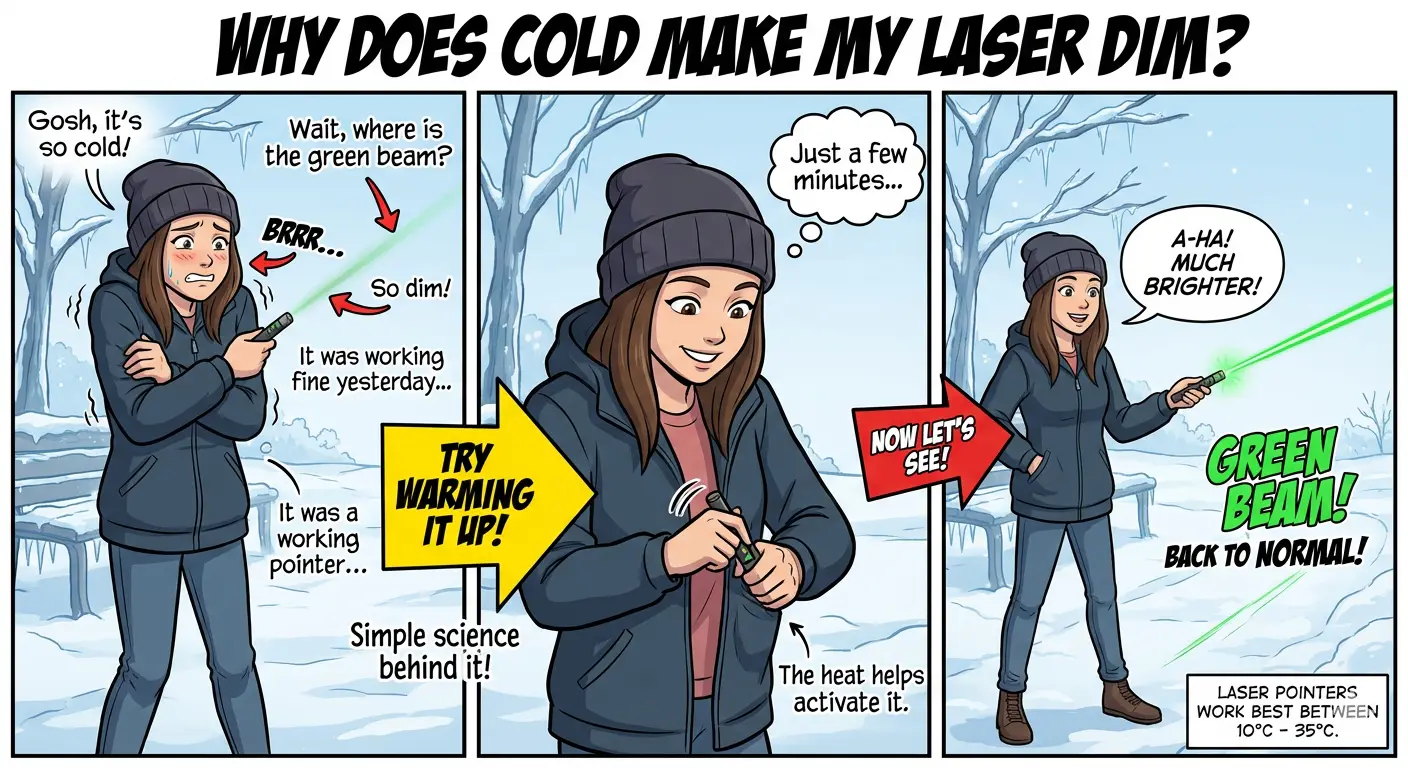
When efficiency drops—due to cold weather, poor alignment, or low build quality—the system does not simply “turn off.”
Instead, part of the energy may remain in the infrared spectrum rather than being converted into visible green light.
In some cases, reduced brightness does not mean reduced total output.
The Dangerous Paradox: Dim Does Not Always Mean Safer
According to NIST Technical Note TN 1668:
- A “10mW” green laser
- Produced ~10mW visible light
- But nearly 20mW infrared output
Real usage scenario
In cold environments:
- The visible beam may weaken
- Conversion efficiency drops
- Output shifts partially toward infrared
👉 Result:
- The beam appears dimmer
- Invisible radiation may still be present
- Natural blink reflex may not be triggered
What Counts as a “High-Power” Laser Pointer?
In practical terms, “high-power” typically refers to:
- Above 5mW (beyond standard consumer-safe limits)
- Class 3B (5–500mW) or Class 4 (>500mW)
These devices behave very differently from low-power pointers:
- Higher energy density
- Increased thermal effects
- Immediate eye hazard at short exposure
What NIST Found: Consumer Laser Output Is Often Misleading
NIST tested 122 consumer laser pointers:
https://www.nist.gov/news-events/news/2013/03/nist-tests-underscore-potential-hazards-green-laser-pointers
Results:
- ~90% exceeded the 5mW legal limit
-
75% exceeded infrared safety thresholds
- Peak IR output reached 66.5mW
Practical takeaway
- Labels are often unreliable
- Output can vary significantly
- Infrared filtering is not always present
Laser Power Classes (What “Safe” Actually Means)
According to FDA laser safety regulations:
What Actually Happens to Your Eye
Clinical reports (NIH/PMC) show:
- “5mW” labeled lasers causing retinal damage
- Exposure as short as 30–60 seconds
- Permanent macular injury in some cases
Why it’s dangerous
- Infrared (especially 1064nm) penetrates deeply
- No visible brightness → no warning
- Retina absorbs energy silently
👉 For a deeper medical explanation, see:
laser pointer eye damage and the real injury mechanism
Aviation Risk: Real-World Consequences
FAA data shows:
https://www.faa.gov/about/initiatives/lasers
- 12,840 aircraft laser incidents (2024)
- Fines up to $32,646 per violation
Even low-power lasers can cause:
- Flash blindness
- Afterimages
- Loss of situational awareness
How to Detect Infrared Leakage (Simple Home Test)
A simplified version of the NIST method:
- Shine laser onto a CD
- Observe diffraction pattern
- View through a camera (without IR filter)
- Look for extra light spots between green lines
Limitations
- Only qualitative
- Not all cameras detect IR equally
- Cannot measure power
Common Misconceptions
❌ “Green lasers are stronger”
✔️ They appear brighter due to human eye sensitivity
❌ “Cheap just means lower quality”
✔️ Cheap devices may lack proper filtering
❌ “If it looks weak, it’s safe”
✔️ Visible brightness does not always reflect total output
❌ “Blue lasers are safer”
✔️ Similar retinal risk, different visibility
What Actually Makes a Laser Safer
The most important factor:
Proper infrared filtering
Reliable manufacturers:
- Include IR filters
- Verify output
- Maintain tighter quality control
Low-cost devices may:
- Omit IR filters
- Use unstable alignment
- Produce inconsistent output
Frequently Asked Questions
Why are green lasers brighter than blue at the same power?
Because the human eye is most sensitive to ~532nm. Blue (~445nm) appears dimmer at equal power.
Why does my laser weaken in cold weather?
Temperature affects conversion efficiency in DPSS systems, which can reduce visible output.
How far can a laser actually go?
Distance depends on divergence, power, and atmosphere—not just wattage. See:
how far a laser pointer can travel in real conditions
What power level should I choose?
For general use:
- Stay ≤5mW (US legal limit)
- Avoid unverified high-power devices
Conclusion
A high-power laser pointer is not a simple consumer gadget. It is a multi-stage optical system where visible light is only part of the output.
Understanding how energy is generated, converted, and emitted helps explain why different laser types behave differently—and why output is not always what it appears to be.
👉 If you're evaluating different laser types or power levels, this guide helps you make a safer decision:
understanding laser power levels, safety, and real applications