
Is a Laser Pointer Bad for Cats? The Truth & Safe Play Guide (2026)
Are laser pointers bad for cats? The truth is more complex. Learn about laser pointer syndrome, eye safety risks, FDA laser regulations, and how to safely play with your cat using a certified red laser pointer under 5mW.
Image Gallery
Is a Laser Pointer Bad for Cats? The Truth & Safe Play Guide (2026)
The Bottom Line:
No, laser pointers are not inherently bad for cats. However, improper use can lead to a behavioral issue known as “Laser Pointer Syndrome,” and cheap, unregulated green lasers may cause serious eye damage due to invisible infrared leakage. The key to safe play is understanding feline hunting psychology, closing the hunting loop, and choosing a safety-certified red laser pointer under 5 mW.
The Psychology: What Is “Laser Pointer Syndrome”?
Cats are natural predators, and their hunting instinct follows a fixed behavioral sequence:
Locate → Stalk → Chase → Pounce → Catch → Kill → Eat
A laser dot perfectly imitates the erratic motion of prey, triggering the first four steps of this sequence. However, because the light has no physical body, the cat can never actually catch or kill the prey.
This incomplete hunting cycle can create long-term frustration. Some cats develop obsessive behaviors such as:
- Chasing shadows or reflections
- Staring at bright spots on walls
- Excessive grooming or chewing paws
- Reduced interest in normal toys
Veterinary behaviorists warn that repeatedly interrupting the hunting sequence may lead to compulsive behaviors in sensitive cats.
According to veterinary behaviorist Dr. John Ciribassi (DACVB), laser pointer play lacks a natural endpoint, meaning cats never receive the reward of catching prey. Over time, this can lead some cats to compulsively chase light reflections and shadows.
The Physical Risk: Can Laser Pointers Damage a Cat's Eyes?
Cats have extremely sensitive retinas designed for low-light hunting. If a laser beam is too powerful, it can cause retinal burns in a fraction of a second.
According to the U.S. FDA laser safety regulations, consumer laser pointers must meet strict safety requirements.
| Regulatory Parameter | Requirement |
|---|---|
| Maximum allowed power | < 5 mW |
| Safety classification | Class IIIa (FDA) / Class 3R (IEC) |
| Intended use | Presentation / pointing only |
Lasers stronger than 5 mW fall into Class IIIb, which can cause serious eye injury and should never be used as pet toys.
Cheap, unlabeled laser pointers purchased from discount stores often exceed legal power limits, creating unnecessary risk.
To dive deeper into laser pointer safety, read our The Complete Guide to Laser Pointer Safety.
Red vs. Green Lasers: Why Cheap Green Lasers Can Be Dangerous
Laser color is not just cosmetic—it reflects different internal technologies.
Red Laser
- Wavelength: ~650 nm
- Technology: Direct diode laser
- Stable output
- No infrared by-products
Green Laser
Most inexpensive green lasers use DPSS technology (Diode Pumped Solid State), which involves a multi-stage process:
808 nm infrared pump
↓
1064 nm infrared crystal output
↓
KTP crystal frequency doubling
↓
532 nm green light
This design means green lasers contain two powerful infrared beams internally. If the infrared filter is missing or misaligned (common in cheap products), invisible radiation can leak out.
A NIST study reported by ScienceDaily found that some cheap green laser pointers labeled at 10 mW actually emitted nearly 20 mW of invisible infrared light, enough to cause retinal damage before the user even notices the beam.
Red vs. Green Laser Comparison
| Feature | 🔴 Red Laser | 🟢 Cheap Green Laser |
|---|---|---|
| Wavelength | ~650 nm | ~532 nm |
| Internal technology | Direct diode | DPSS multi-stage system |
| Typical labeled power | <5 mW | Often 5–10 mW |
| Hidden infrared risk | None | Possible IR leakage |
| Safety compliance | Usually compliant | Frequently mislabeled |
| Eye injury risk | Low when used properly | Significantly higher |
Conclusion:
For cat toys, a low-power red laser under 5 mW is the safest choice.
4 Rules to “Close the Loop” During Laser Play
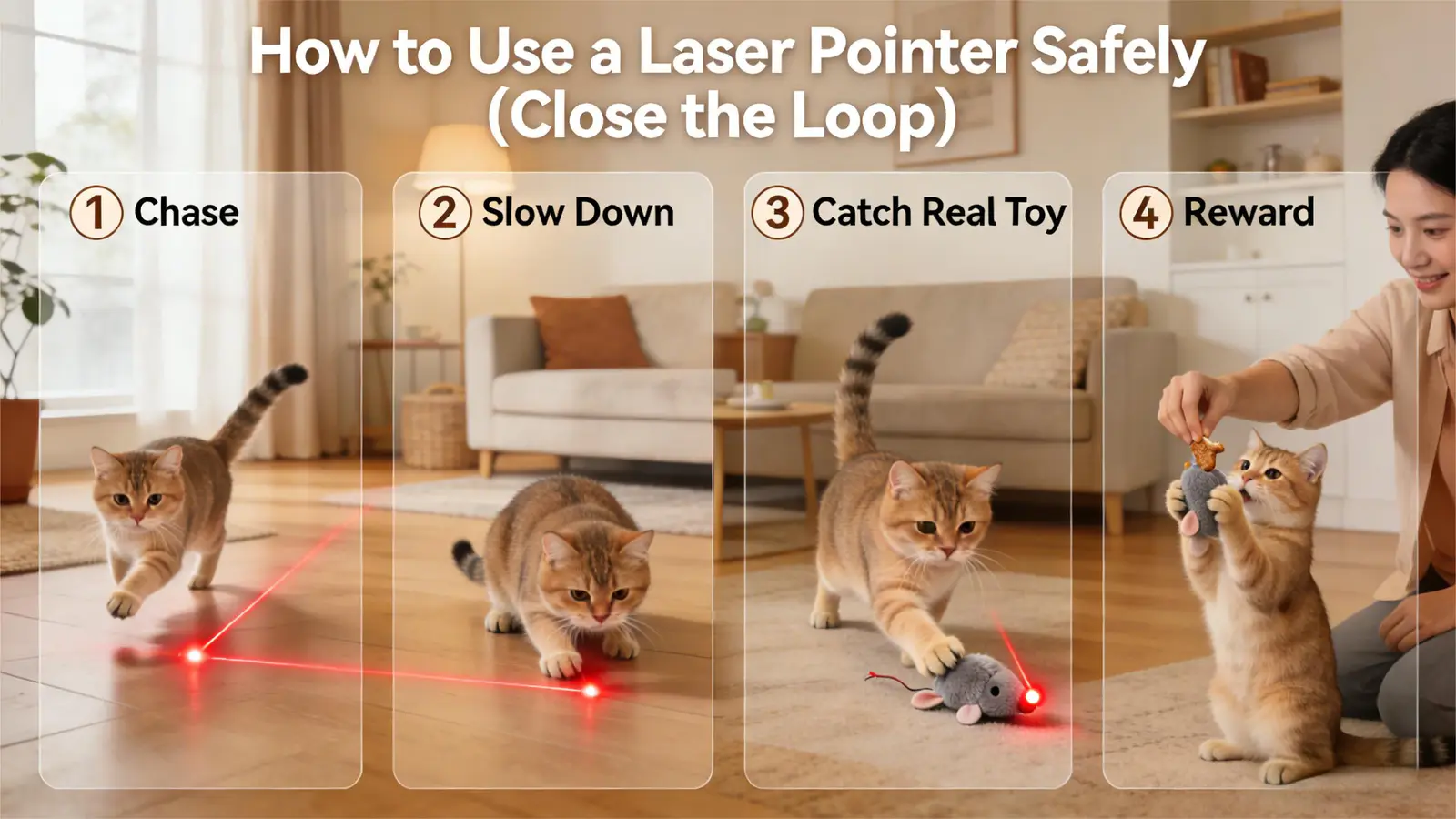
Laser toys can be great exercise if used correctly. Veterinary behaviorists recommend following a structured play routine.
1. Activation (2–5 minutes)
Move the laser across the floor in short bursts to trigger stalking and chasing behavior.
2. Slow the Prey
Gradually slow the movement so the cat believes the prey is becoming tired.
3. Close the Loop
Guide the laser dot onto a physical toy, such as a stuffed mouse or feather wand, then turn off the laser.
Your cat pounces and captures the real toy, completing the hunting sequence.
4. Reward
Offer a small treat immediately afterward to reinforce the successful hunt.
Veterinary guidance suggests limiting laser play sessions to 5–10 minutes to prevent overstimulation, as explained by PetMD’s veterinary guide on laser play safety.
How to Choose the Best Laser Pointer for Cats
When selecting a laser toy for your cat, focus on safety first.
| Feature | What to Look For |
|---|---|
| Laser color | Red (~650 nm) |
| Power output | < 5 mW |
| Certification | Class IIIa / IEC 3R |
| Design | Pen-style for controlled wrist movement |
| Brand transparency | Clear manufacturer information |
Quick Safety Checklist
- Never shine a laser directly into a person or animal’s eyes.
- Always finish laser play with a physical toy capture.
- Limit sessions to 5–10 minutes.
- Monitor your cat for obsessive behaviors.
- Supervise children when using laser toys.
FAQ
Are laser toys safe for cats?
Yes, laser toys can be safe for cats when used properly and when the device is a low-power red laser under 5 mW.
Can laser pointers damage a cat’s eyes?
High-power or unregulated lasers can damage the retina. Always use FDA-compliant low-power lasers.
Why do some cats become obsessed with laser dots?
Because the hunting sequence is never completed. Without a physical reward, cats may continue searching for the “missing prey.”
How long should laser play sessions last?
Veterinarians typically recommend 5–10 minutes per session to prevent overstimulation.
References
-
U.S. FDA – Laser Pointer Safety Regulations
https://www.fda.gov/radiation-emitting-products/laser-products-and-instruments/important-information-laser-pointer-manufacturers -
ScienceDaily – NIST Green Laser Infrared Study
https://www.sciencedaily.com/releases/2010/08/100804110207.htm -
PetMD – Are Laser Pointers Bad for Cats?
https://www.petmd.com/cat/general-health/are-laser-pointers-bad-cats
Author: LaserPointerHub Research Team
Last Updated: March 2026