
Laser Pointer Laws by Country: What You Can (and Can't) Own in 2026
A country-by-country breakdown of laser pointer ownership laws, use restrictions, and customs risks — covering the US, UK, Australia, EU, Canada, and Switzerland. Based on government sources, court records, and real-world shipping experience. Updated for 2026.
Image Gallery
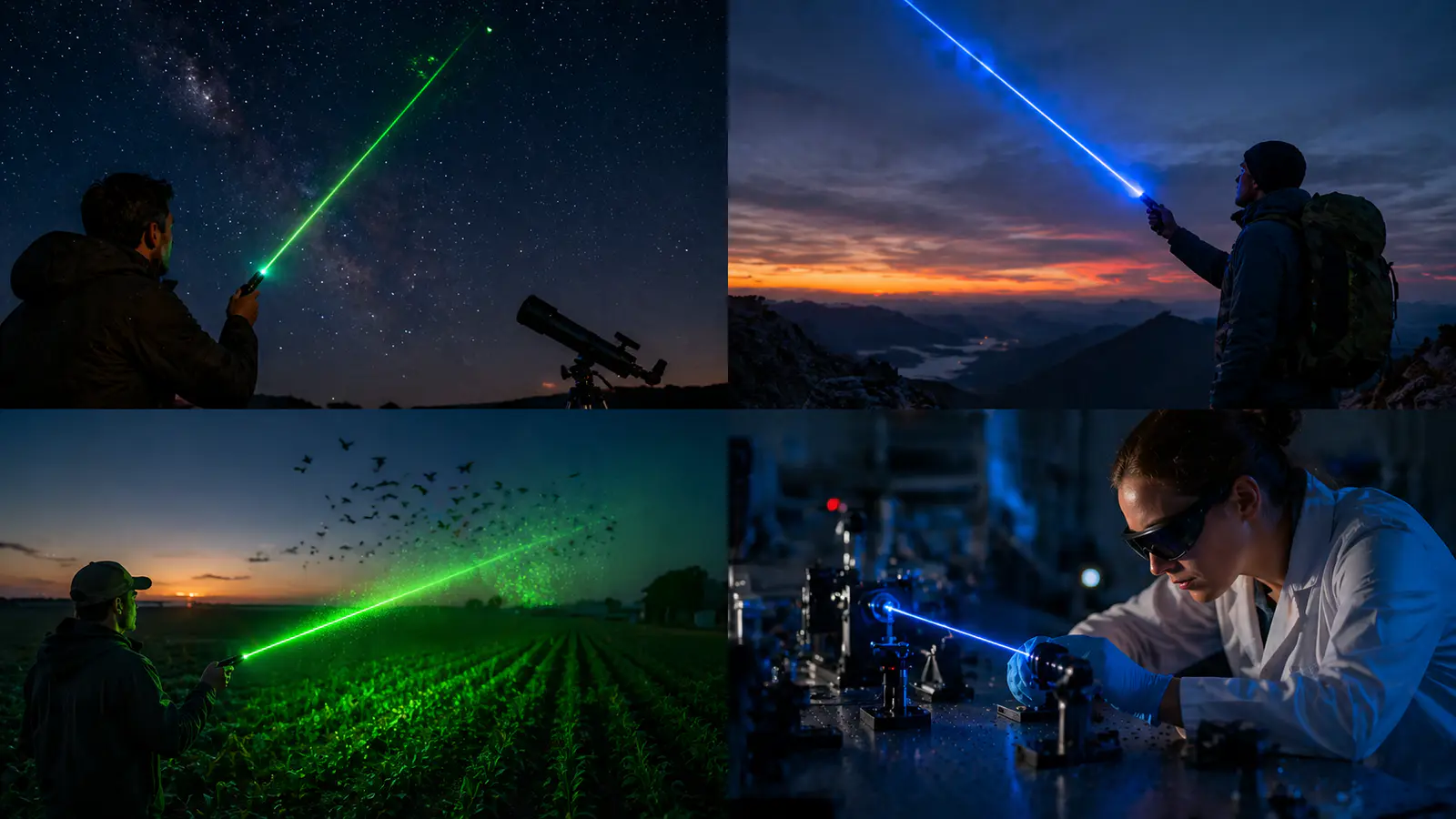
If you've ever searched for a high-power laser pointer, you've probably asked yourself: "Is this actually legal where I live?"
It's a fair question — and the answer isn't as simple as "yes" or "no." Laser laws vary dramatically from country to country. In the United States, owning a high-power laser is perfectly legal. In Australia, the same device could be classified as a prohibited weapon. In Switzerland, you could face a fine of up to CHF 40,000.
This guide breaks down the real laws — country by country — so you know exactly where you stand as a buyer and owner. No legal jargon, no guesswork. Just the facts, sourced directly from government legislation.
What this guide covers: Your rights and responsibilities as someone who owns or uses a high-power laser. We focus on what matters to you — not manufacturing regulations or industry compliance standards.
I've been deep in the laser pointer space for over five years — testing products, tracking regulatory changes across countries, and digging through government databases most people don't even know exist. This guide is the result of months of research, pulling from FDA filings, court records, and dozens of government sources. I update it regularly as laws change, because in this niche, outdated information can mean a seized package or worse.
Quick Summary: Laser Laws at a Glance
Before we dive into the details, here's the big picture. This table shows the legal status of owning and using high-power laser pointers (Class 3B / Class 4) in major countries:
Now let's look at each country in detail.
🇺🇸 United States — The Most Favorable Market
If you're in the US, here's the good news: federal law does not prohibit consumers from owning laser pointers of any power level. This is one of the most misunderstood points in laser law.
There is no federal registration requirement. No permit. No power limit on what you can personally own.
What is regulated is how you use it — and there are hard lines you must never cross.
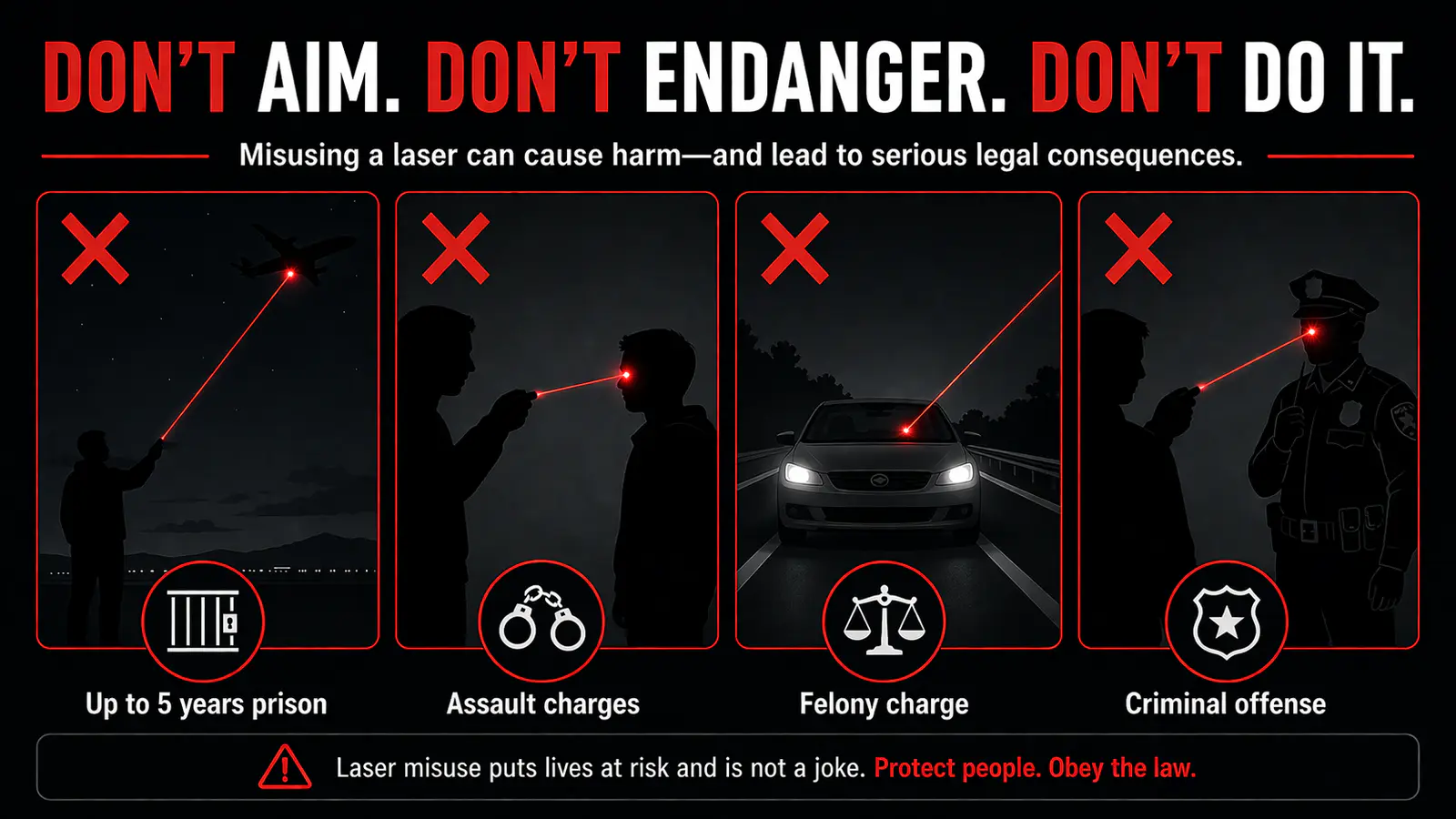
The One Rule That Can Send You to Prison
Under 18 U.S.C. § 39A, knowingly aiming a laser beam at an aircraft — or at its flight path — is a federal crime punishable by:
- Up to 5 years in federal prison
- Up to $250,000 in fines
- Additional FAA civil penalties of up to $11,000 per incident (up to $30,800 for repeat violations)
This is not theoretical. People go to prison for this:
- 2024, New Mexico: A man was federally charged for aiming a laser at a sheriff's helicopter in Albuquerque.
- 2023, Florida: A defendant faced two counts under §39A for separate aircraft laser strikes.
- The FAA reported over , though numbers have .
There are only three narrow exceptions to this law: FAA-authorized research/testing, Department of Defense operations, and using a laser emergency signaling device to send a distress signal.
Bottom line: Own whatever you want. But point it at an aircraft, and you're looking at a federal felony.
State-Level Laws
At least 17 U.S. states have additional laser-specific laws. Here are the most notable:
California (most detailed state-level legislation):
- Penal Code §417.25: Aiming a laser at someone in a threatening manner — misdemeanor, up to 30 days in jail.
- §417.26: Aiming at a police officer — up to 6 months; repeat offenders up to 1 year.
- §417.27: It is illegal to sell laser pointers to anyone under 17 (unless accompanied by a parent). Students cannot possess them on school grounds. Aiming at someone's eyes or a moving vehicle is prohibited.
Florida (§784.062): Aiming at vehicle/boat/aircraft operators is a third-degree felony. Causing injury elevates it to a second-degree felony.
Illinois: Class 3B and Class 4 lasers require state registration.
Most state laws target misuse (aiming at people, vehicles, aircraft) rather than ownership. If you use your laser responsibly — for astronomy, signaling, or experiments — you're on solid legal ground in all 50 states.
Traveling with a Laser in the US
Planning to fly? The TSA allows laser pointers in carry-on luggage, but there are practical considerations. We've written a detailed guide on how to carry a laser pointer safely while flying, including how to prevent accidental activation.
🇬🇧 United Kingdom — Strict Use Laws, Grey-Area Ownership
The UK doesn't have a specific law that bans you from owning a high-power laser. But the regulatory environment makes it risky.
What the Law Says
The UK government's official laser safety advice states that Class 3B and Class 4 lasers are "not suitable for general use by consumers." Under General Product Safety Regulations 2005, Trading Standards officers can seize laser products they consider unsafe for consumers.
For consumer products, the practical power ceiling is around 1 mW (Class 2). Products aimed at children must not exceed Class 1.
The Laser Misuse (Vehicles) Act 2018
This is the UK's most important laser law. Fully enacted in July 2018, it makes it a criminal offense to shine or direct a laser beam at a vehicle in motion (or about to move) if the beam dazzles or distracts — or is likely to dazzle or distract — the person controlling it.
The scope is remarkably broad. "Vehicle" includes:
- Aircraft and helicopters
- Trains
- Cars, trucks, buses
- Bicycles
- Ships, hovercrafts, even submarines
Key detail: The prosecution does not need to prove intent. If the beam was "likely to dazzle or distract," that's enough for a conviction.
Penalties:
| Court |
|---|
What This Means for You
If you're in the UK and you own a high-power laser, the legal risk is primarily in how you use it. Using it for stargazing in your backyard or scientific experiments at home is very different from shining it at traffic. The law targets misuse, not ownership — but be aware that Trading Standards can intervene if they consider a product unsafe for consumers.
🇦🇺 Australia — The Most Restrictive Country
Australia treats high-power laser pointers more seriously than almost any other country. If you're in Australia, you need to understand these rules before purchasing.
The Core Rule
In most Australian states and territories, any handheld laser pointer above 1 mW is classified as a prohibited weapon. Owning one without a permit is a criminal offense.
This is governed by state-level weapons legislation. Here's how it breaks down:
Yes, you read that right — South Australia has a maximum 14-year prison sentence for possession of a prohibited weapon, which includes laser pointers over 1 mW.
Can You Get a Permit?
Yes. Most states offer a permit pathway, typically through state police:
- NSW: Prohibited Weapon Permit
- Victoria: Vic Police Forms
- Western Australia: WA Police Licensing
Typical permit cost: approximately $127 AUD. You'll need to provide a genuine reason for possession — astronomy, scientific research, or professional use are commonly accepted.
Exemptions
Several categories of people can legally possess high-power lasers without going through the standard permit process:
- Members of recognized astronomical societies (e.g., Astronomical Society of South Australia, Mars Society Australia)
- University researchers and laboratory staff
- Emergency services personnel
- Licensed laser show operators
- Museum and gallery professionals
What About Customs?
Australian Border Force (ABF) actively intercepts laser pointers at the border. Under the Customs (Prohibited Imports) Regulations 1956, importing a handheld laser >1 mW requires a B709B form — a document issued by your state police confirming you have permission to possess the item. Without it, your laser will be seized and may be destroyed. No refund, no return.
If you're an Australian buyer: get your state permit first, then order.
🇪🇺 European Union — New Rules Since September 2024
The EU landscape changed significantly in 2024.
The New Standard: EN 50689:2021
According to the German Federal Office for Radiation Protection (BfS):
"Since September 2024, only devices of laser classes 1 and 2 have been allowed. In accordance with the new standard EN 50689 for laser pointers, the maximum permissible power is limited to 1 mW."
This means within the EU, consumer laser pointers sold in retail are now capped at 1 mW (Class 2).
But What About Ownership?
This is where it gets nuanced. The EU regulation targets the sale of consumer products — not necessarily private ownership of items already purchased. The practical impact varies by country:
Germany is the most relevant example. German law prohibits public use of lasers above 5 mW, and selling them to consumers is restricted. However, private ownership is not explicitly criminalized. If you already own a high-power laser or import one for personal/professional use, you're in a legal grey area — enforcement focuses on public safety and misuse rather than private possession.
Customs agencies in EU countries may seize laser products that lack proper CE marking or violate consumer safety regulations. This is more about product compliance than ownership status.
Switzerland — Near-Total Ban (Non-EU but Worth Noting)
Switzerland has the strictest laser laws in Europe. Since June 2019, only Class 1 lasers (≤0.39 mW) are permitted. All other classes — including Class 2, 3R, 3B, and 4 — are banned for import, sale, transfer, and even gifting.
The penalty: fines up to CHF 40,000 (~$39,800 USD).
If customs intercepts a laser pointer coming into Switzerland, it will be destroyed. You won't get a refund from customs, and the seller has no way to recover it. If you're in Switzerland, this is not a risk worth taking.
🇨🇦 Canada — Location-Based Rules
Canada takes a unique geographic approach to laser regulation.
The 10-Kilometer Airport Rule
Under Transport Canada regulations (SOR/2020-124), you cannot possess a handheld laser over 1 mW outside of a private dwelling within:
- Any municipality in the Greater Montréal, Toronto, or Vancouver regions
- A 10-kilometre radius of any airport or certified heliport in Canada
This is a geographic restriction — the same laser that's fine to own in rural Saskatchewan becomes a problem if you carry it near Pearson International Airport.
Exceptions
You can still possess a >1 mW laser in restricted areas if:
- You need it for work or school
- You're a member of an astronomical society
- The laser is ≤1 mW
Penalties
| Offense | Penalty |
|---|
Customs
Health Canada does not recommend that consumers purchase portable Class 3B or higher laser devices. Canadian Border Services Agency (CBSA) may intercept and seize high-power lasers at the border.
What You Should NEVER Do With a Laser
Regardless of where you live, these actions are illegal virtually everywhere and carry severe criminal penalties:
❌ Never aim at aircraft
Every country covered in this guide treats this as a serious criminal offense. Penalties range from $5,000 fines to 14 years in prison. Thousands of people are prosecuted for this every year — the FAA alone tracked over 13,000 incidents in 2023.
❌ Never aim at people
Pointing a high-power laser at someone's eyes can cause permanent retinal damage in milliseconds. In most jurisdictions, this constitutes assault.
❌ Never aim at vehicles
This includes cars, trains, boats, and emergency vehicles. The UK's Laser Misuse Act covers everything from bicycles to submarines. Similar laws exist in the US, Canada, and Australia.
❌ Never aim at emergency services
In California, aiming a laser at a police officer is a specific criminal offense (Penal Code §417.26). Other states and countries have similar provisions.
How to Use High-Power Lasers Responsibly
High-power lasers are legitimate tools with genuine applications. Here's where they're both legal and useful:
🔭 Astronomy & Stargazing
This is the most common — and most widely accepted — use for high-power green lasers. Pointing out constellations, aligning telescopes, and leading star parties are recognized as legitimate activities in every country we've covered. Even Australia's strict permit system explicitly allows astronomical use.
For stargazing, 520nm green lasers are the gold standard — the human eye is most sensitive to green light, so the beam is visible against the night sky even at lower power levels. A long-range unit like the B020 Green Laser, with its 520nm direct-diode and 10 km beam range, is a popular choice among astronomy club members who need a beam that stays stable even in cold nighttime conditions — something traditional 532nm DPSS lasers struggle with.
Related reading: Best Laser Pointer for Astronomy: Complete Stargazing Guide
🆘 Emergency Signaling & Search and Rescue
A high-power laser beam visible at 5–10 km is a genuine survival tool. Several countries — including the US — specifically exempt emergency signaling from their laser misuse laws. The key statute (18 U.S.C. § 39A) explicitly carves out an exception for "laser emergency signaling devices" used to send distress signals.
Both blue and green lasers work for long-range signaling, though they behave differently in the atmosphere. A blue 450nm beam like the B017 cuts through darkness with high contrast, while green beams offer better daytime visibility. If you're building a wilderness emergency kit, either wavelength at Class IV power levels gives you a signaling range that no flashlight can match.
Related reading: Using High-Power Lasers for SOS Signaling
🐦 Agricultural Bird Deterrence
Green lasers are used by farmers and fisheries worldwide for non-lethal bird control. Research shows 85–98% effectiveness for displacing pest birds from crops, fish farms, and airfields. This is an established commercial application with dedicated products.
Related reading: Do Laser Pointers Really Deter Birds?
🔬 Scientific Research & Education
Light scattering experiments, beam divergence demonstrations, optical alignment — Class 3B and 4 lasers are standard lab equipment. University exemptions exist in most restrictive jurisdictions.
Safety Is Non-Negotiable
Whatever you use your laser for, proper safety equipment is essential. At a minimum, you need wavelength-matched safety goggles rated for your laser's output — OD4+ for 450nm blue lasers, OD3+ for 520nm green lasers.
This is one area where cutting corners can cost you your eyesight. A quality laser kit should come with goggles matched to its specific wavelength — for example, the B023 Blue Laser ships with OD4+ goggles calibrated for 450nm, along with a safety key lock to prevent unauthorized use. If you're buying a laser that doesn't include matched safety gear, that's a red flag about the seller.
Not sure what protection level you need? Read our Laser Safety Glasses Guide for a breakdown of OD ratings, wavelength coverage, and how to choose the right pair.
Frequently Asked Questions
Q: Is it legal to own a high-power laser pointer in the United States?
Yes. Under U.S. federal law, there is no restriction on consumers owning laser pointers or laser devices of any power level. There is no registration or permit requirement. The legal restrictions apply to how you use the laser — particularly regarding aircraft (18 U.S.C. § 39A) and aiming at people or vehicles.
Q: Can I import a laser pointer to Australia?
Only with proper authorization. Under the Customs (Prohibited Imports) Regulations 1956, importing a handheld laser above 1 mW requires a B709B form from your state police, which confirms you have a valid prohibited weapon permit. Without this form, Australian Border Force will seize the item at customs. Permit costs are approximately $127 AUD.
Q: Will my laser get seized at customs?
It depends on the destination country. The highest-risk countries for customs seizure are Switzerland (near-total ban), Australia (requires prior permit), and Canada (CBSA may intercept Class 3B+). Within the EU, items without CE marking are at risk. The United States has the lowest customs risk for personal laser imports.
Q: What's the penalty for pointing a laser at an aircraft?
In the United States: up to 5 years in federal prison and $250,000 in fines under 18 U.S.C. § 39A. In the United Kingdom: up to 5 years under the Laser Misuse (Vehicles) Act 2018. In Canada: up to $100,000 and 5 years under the Aeronautics Act. In Australia: up to 2 years under the Civil Aviation Act. This is treated as a serious criminal offense in every jurisdiction.
Q: Do I need a license for a Class 4 laser?
In the United States: No. In Australia: Yes — a prohibited weapon permit from state police. In Canada: Not a license per se, but geographic restrictions apply near major airports. In the UK and EU: No formal license system, but Trading Standards (UK) and customs (EU) may act on unsafe consumer products. In Switzerland: effectively banned regardless of licensing.
Q: Are there any countries where I can use a high-power laser freely?
The United States offers the most permissive legal environment for high-power laser ownership and use. You can freely own, possess, and use lasers of any power level on private property. The only absolute restrictions are: don't aim at aircraft, people, vehicles, or into areas where the beam could reach these targets.
Q: I'm a member of an astronomy club. Does that help?
Yes, significantly. In Australia, membership in a recognized astronomical society (e.g., Astronomical Society of South Australia) is an accepted basis for a prohibited weapon permit. In Canada, astronomy club membership is an explicit exception to the 10 km airport restriction. Even in jurisdictions without formal exemptions, documented astronomical use strengthens your case if questions arise.
Summary
Laser laws aren't one-size-fits-all. The United States is the most permissive — you can legally own high-power lasers with no restrictions on power level. Australia is the most restrictive — even a modest laser above 1 mW requires a police permit. The UK, EU, and Canada fall somewhere in between, with laws that primarily target misuse rather than ownership.
No matter where you are, the universal rules are simple: never aim at aircraft, never aim at people, and always use proper eye protection. If you follow those principles, you're not just staying legal — you're using your equipment the way it's meant to be used.
If you're new to high-power lasers and want to learn the fundamentals of safe handling, our Complete Guide to Laser Pointer Safety is a good next step.
Disclaimer: This article is for informational purposes only and does not constitute legal advice. Laws change frequently — always verify current regulations in your jurisdiction before purchasing or using high-power laser devices. Last updated: April 2026.