
Do Laser Pointers Really Deter Birds? Research, Costs & What Actually Works (2026)
Do laser pointers deter birds? This research-backed guide covers real effectiveness data (85–98%), habituation risks, safety concerns, and cost comparisons for growers and gardeners.
Image Gallery
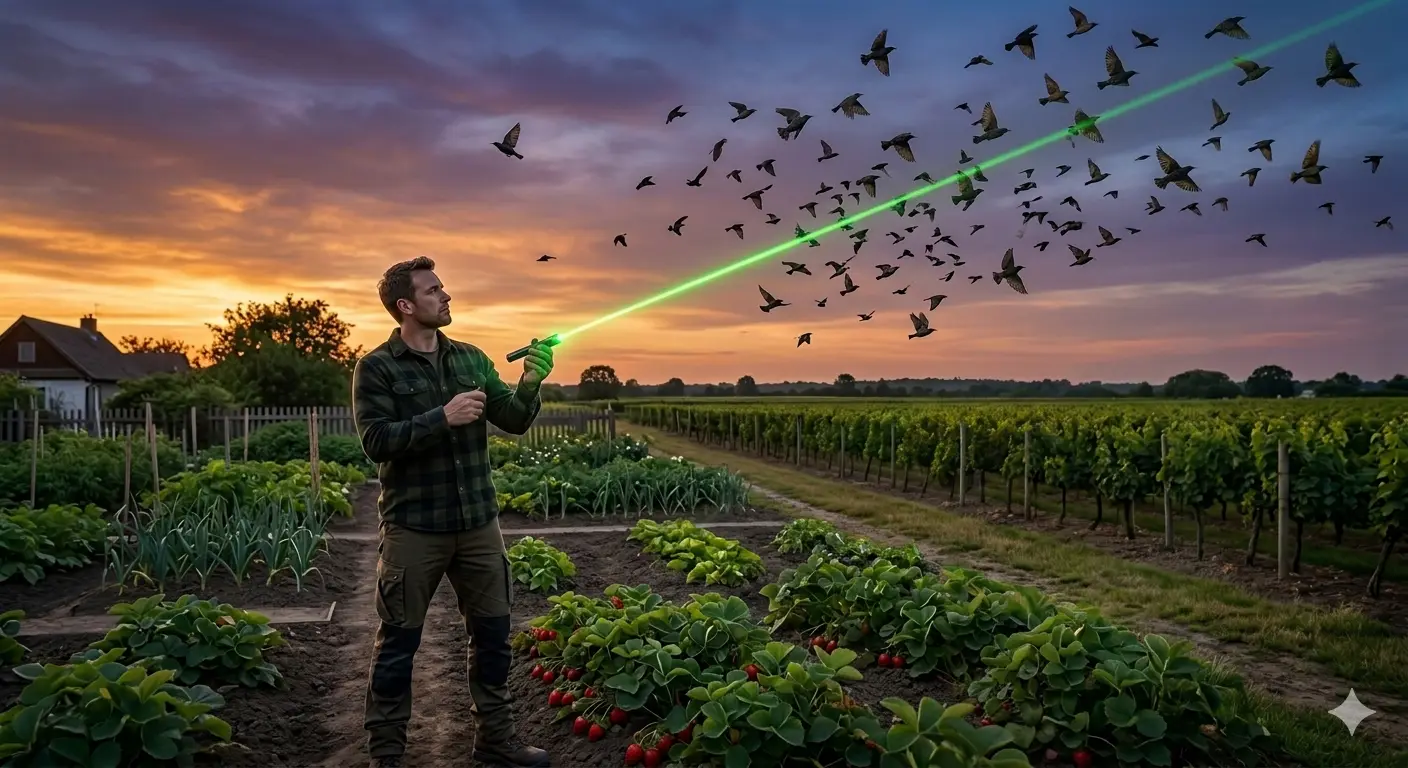
Do Laser Pointers Deter Birds?
Yes — laser bird deterrents can reduce bird activity by 85–98% in controlled field studies. However, effectiveness depends heavily on timing (dawn and dusk), system quality, and whether the laser movement is randomized. Low-cost laser pointers are significantly less effective due to rapid bird habituation.
If you've ever watched a flock of starlings demolish a cherry orchard in under an hour, you know bird damage isn't a minor inconvenience—it's a financial crisis. Across the US, uncontrolled bird predation costs growers hundreds of millions annually. But here's the problem: most folk remedies don't work, and the ones that do often cause other problems.
Laser bird deterrents have emerged as one of the most promising non-lethal tools in the fight against crop loss. Multiple peer-reviewed studies show impressive reduction numbers. But—and this is the part most product pages skip—the technology comes with real limitations, safety questions, and a habituation problem that can neutralize your investment in weeks. This guide gives you the research-backed picture: what lasers actually do to birds, where they work, where they fail, and how to build a system that doesn't just look good in a demo video.
Why Birds See Green Lasers Differently Than Humans
The reason green lasers work on birds—and not just because they're bright—comes down to biology. Birds are tetrachromats, meaning they have four types of cone cells in their retinas compared to the three humans possess. Their fourth cone is sensitive to ultraviolet light, peaking around 370nm. This gives birds a fundamentally different visual experience of the world, and of laser beams, than we have.
When a 532nm green laser fires across a vineyard at dusk, a bird doesn't just see a green dot on the ground. It sees the entire laser column—the beam cutting through the air as a solid, approaching object. That visual signature closely mimics a predator crossing open ground, triggering an innate flight response. The same 532nm wavelength that looks merely bright to human eyes registers as a direct physical threat to most bird species.
This is why green is the only wavelength with consistent field results for bird deterrence. Red lasers at 650nm appear far less bright to birds, and blue at 450nm lacks the threat-signaling quality that makes green effective. The bird's visual system simply doesn't respond to those colors with the same urgency.
The practical implication for growers: color matters, but it's not about what looks impressive in your hand. It's about what registers as danger to the target. For more on how bird vision differs from human vision, see BirdBeam's analysis of laser beam physics.
What the Research Says — Real Bird Deterrence Numbers
Marketing claims are one thing. Independent data is another. Here's what the peer-reviewed record actually shows.
A Dutch study published in BMC Veterinary Research (2021) , conducted on a free-range poultry farm, tested an automated Class IIIB laser system against wild bird intrusions. Results: overall wild bird visits dropped 98.2%, with waterfowl species showing a 99.7% reduction. Those are not cherry-picked demo numbers—they're from a real working farm. (PMC8211814)
The US Sustainable Agriculture Research and Education (SARE) program funded a multi-farm trial in the Northeast, protecting sweet corn plots with laser systems. Protected plots averaged 14.6 damaged ears per acre versus 48.6 in unprotected controls—a statistically significant result (p=0.005). All five participating commercial farms reported losses below 10%, compared to historical losses of 40–80% on unprotected fields. (SARE ONE17-291)
Australian vineyard field trials showed crop loss reductions of 85–95% with laser deterrence, and participating growers cut their annual bird control costs by 60–87%. Those numbers come from commercial operations with real financial stakes. (Edisonic)
For context on what power levels achieve these results: Class IIIB lasers in the 50–499mW range are what professional automated systems use. That power, paired with beam-expanding optics, is what separates a demonstrated result from a $30 laser pointer that might move a few birds on a good day. For more on laser power classifications and what the mW rating means in practice, see our laser pointer power guide.
Research Data Summary
| Study | Setting | Result |
|---|---|---|
| BMC Veterinary Research (2021, Netherlands) | Free-range poultry farm, automated Class IIIB laser | 98.2% wild bird visit reduction; 99.7% waterfowl reduction |
| SARE Northeast Trial (USA) | Sweet corn plots, 5 commercial farms | 14.6 vs 48.6 damaged ears/acre (p=0.005); all farms <10% loss vs 40–80% historical |
| Australian Vineyard Trials | Wine grape orchards | 85–95% crop loss reduction; 60–87% annual cost reduction |
Laser vs Other Bird Deterrent Methods
Lasers are one option, but they’re not the only one. Understanding how they compare helps you choose the right approach—or combination.
| Method | Effectiveness | Cost | Maintenance | Key Weakness |
|---|---|---|---|---|
| Laser Systems | 85–98% | High | Low | Habituation risk |
| Netting | 90–100% | Medium | High | Labor intensive |
| Sound Cannons | 60–80% | Low | Medium | Noise complaints |
| Visual Scare (kites, tape) | 20–50% | Low | Low | Rapid habituation |
What this tells you:
- Lasers offer the best low-labor solution for medium to large properties
- Netting is most reliable but labor-heavy
- The strongest long-term results come from layering methods (e.g., laser + sound)
The Habituation Problem — Why Birds Learn to Ignore Lasers
Here's the inconvenient truth that most product pages don't lead with: birds can learn to ignore lasers. A Western Australian farmer reported starlings adapting to his laser's movement pattern in just 10 days. Once birds realize the moving light is predictable and causes no actual harm, it loses its terror.
The core principle from Ohio State University researchers: randomization is everything. A static or patterned laser gives birds a puzzle to solve. An oscillating, unpredictable one doesn't. Ryan Slaughter, OSU research assistant, put it directly: "The randomness means they can't find a pattern. If you don't have that, this method fails."
Professional systems like the AVIX Autonomic Mark II address this with AI-driven algorithms that vary projection direction, timing, and intensity across coverage areas up to 12 acres. Birds can't predict the behavior because there is no behavior to predict—only chaos that looks like a constant threat.
Dr. Catherine Lindell from Michigan State University, who has studied bird behavior in agricultural contexts extensively, puts it this way: "If the same thing keeps happening in the same way, birds quickly figure it out. Randomness and surprise are key."
The implication for growers: buying a cheap rotating laser and setting it to a fixed pattern will likely disappoint. The technology works—the question is whether the system you're using is smart enough to stay ahead of the birds' learning. For more on laser power classes and what separates a consumer device from a professional system, see our Class 3R vs Class 4 laser guide. The OSU researchers' findings on habituation patterns are detailed in their Connections Newsletter research summary.
When and Where Laser Bird Deterrents Actually Work
Laser bird deterrents are not a universal solution. Their effectiveness is highly context-dependent, and understanding those conditions is the difference between a system that pays for itself and one that ends up in a storage shed.
Dawn and dusk are the most effective windows. This is consistently the most effective time period. Ambient light is low, so the contrast between the laser beam and the background is highest. Birds are actively foraging during these transitions, and a moving light reads as a predator crossing open ground. As light levels rise—particularly under direct sunlight—the contrast ratio collapses and the laser becomes nearly invisible even at close range. French airport data cited by LaserPointerSafety.com found lasers "effectively useless" in strong daylight.
Open orchards and vineyards work well. Large, relatively flat growing areas without heavy tree cover allow the beam to sweep across the full range of the property. The system needs line-of-sight to be effective. Heavy canopy, buildings, or topography create blind spots.
Established urban bird populations are harder to shift. City pigeons, for example, have often habituated to human activity and structures. If birds have already established feeding and nesting patterns in your area, they're slower to abandon them. Early-season deployment—when birds are just beginning to discover your crop—is the optimal window.
Coverage area and power matter together. A system rated for 5 acres running on a 20-acre property will underperform not because the laser is weak, but because birds learn the boundaries of the safe zone. Professional systems like the AVIX Autonomic are designed for continuous coverage across their rated area with no gaps for birds to exploit.
The Cost Reality — From $100 to $25,000
Walk into any online marketplace and you'll find laser bird deterrent products ranging from under $100 to several thousand dollars. At the high end, fully automated systems like the AVIX Autonomic run $15,000–$25,000 depending on coverage configuration. That's a staggering spread, and the confusion is real.
The price gap reflects real technical differences. A $100 rotating laser pointer might move a beam in a predictable pattern, cover a small area, and lack any randomization capability. An AVIX system uses AI-driven beam movement, precision optics, weatherproof housing, solar integration, and multi-acre coverage—all of which justify the price in commercial contexts.
For a small home garden, that $100 unit might actually be sufficient. But Ohio State University researcher Dr. Gary Gao, who has evaluated multiple systems in field trials, notes: "Prices range from around $100 to $25,000, and there are meaningful differences in what you get at each tier."
A 5-year total cost of ownership analysis shifts the picture somewhat. For a typical UK commercial facility (~5,000 sqm): netting runs $8,000–$12,000 over five years when you factor in installation, seasonal removal, and replacement. Professional laser systems cost $9,000–$17,000 over the same period—but require no seasonal labor, make no noise, and run 24/7 autonomously. For large orchards, the math increasingly favors laser, especially when crop values are high.
The practical advice: match the system to the scale. A small garden with modest bird pressure doesn't need a $10,000 professional unit. A 20-acre cherry orchard with historical losses in the 30–40% range almost certainly needs something closer to it. For more on how power ratings translate into real-world capability, see our high-power handheld lasers guide. Dr. Gao's full analysis of laser bird deterrent cost-effectiveness is available from OSU South Centers.
Which Laser System Should You Choose?
Not every property needs a $20,000 automated system—but many growers buy the wrong tier and end up disappointed.
Small garden (<1 acre)
A low-cost rotating laser may be sufficient, especially if bird pressure is light. Expect limited long-term effectiveness unless you manually randomize operation.
Medium farm (1–10 acres)
Semi-automated systems with randomization capabilities are recommended. This is the size where predictable patterns become a liability.
Large orchard (>10 acres)
Fully automated Class IIIB systems with AI-driven movement are the only reliable solution. Manual or semi-automated approaches will likely fail as birds learn boundaries and patterns.
If you're between tiers, size up. A system that barely covers your acreage gives birds a safe zone to exploit.
FAQ
Q1: Do lasers really work to deter birds, or will they just get used to them?
Yes, lasers can work—but habituation is a real problem with entry-level systems. Peer-reviewed research shows 85–98% reduction in bird activity with professional automated Class IIIB systems. However, birds can learn to ignore static or predictable laser patterns within 10 days. The solution is randomization: AI-driven systems that vary direction, timing, and intensity so birds cannot establish a pattern. If you buy a cheap rotating laser, expect limited long-term effectiveness.
Q2: Can lasers hurt birds' eyes? Is it humane?
This is a legitimate concern that marketing claims often dismiss too quickly. Purdue University's 2022 controlled study found that laser exposure caused corneal edema, cataracts, retinal atrophy, and photoreceptor cell nucleus displacement in sparrows and starlings. The study concluded that "lasers as bird deterrents may not be entirely safe." Professional systems using beam expanders reduce the intensity per unit area, which mitigates—but may not eliminate—the risk. The RSPCA has stated it does not support direct laser illumination of animals' eyes. Humane use requires appropriate power levels and beam expansion.
Q3: What power laser do I need for bird control — and is it safe?
Class IIIB lasers in the 50–499mW range are what professional bird control systems use. Below 5mW (Class 2), effectiveness drops significantly because the beam loses the visual intensity that triggers bird flight responses. Above 500mW (Class IV), fire and eye hazards become serious concerns for both operators and bystanders. Consumer use of Class IIIB or higher without beam-expanding optics is not recommended by LaserPointerSafety.com due to eye safety risks to humans, birds, and low-flying aircraft.
Q4: Can I use a cheap laser pointer instead of a professional system?
A cheap laser pointer is not a bird deterrent system, regardless of what product listings claim. The difference lies in beam expansion optics, randomization algorithms, weatherproofing, and power consistency. A $30 green laser pointer may produce a visible green dot, but it lacks the column visibility that birds respond to, has no randomization, and will not maintain effectiveness as birds habituate. For a small garden with light bird pressure, it may provide some deterrent effect—but for any serious agricultural application, a purpose-built system is the only purchase that will likely pay for itself.
Q5: Should I use lasers alone or combine them with other methods?
Industry experts and field results consistently point toward integrated approaches. Bird-X's sales manager notes: "If the laser isn't paired with some kind of distress sound, it will lose effectiveness over time. Combining lasers and sound is where the real success happens." The Devonian Coast Winery in Canada runs lasers alongside 7 bird distress callers, 3 propane cannons, and 10 decoy eagle kites. Auburn's urban crow dispersal program achieved roughly 50% removal within one week using laser plus sound plus distress calls—but the crows relocated to neighboring cities, demonstrating that birds move rather than disappear. For most growers, lasers work best as one component of a layered system.
Conclusion
Laser bird deterrents are one of the most effective non-lethal tools available for protecting orchards and gardens—but only when deployed with realistic expectations and the right hardware. The research numbers are real: 85–98% reductions in bird activity are achievable with professional-grade Class IIIB systems using proper beam expansion and randomization. But a $100 rotating laser from an online marketplace is a different product in a different category, and results will reflect that.
The practical framework: start early in the season before birds establish feeding patterns, invest in randomization or smart systems, combine with at least one other deterrent method (sound, physical barrier, or decoy), and never assume the laser solves the problem alone. Birds adapt. Systems that adapt with them are the ones that pay off over years, not weeks.
For smaller gardens, a basic unit may provide adequate protection. For commercial orchards, the 5-year cost analysis increasingly favors professional laser systems over seasonal netting and labor. Choose the tool that matches your scale, your bird pressure, and your willingness to monitor and adjust.
Safety Note
Laser use for bird deterrence must comply with local regulations and should never be directed at aircraft, humans, or animals at close range. Improper use can cause permanent eye damage.