
Laser Safety Glasses Guide: What Protection Level Do Laser Pointer Users Need?
Learn how to choose the right laser safety glasses for laser pointers. This guide explains wavelength matching, optical density (OD), laser classes, and recommended protection levels to prevent eye injuries.
Image Gallery
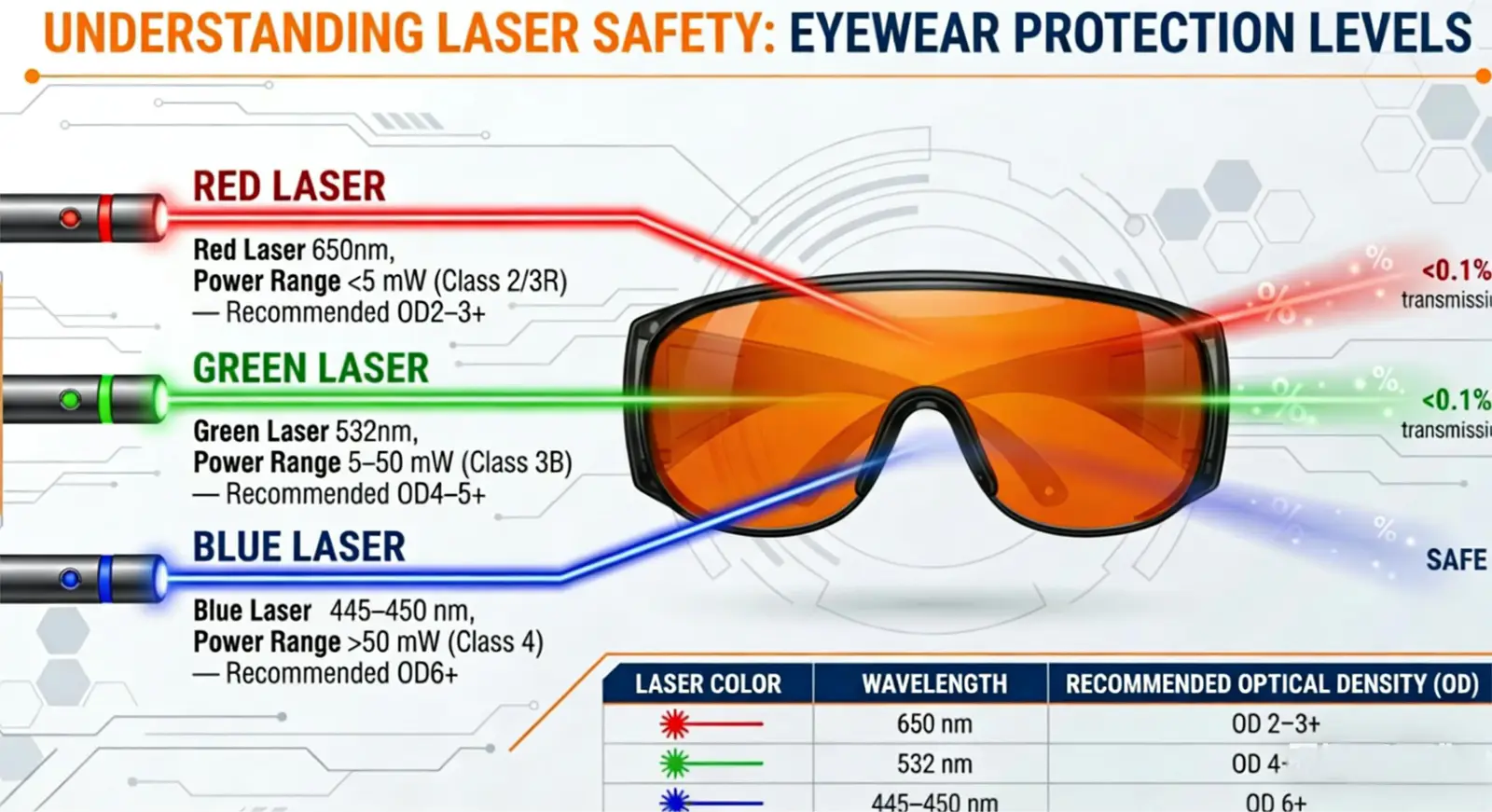
Laser safety glasses are one of the most important protective tools when using high-power laser pointers. Even a small handheld laser can focus intense energy into the eye and potentially cause retinal damage.
The most important rule is simple:
Laser safety glasses must match both the wavelength and the power of the laser.
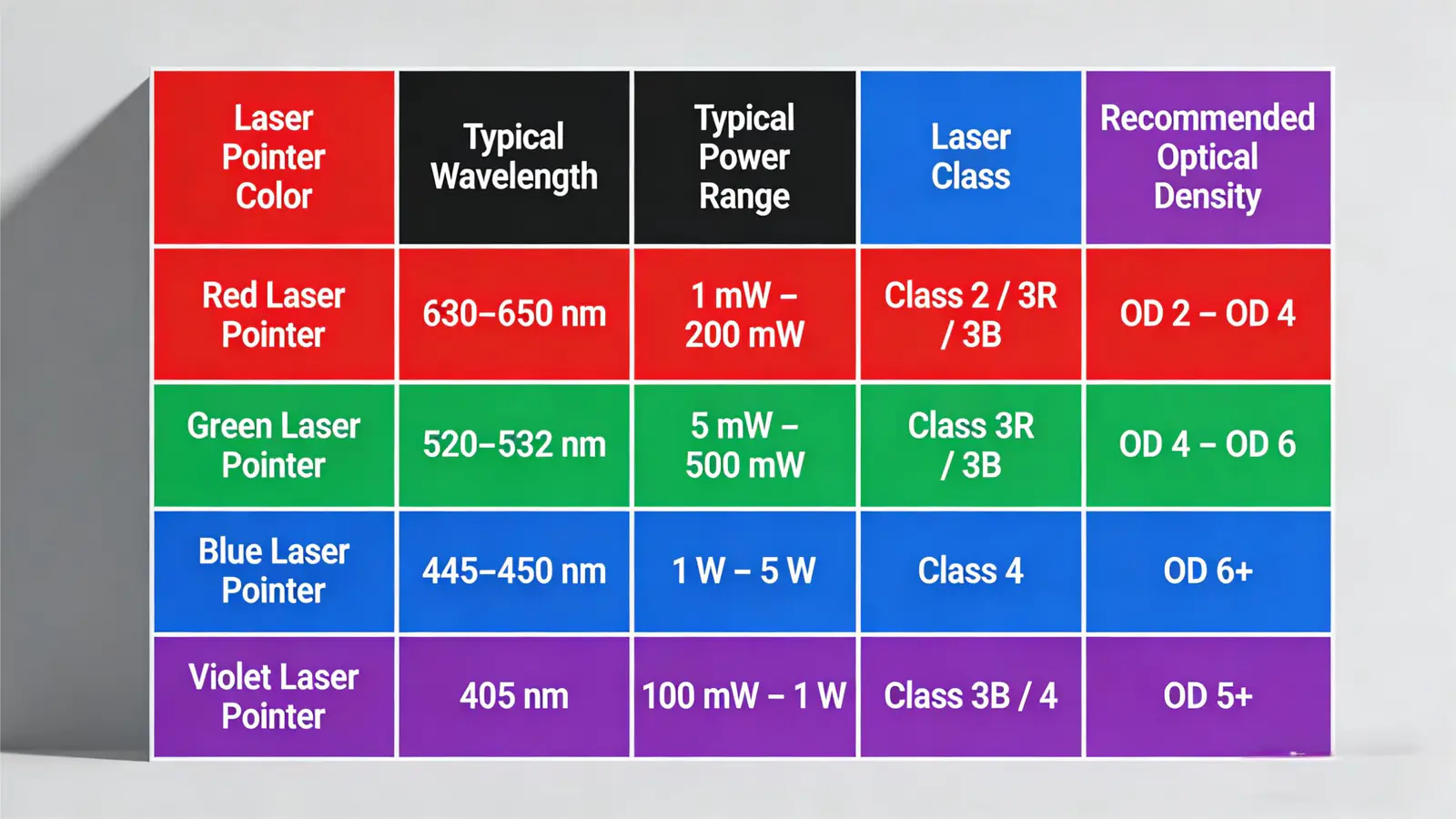
Below is a quick reference table specifically for common laser pointer types, helping users understand what level of protection is typically required.
Quick Reference: Recommended Laser Safety Glasses for Laser Pointers
Important: Laser safety glasses are designed to protect against accidental exposure or reflections, not intentional direct viewing of a laser beam.
If you are unsure about the power level of your device, read our guide:
How Powerful is a Laser Pointer? Understanding Power Levels, Safety, and Applications (internal link)
Why Laser Safety Glasses Are Important
Laser light behaves very differently from ordinary light sources such as flashlights or LEDs.
Lasers are:
- Highly directional – the beam remains narrow over long distances
- Monochromatic – nearly a single wavelength
- Extremely concentrated – energy density can be very high
When laser light enters the eye, the eye’s lens focuses the beam onto the retina. This focusing effect can increase the energy density dramatically.
According to laser safety research, the eye can concentrate incoming light up to 100,000 times onto the retina.
This amplification means even relatively low-power lasers can cause damage under certain conditions.
Possible eye injuries include:
- retinal burns
- permanent vision loss
- flash blindness
- long-term retinal damage
For a detailed explanation of laser eye injuries, see:
Can a Laser Pointer Blind You? The Real Science of Laser Eye Damage (internal link)
Authoritative safety references include:
- Laser Institute of America — https://www.lia.org/resources/laser-safety-information
- Laser Safety Facts — https://www.lasersafetyfacts.com
- FDA Laser Product Regulations — https://www.ecfr.gov/current/title-21/chapter-I/subchapter-J/part-1040/section-1040.10
How Laser Eye Damage Happens
The human eye acts like a precision optical system.
When laser light enters the eye:
- The cornea allows the light to pass through.
- The lens focuses the beam into a very small spot.
- The retina absorbs the concentrated energy.
Because the retina contains delicate photoreceptor cells responsible for vision, excessive energy can cause permanent damage in milliseconds.
High-power handheld laser pointers, particularly blue lasers above 1 watt, are often classified as Class 4 lasers, meaning they can pose serious eye hazards.
Understanding these risks is essential for safe laser use.
For a complete overview of laser safety practices, read:
The Complete Guide to Laser Pointer Safety: Protecting Eyes, Kids, Pets, and More (internal link)
Understanding Optical Density (OD)
The most important specification of laser safety glasses is Optical Density (OD).
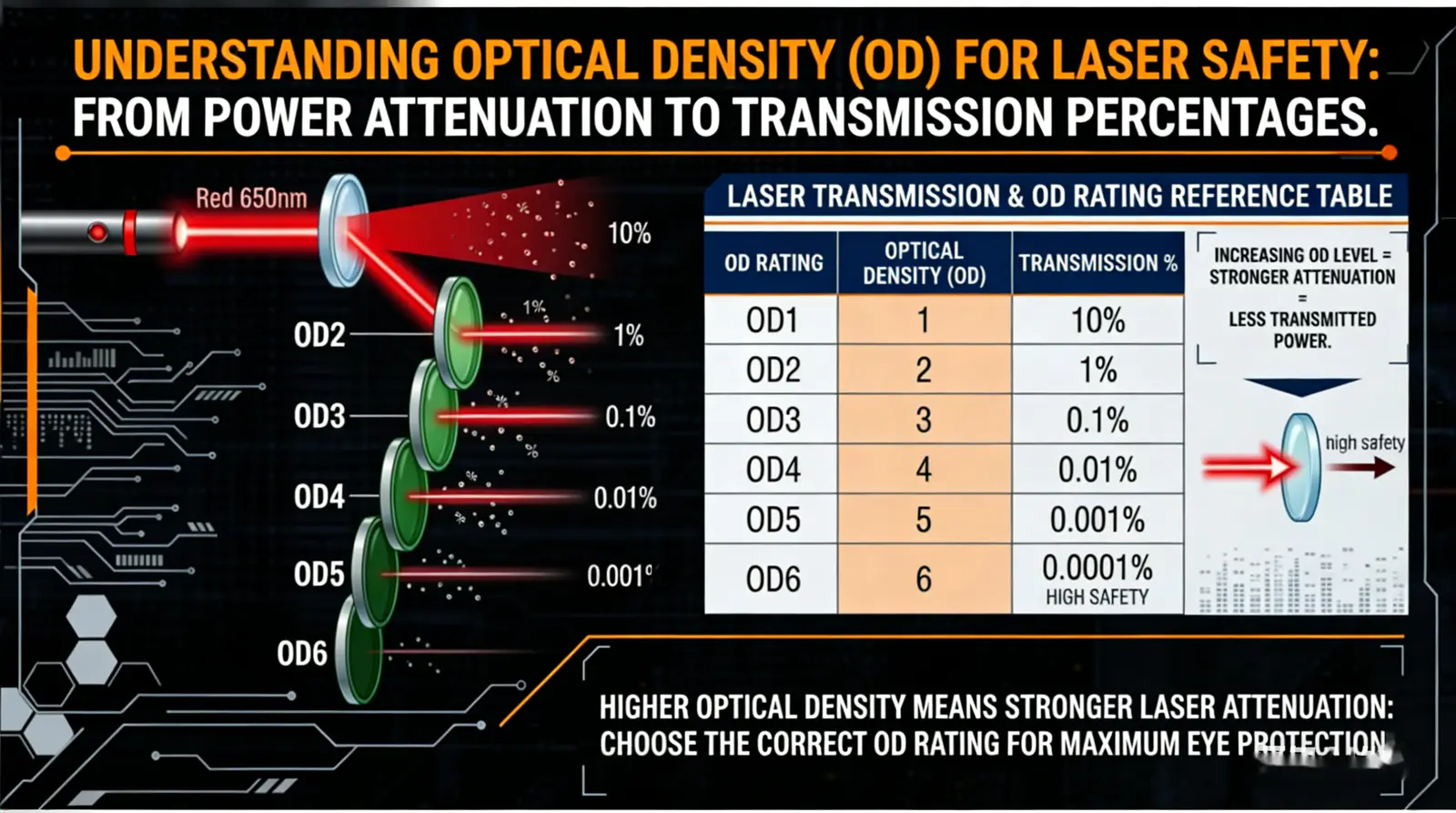
Optical Density measures how effectively the lens blocks laser radiation at a specific wavelength.
Mathematically, OD is defined as:
OD = log10 (1 / T)
Where T is the transmission, meaning the fraction of light that passes through the lens.
Higher OD means less laser energy passes through the eyewear.
Optical Density vs Light Transmission
For example:
- OD4 blocks 99.99% of laser energy
- OD6 blocks 99.9999% of laser energy
Higher OD levels provide stronger protection but often reduce visible brightness through the lens.
Why Wavelength Matching Matters
Laser safety glasses must match the specific wavelength of the laser being used.
Laser filters are designed to block narrow wavelength ranges. If the wavelength does not match the filter range, the laser may pass through the lens with minimal attenuation.
Example:
A green 532 nm laser may originate from a frequency-doubled Nd:YAG system that also produces 1064 nm infrared radiation.
Professional laser safety glasses designed for this laser often block both wavelengths.
High-quality laser eyewear typically lists:
- protected wavelength range
- optical density rating
- certification standard
Always verify these specifications before choosing protective eyewear.
Why Ordinary Safety Glasses Do NOT Protect Against Lasers
Many users assume that standard safety goggles, sunglasses, or welding glasses can protect against lasers. In reality, most of these products provide little to no laser protection.
Regular safety eyewear is designed for:
- mechanical impacts
- dust
- debris
- UV filtering
Laser protection requires special optical filters engineered to block specific wavelengths with measured optical density.
Without this filtering capability, a laser beam can pass through ordinary lenses almost unaffected.
This is why certified laser safety glasses are required when working with higher-power lasers.
Laser Classes and Eye Safety
Laser devices are categorized according to hazard potential. The most widely used classification system comes from IEC 60825-1 and ANSI Z136.1.
Most high-power handheld laser pointers fall into Class 3B or Class 4, meaning protective eyewear is recommended or required.
More details on classification can be found here:
https://www.lasersafetyfacts.com/laserclasses.html
How to Choose Laser Safety Glasses
When selecting laser safety glasses, several key factors should be considered.
1. Wavelength Coverage
The protection range must include the exact wavelength of your laser.
For example:
- 445 nm blue lasers
- 520 nm green lasers
- 650 nm red lasers
If multiple lasers are used, choose eyewear covering all relevant wavelengths.
2. Optical Density Level
Select an OD level appropriate for the power of the laser.
Typical guidance:
| Laser Power | Suggested OD |
|---|---|
| under 5 mW | OD2 |
| 5 – 50 mW | OD3–OD4 |
These values are general recommendations; professional environments may require calculations based on Maximum Permissible Exposure (MPE).
3. Visible Light Transmission
Very high OD lenses may appear darker, reducing visibility.
A good pair of laser safety glasses balances:
- protection
- visibility
- comfort
Manufacturers usually list the visible light transmission percentage (VLT).
4. Comfort and Fit
Look for features such as:
- wraparound protection
- side shields
- adjustable nose pads
- anti-fog ventilation
Comfort is important because protective eyewear must be worn consistently to be effective.
5. Safety Certification
Reliable laser safety glasses typically comply with standards such as:
- ANSI Z136.1
- EN 207
- EN 208
Certified products will include markings indicating wavelength protection and optical density ratings.
More information on laser safety standards is available from the Laser Institute of America:
https://www.lia.org/resources/laser-safety-information/laser-safety-standards
Maintenance and Inspection
Laser safety glasses should be inspected regularly to ensure they remain effective.
Recommended practices include:
Lens Inspection
Check for:
- scratches
- cracks
- coating damage
- discoloration
Any damage can reduce protection.
Cleaning
Use:
- mild soap
- optical lens cleaner
- microfiber cloth
Avoid harsh chemicals that may damage coatings.
Storage
Store laser safety glasses:
- in a protective case
- away from heat
- away from chemical fumes
Manufacturers often recommend replacing laser safety glasses every 2–5 years, depending on usage and material aging.
Frequently Asked Questions
Do laser safety glasses make it safe to look directly at a laser?
No. Laser safety glasses are designed to protect against accidental exposure or reflections, not direct intentional viewing of the beam.
What OD level is needed for a high-power laser pointer?
For most handheld lasers above 500 mW, eyewear with OD6 or higher is typically recommended.
Can the same glasses protect against different lasers?
Only if the protective filter covers all wavelengths used. Many users keep separate glasses for different laser types.
Are cheap online laser glasses reliable?
Low-cost eyewear without certification may not provide verified optical density protection. Always check for wavelength ratings and safety standards before purchasing.
Conclusion
Laser safety glasses are an essential part of responsible laser use, especially when working with high-power laser pointers.
Choosing the correct eyewear requires understanding:
- the wavelength of the laser
- the power level
- the required optical density
Properly matched laser safety glasses can significantly reduce the risk of accidental eye exposure.
Combined with safe operating practices and awareness of laser hazards, they help ensure that laser technology can be used safely and effectively.