
The Complete Guide to Laser Pointer Safety: Protecting Eyes, Kids, Pets, and More
Image Gallery
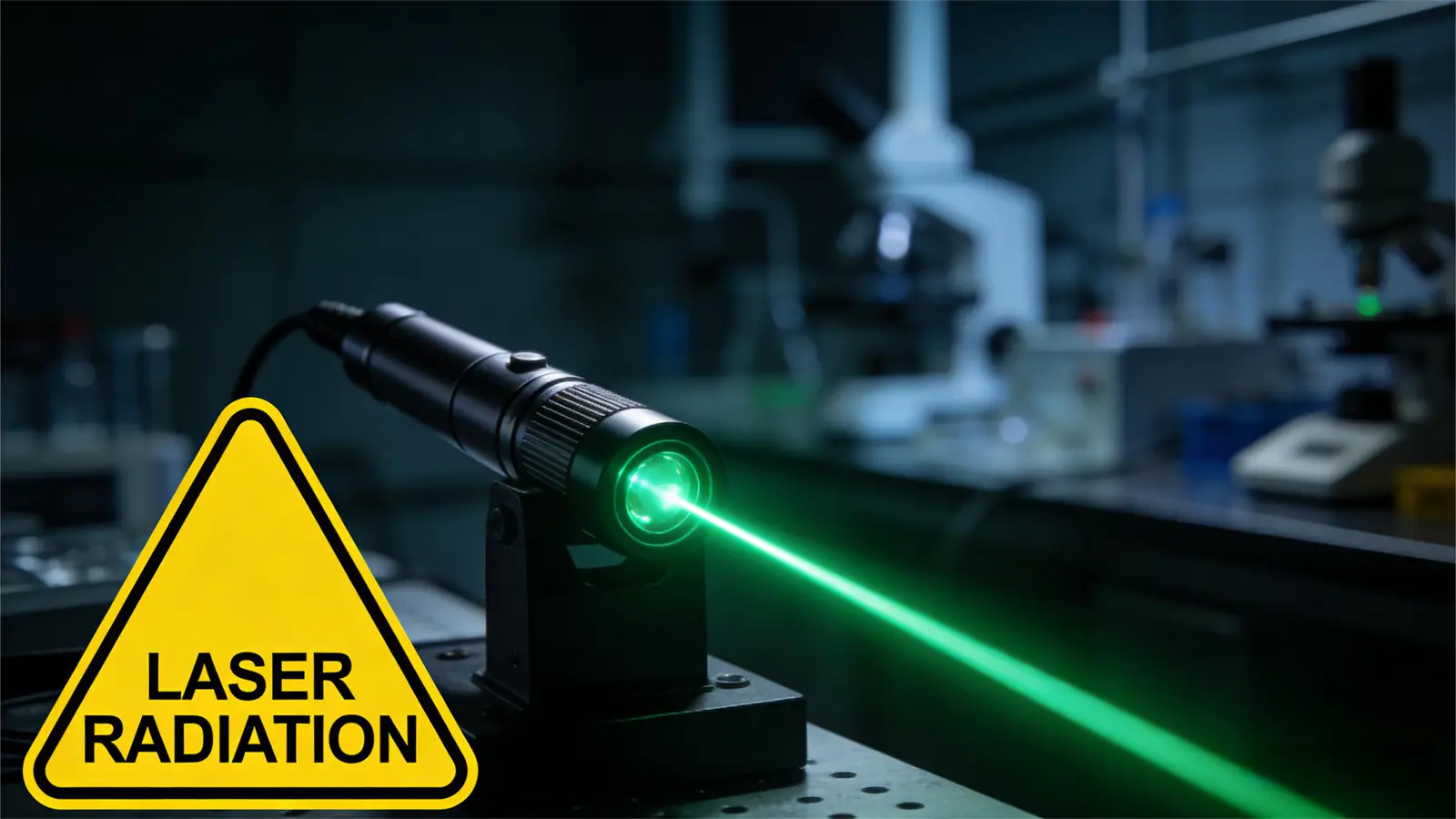
1. Introduction: Brilliance Comes with Responsibility
Laser pointers are remarkable tools. Whether you are an amateur astronomer pointing out constellations, a professor highlighting key data, or a professional in construction, their utility is undeniable. However, beneath the focused brilliance of that beam lies a potential for significant, often permanent, damage.
Because lasers are so common, many people treat them like simple flashlights. This is a dangerous misconception. According to the FDA (Food and Drug Administration), misused laser pointers can cause permanent eye injury—and the number of incidents, especially among children, is rising.
This guide provides a comprehensive, data-driven look at laser pointer safety, ensuring you can enjoy this technology while protecting yourself, your children, your pets, and even passing aircraft.
2. Laser Safety and Eye Protection: Why the Retina is Vulnerable
The Physics of Damage
The most vulnerable part of the human body to laser light is the eye. Unlike a traditional light source, a laser beam is collimated (parallel). When it enters your eye, the lens focuses that intense energy onto a tiny spot on the retina—magnifying the intensity by up to 100,000 times.
Because the retina lacks pain receptors, you might not feel the damage occurring. By the time you notice a problem, the injury is often permanent.
The Legal Limit vs. Reality
Under FDA regulations (21 CFR 1040.11), consumer laser pointers sold in the US are strictly limited to Class IIIa (IEC Class 3R) with a maximum output of 5 milliwatts (mW) in the visible range (400-710 nanometers).
The FDA explicitly states:
"This means that pointers are limited to 5 milliwatts output power... Class IIIb hand-held lasers are too dangerous for use as pointers or amusement articles. Furthermore, promotion of Class IIIb or IEC Class 3B products for pointing or amusement violates FDA requirements and United States law."
— FDA: Important Information for Laser Pointer Manufacturers
However, the reality is alarming: illegal high-power lasers (Class 3B and Class 4) are easily available online, often mislabeled as safe "5mW" products.
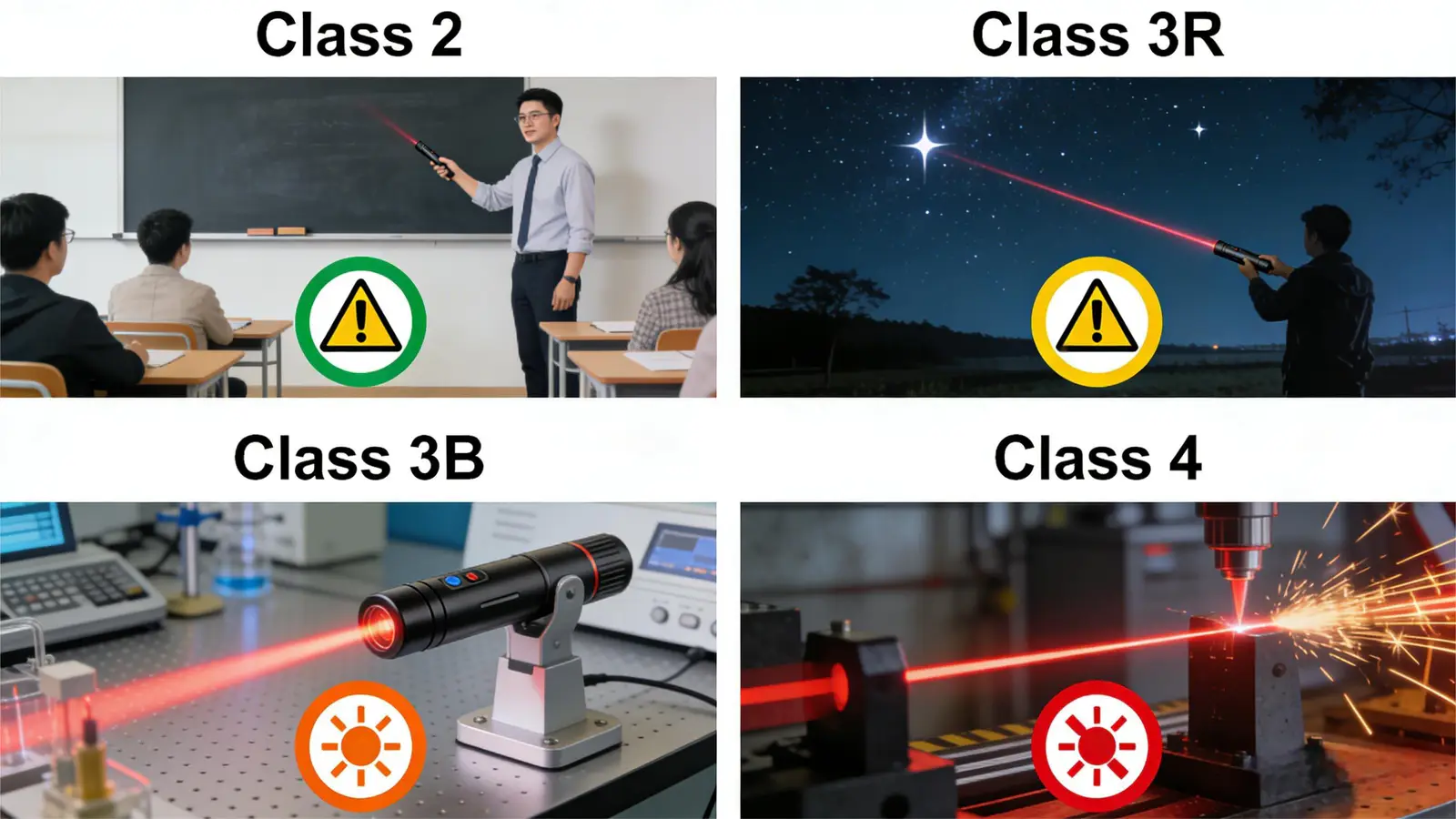
Laser Classifications at a Glance
| FDA Class | IEC Class | Power Range | Hazard Level |
|---|---|---|---|
| Class II | Class 2 | < 1 mW | Generally safe due to blink reflex |
| Class IIIa | Class 3R | 1–5 mW | Legal limit for pointers—direct viewing hazardous |
| Class IIIb | Class 3B | 5–500 mW | Direct exposure causes immediate eye injury |
| Class IV | Class 4 | > 500 mW | Severe eye/skin hazard, diffuse reflections dangerous, fire hazard |
"Class IV: Immediate skin hazard and eye hazard from exposure to either the direct or reflected beam; may also present a fire hazard."
— FDA: Laser Products and Instruments
Alarming Medical Evidence: The Hidden Danger
Recent medical literature reveals a disturbing trend: laser-induced eye injuries in children are increasing sharply, and most young victims don't even realize they've been hurt.
A 2023 study published in the Journal of Pediatric Ophthalmology and Strabismus (PMID: 35611824) examined pediatric laser injury cases and found:
"Within the case series, 67% of patients were asymptomatic on presentation. A mean follow-up of 25.6 months showed that structural changes persisted in all cases… there is usually permanent structural damage to the macula."
— PubMed: PMID 35611824
67% of children with confirmed retinal damage had no symptoms at all. They walked around with permanent eye damage—and had no idea.
A 2025 case report in S D Med (PMID: 40878272) documented a 12-year-old boy who used a green laser pointer labeled as the legal limit of "5 mW." He suffered a linear retinal burn and developed a permanent dark spot (scotoma) in his vision.
"Symptoms improved during observation, but at the most recent follow-up three years after the injury, the scotoma persisted."
— PubMed: PMID 40878272
Three years later, the damage was still there.
Why You Must Use Laser Safety Goggles
For any laser exceeding 5 mW (Class 3B or 4), safety glasses are mandatory. Regular sunglasses are completely useless.
Optical Density (OD) measures how much light is blocked. According to ANSI Z136.1 standards:
- OD 3 → 1,000× reduction (minimum for Class 3R)
- OD 4 → 10,000× reduction (for Class 3B)
- OD 6 → 1,000,000× reduction (for Class 4)
Crucially, OD value alone is not enough. The goggles must be matched to your laser's specific wavelength. A pair rated OD 7 for 1064nm (infrared) provides zero protection against a 532nm green laser.
"Protection is only valid within the marked wavelength range."
— DHS Laser Protective Eyewear Report
3. Protecting the Next Generation: Laser Pointers and Kids
Children are at the highest risk. Their curiosity, combined with clearer lenses that allow more light to reach their retinas, makes them uniquely vulnerable.
A 2023 study from the University of Freiburg Eye Center (10-year data review, PMC10313552) found that the number of pediatric laser injuries has increased dramatically in recent years. The researchers concluded:
"The number of laser pointer injuries has increased over the last years. Therefore, access to laser pointers for children should be strictly controlled."
— PMC: PMC10313552
All the injuries occurred during school trips or while playing with siblings.
Safety Tips for Parents:
- Not a Toy: Never treat a laser pointer as a plaything. Store it in a locked case.
- Supervision is Non-Negotiable: Even for low-power presentation lasers, children must be supervised.
- Beware of Mislabeled Products: Cheap online lasers labeled as "5mW" may actually output 50mW or more.
- The Scariest Fact: Your child could have permanent retinal damage and show no symptoms. Prevention is the only defense.
4. Laser Pointers and Pet Safety: The Hidden Psychological Toll
That game of "chase the red dot" might seem like harmless fun—but veterinary experts warn it could be damaging your pet's mental health.
The Research: It's Not Just Anecdotal
A 2021 peer-reviewed study published in Animals (PMC8388446), conducted by Colorado State University with IRB approval, surveyed 618 cat owners and found a statistically significant association between laser play and compulsive behaviors.
"We found significant associations between the frequency of laser light play and the occurrence of all surveyed ARBs [Abnormal Repetitive Behaviors] … The strongest associations were seen for behaviors which may be connected to laser light play: chasing lights or shadows, staring obsessively at lights or reflections, and fixating on a specific toy."
— PMC: PMC8388446
The Numbers:
- Cats played with lasers multiple times weekly showed obsessive light-chasing behavior in 47% of cases
- Compared to just 12% in cats never exposed to lasers
- Statistical significance: p < 0.001 (extremely strong)
Why Does This Happen?
Dr. John Ciribassi, DVM, DACVB (American Veterinary College of Veterinary Behaviorists), explains:
"The problem with laser pointers is that they lack an endpoint. Nothing is ever physically caught… can cause some cats to develop a compulsive disorder. Instead of engaging in normal activities like playing with their owners or even eating, these cats will spend a large portion of their day chasing things that are similar to the laser pointer light, such as shadows or reflections. It's a quality of life issue."
— dvm360: Laser pointers can cause behavior disorders in cats
Only 35.6% of owners in the study provided a physical reward at the end of play—meaning most cats never get the satisfaction of "catching" their prey.
Safe Play Guidelines:
- Use Low Power Only: Never use lasers above Class 2 (<1mW) with pets.
- The "Reward" Ending: Always end by pointing the light at a physical toy or treat, so your pet can "catch" something real.
- Limit Frequency: The study shows risk increases with frequency. Even with cats, use sparingly.
- Watch for Signs: If your pet starts chasing shadows or reflections obsessively, stop laser play immediately.
A Note on Dogs
Veterinarians at Butte Humane Society warn:
"Laser pointers are generally considered safe for cats, but should not be used with dogs. Dogs may develop OCD behaviors, starting to stare at or chase all shadows and reflections."
— Butte Humane Society
This condition, sometimes referred to as Light and Shadow Chasing (LSC), is a serious form of canine OCD that can severely impact a dog's quality of life.
5. Aviation Safety: A Federal Offense
Aiming a laser at an aircraft isn't just dangerous—it's a federal crime with severe consequences.
The Latest FAA Data
According to the FAA's official statistics released February 25, 2026:
- 2025: 10,994 reported laser strikes (a 14% decrease from 2024, but still alarmingly high)
- 2023: 13,304 strikes — the highest on record
- Since tracking began in 2010, 337 pilots have been injured by lasers
"Pilots reported 10,994 laser strikes to the Federal Aviation Administration (FAA) in 2025 — a 14 percent decrease from the year before but still too high… 'But even one laser strike is too many when pilots have hundreds of lives in their hands.'"
— Ben Supko, FAA Deputy Administrator
— FAA Newsroom: Laser Strikes on Aircraft Drop for Second Year in a Row
The Risk
During critical phases of flight—takeoff and landing—a laser strike can cause flash blindness or distraction, with potentially catastrophic consequences. A momentary distraction at the wrong time can endanger hundreds of lives.
The Penalties
The FAA is clear about the legal consequences:
"People who shine lasers at aircraft face FAA fines of up to $11,000 per violation… They also can face federal criminal penalties of up to five years in prison and a $250,000 fine, as well as state and local penalties."
— FAA: Laser Laws
Bottom line: Never point a laser toward the sky if an aircraft is visible. The consequences can change your life forever.
6. Frequently Asked Questions (FAQ)
Are laser pointers safe for cats?
Only with strict precautions. Use only low-power lasers (Class 2, <1mW). End every session with a physical reward. A 2021 study found that frequent play is linked to compulsive behaviors—use sparingly.
Can laser pointers hurt dogs' eyes?
Yes. A direct hit from a 5mW+ laser can cause permanent retinal scarring in dogs. Many veterinarians advise never using lasers with dogs due to OCD risks.
What laser is safe for kids?
Only Class 1 or Class 2 lasers (<1mW) are appropriate for children, and only with adult supervision. Remember: 67% of children with laser eye injuries had no symptoms—prevention is the only defense.
Do I need safety glasses for my laser pointer?
If your laser exceeds 5mW (Class 3B or Class 4), absolutely yes. You need goggles with the correct Optical Density (OD) and wavelength match for your specific laser. Regular sunglasses offer zero protection.
Where can I buy safe lasers?
Only from reputable sellers who provide FDA/IEC certification and clear power specifications. Be wary of cheap online lasers that may be mislabeled—a "5mW" laser that actually outputs 50mW is illegal and dangerous.
What are the penalties for pointing a laser at an aircraft?
Up to $11,000 per violation in FAA fines, plus federal criminal penalties of up to five years in prison and $250,000 in fines.
7. Conclusion: Safety is a Choice
The evidence is overwhelming:
- Illegal high-power lasers are easily available, putting everyone at risk.
- Children are being permanently blinded—often without knowing it (67% asymptomatic).
- Frequent laser play can cause serious psychological disorders in pets (47% of cats affected).
- Aiming at aircraft can land you in federal prison with penalties up to five years and $250,000.
Laser technology is a gift of modern science, but it requires respect and responsibility. Whether you need a pointer for presentations, stargazing, or professional use, always choose FDA-compliant devices, use wavelength-matched OD-rated safety goggles for any laser above 5mW, and follow the guidelines in this article.
Protect your eyes. Protect your family. Protect your pets.
© 2026 Laserpointerhub.com. All rights reserved. | Data sources: FDA, FAA, PubMed, NIH, ANSI Z136. | Last updated: March 2026