
Using High-Power Lasers for SOS Signaling: What You Need to Know
Learn when lasers work for SOS signaling, how beam shape matters more than power, the legal risks of aiming at aircraft, and the right tools for emergency use.
Image Gallery
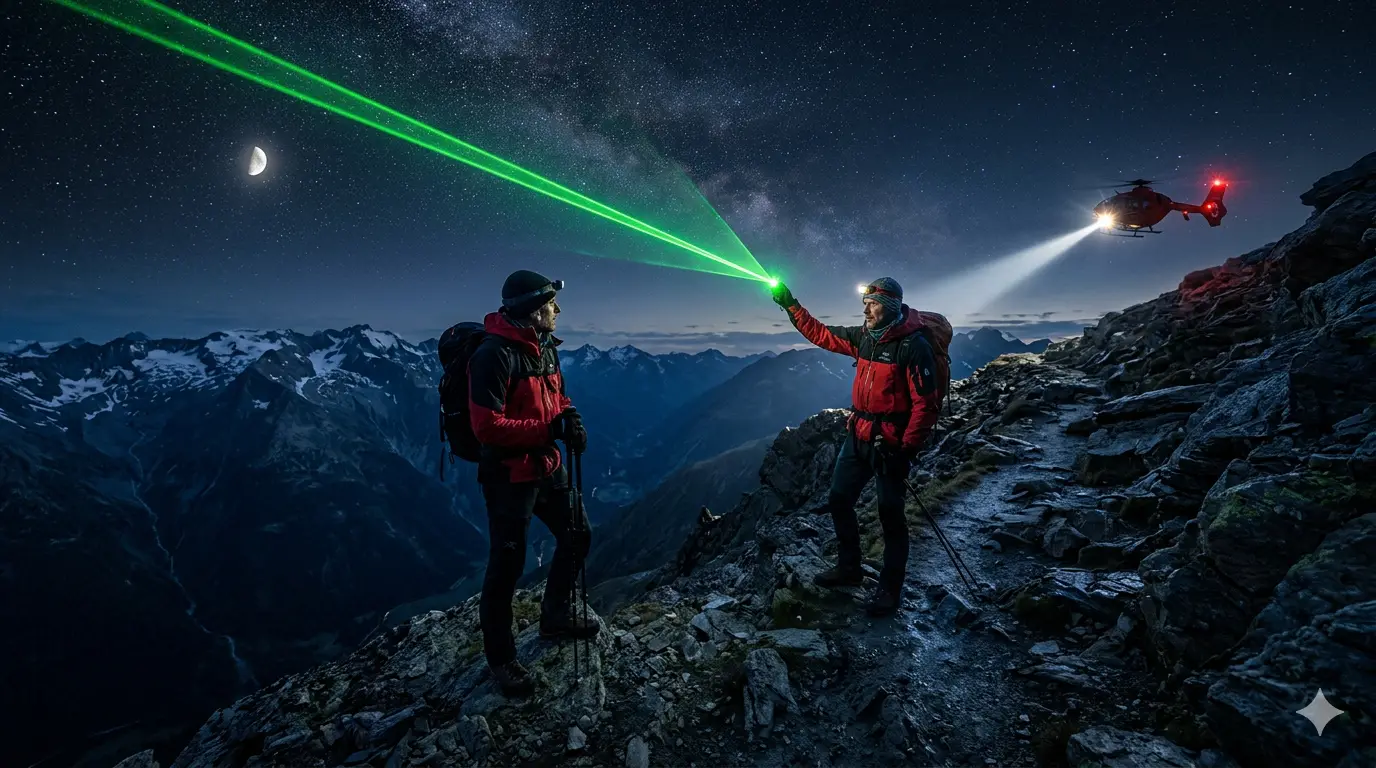
Using High-Power Lasers for SOS Signaling: What You Need to Know
When you're lost in the backcountry or adrift at sea, that handheld laser in your pack might seem like a lifeline. But here's what most gear reviews won't tell you: not all lasers are created equal for emergency signaling, and using the wrong one—or using any laser the wrong way—can actually make your situation worse.
This guide cuts through the confusion. We'll look at why some lasers work for SOS while others don't, how to use one properly if you have the right device, and the legal and safety boundaries that could determine whether you get rescued or get arrested. The key distinction most people miss: a standard laser pointer and a purpose-built rescue laser are fundamentally different tools, and confusing them has sent more than a few backcountry travelers down the wrong path.
What Makes a Laser Work as an SOS Signal
A laser is useful for signaling because of two physical properties: extreme directionality and high intensity at distance. Unlike a flashlight that spreads light in all directions, a laser beam stays narrow, which means its light energy doesn't dilute as quickly over distance.
The 532nm green wavelength matters here. The human eye is most sensitive to green light under low-light conditions, roughly 30 times more sensitive than to red light of equal power. This is why a 5mW green laser can appear brighter than a 50mW red laser in nighttime conditions. But—and this is the part most product reviews skip—the visual brightness you perceive has almost no relationship to actual danger to your eyes or to the aircraft you're trying to signal.
The FAA's laser safety briefing notes that the human eye can intensify laser energy density by up to 100,000 times through its focusing action. That's not a theoretical number—it means even a modest laser aimed at an aircraft cockpit can create genuine flash blindness and afterimages. The same property that makes lasers useful for long-range signaling is precisely what makes them hazardous to pilots and bystanders.
Laser Pointer vs Rescue Laser — Why Beam Shape Matters
Here's where most consumer content gets it wrong. When people talk about using "a laser" for SOS signaling, they're usually thinking of a pen-style laser pointer—a device that produces a narrow, focused point of light. But that's not what rescue professionals actually use.
A rescue laser flare—sometimes called a laser signaling device—is designed differently. Instead of a tight point, it produces a fan or line of light. The goal isn't to create a bright spot on a distant target; it's to increase the odds that anyone scanning the area will see something without being blasted by a concentrated beam.
This distinction matters for two reasons. First, a focused point of light at high power creates a genuine hazard to anyone it directly hits—especially pilots. Second, a narrow beam is nearly impossible to keep steady on a target when you're on a rocking boat or uneven terrain. The practical sailor testing found that narrow-beam lasers were "brilliant but too directional" for maritime use. A line or fan beam spreads the light across a wider visual field, reducing the danger of direct exposure while still creating a visible signal against the dark.
If you're evaluating whether to carry a laser for emergency use, check whether it produces a point or a fan/line pattern. For more on laser safety fundamentals, see our laser pointer safety guide. And for a deeper look at laser classifications and what they mean in practice, the Cruising Club of America's analysis is worth reading.
How to Actually Use a Laser for SOS Signaling
Assuming you have the right tool—a fan or line-beam rescue laser, not a pointer—the technique matters as much as the hardware. You don't just aim and hold.
The standard approach: slow sweeps across the horizon, a ship bridge, a mountain ridge, or wherever you think search and rescue assets might be approaching from. Each sweep should be slow enough that an observer's eye can register the light and recognize it as intentional, not random noise. Sweep too fast and the light reads as meaningless.
For visual signaling conventions, the SOS rhythm—three short, three long, three short—is well established and recognizable to most search and rescue personnel worldwide. If conditions allow, pair your laser sweeps with this rhythm. The Survival Manual's signaling section describes the standard approach: repeating a deliberate pattern over a period of time rather than firing off bursts randomly.
The Practical Sailor testing found that the most effective signaling happened when the operator maintained consistent, rhythmic sweeps over a 10-15 minute window. Inattentional scanning—constant re-aiming and repositioning—was far less effective than disciplined repetition. For more on selecting the right high-power laser device for this kind of use, see our high-power laser guide.
When Lasers Work — and When They Fail
The conditions where laser signaling performs best are specific: nighttime, open terrain, and a known or probable search direction. If you know where rescue is likely to come from—a known flight path, a shipping lane, a road corridor—a laser can be an effective secondary attention-draw.
The problems start when conditions change.
Daylight: Direct sunlight overwhelms even high-power lasers. In daytime, a laser beam becomes essentially invisible beyond a few meters.
Forest or canyon terrain: Narrow beams get blocked by vegetation. A line-of-sight tool requires line-of-sight.
Precipitation and sea spray: Rain, fog, and salt spray scatter laser light, creating visible glow near the source but killing long-range effectiveness. The PBO gear testers found that laser flares performed "very well in darkness but were too directional for reliable daytime or maritime use."
Moving platforms: On a small boat, snowmobile, or ATV, keeping a narrow beam steady on a distant target is genuinely difficult. The same physical property that makes lasers useful—their tightness—becomes a liability when you can't hold still.
Context matters: A laser should never be your primary distress signal. Electronic beacons (PLBs and ELTs), pyrotechnic flares, and signal mirrors all have established advantages. Our guide to Class 3R vs Class 4 lasers covers the power and hazard classifications in more detail.
The practical conclusion from multiple sources: laser signaling works best when rescue is already in the vicinity and you're trying to draw final attention to your location—not when you're trying to be found from scratch over long distances in poor conditions.
The Legal Red Line — Laser Strikes and Emergency Exceptions
This is the section that gets most people in trouble. There is a common misconception that aiming a laser at an aircraft during an emergency is somehow legal or tolerated because you're "signaling for help." It is not.
Under U.S. Code 18 USC § 39A, it is a federal crime to aim a laser at an aircraft. There is no emergency exception for ordinary laser pointers. The FAA, FBI, and Department of Justice have all been clear on this: pointing any laser at an aircraft—even during a genuine emergency—can trigger a laser strike investigation, divert emergency response resources, and result in civil penalties and criminal charges.
FAA data shows 12,840 laser strike incidents recorded in 2024, with 13,304 in 2023—a 41% increase from the prior year. Pilots have reported injuries in 313 incidents since 2010. The civil penalty for a single violation can reach $11,000; multiple violations can total $30,800. Federal criminal penalties can include up to five years imprisonment.
The nuance that does exist: some jurisdictions recognize the use of designated laser emergency signaling devices in genuine distress situations. But "designated" means a device specifically built and certified for emergency signaling—not a consumer laser pointer bought online.
The FBI's guidance is blunt: keep laser pointers away from aircraft. If you're in distress, use a signal mirror, a flare, a radio beacon, or an ELT. A laser pointer pointed skyward is not a distress signal—it's a federal crime waiting to happen.
FAQ
Q1: Can I point a laser at an aircraft to signal for help? Is it legal?
No, and it is not legal. Under U.S. federal law, aiming any laser at an aircraft is a crime regardless of your intent. There is no emergency exception for consumer laser pointers. If you are in a genuine emergency, use a certified signaling device—a flare, signal mirror, ELT, or PLB. Aiming a laser at an aircraft can result in criminal charges, civil penalties, and actually divert the very rescue resources you're trying to reach you.
Q2: What's the difference between a regular laser pointer and a rescue laser flare?
A standard laser pointer produces a narrow, focused point of light. A rescue laser flare produces a fan or line pattern, spreading the beam across a wider area. The fan design is less hazardous to anyone's eyes, easier for nearby rescuers to spot, and more effective in practice than a tight point. Consumer laser pointers are not designed or safe for emergency signaling use.
Q3: Does a greener or more powerful laser work better for SOS signaling?
Green (532nm) lasers appear brighter to the human eye under dark-adapted conditions, but brightness perception is not a reliable indicator of effectiveness or safety. More power does not mean more signal range in practice, and it absolutely does not mean safer. The FDA explicitly warns against judging laser danger by color brightness. For signaling, the beam pattern and technique matter far more than wavelength or power.
Q4: In what environments do laser SOS signals actually work?
Laser signals work best at night, in open terrain, when you know or suspect search and rescue assets are nearby. They fail in daylight, forest or canyon terrain, during precipitation or sea spray, and when you're on a moving or unstable platform. They are not a primary distress tool in any scenario—they are a secondary attention-draw useful for guiding rescuers who are already in the vicinity.
Q5: What are the hidden risks of cheap high-power green lasers?
NIST testing found that 89.7% of consumer green lasers and 44.4% of red lasers failed to meet federal power limits when randomly sampled. Many cheap green lasers also emit significant invisible infrared radiation—sometimes at levels ten times higher than the visible green light. You cannot see this infrared, so it won't trigger your blink reflex, making it especially dangerous. Buying a cheap laser for emergency use means you may be carrying a device that doesn't perform as labeled and that poses unseen hazards.
Conclusion
A laser can be part of an emergency signaling strategy—but only if you understand its actual role and limitations. Think of a laser as a secondary tool: something you use to draw final attention and guide rescuers to your location once they are already nearby, not as a primary beacon to summon help from miles away.
For primary distress signaling, the hierarchy is clear: signal mirror (visible 25+ miles in clear conditions), then ELT or PLB (satellite-positioned), then electronic flares or strobes, then pyrotechnic flares. A rescue laser—if it is a fan-beam device, not a pointer—fits somewhere below strobes on that list.
If you do carry a laser for emergency use, invest in a purpose-built rescue laser with proper beam geometry. Leave the pen-style laser pointer at home or in your pocket. And never, under any circumstances, point it at an aircraft. The legal consequences are real, the safety risks are real, and there are better tools for the job.