
Why Blue Lasers Produce More Visible Thermal Effects Than Green Lasers
Blue lasers are often perceived as more effective at producing visible thermal effects on materials, but the real reasons behind this are material absorption, beam focus, and power output. Discover how these factors influence laser performance and why more visible doesn't mean more dangerous.
Image Gallery
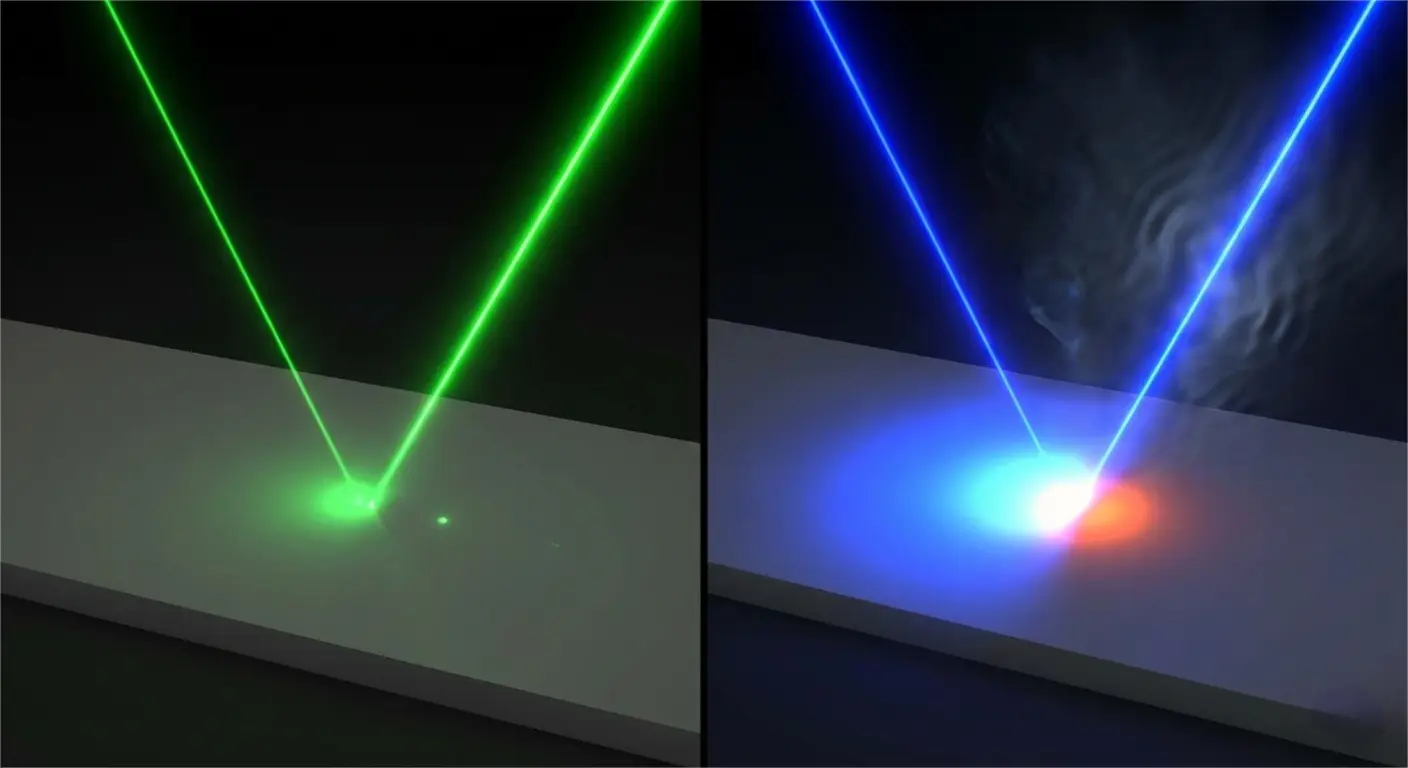
Why Blue Lasers Produce More Visible Thermal Effects Than Green Lasers
If you've seen videos of blue lasers interacting with materials—leaving scorch marks, creating smoke, or rapidly heating surfaces—you may have noticed that blue lasers seem to produce more dramatic results than green lasers. However, this perception isn't necessarily due to an inherent superiority of blue light. In fact, the reasons blue lasers appear more effective at producing thermal effects come down to material absorption, beam focus, and power output—not a magical property of the light itself.
The Science Behind Laser Heating
How Lasers Transfer Heat to Materials
When a laser interacts with a material, the light energy is absorbed by the material and converted into heat. The more light the material absorbs, the more heat it generates. According to SPIE's optics curriculum, absorption depends on both the material and the wavelength of light: SPIE/OP-TEC. For instance, darker materials tend to absorb more light, whereas lighter materials reflect more light. The University of Illinois explains that black or dark surfaces absorb more visible light, making them more likely to heat up when exposed to laser light: University of Illinois Physics Van.
Why Blue Lasers Often Produce Stronger Thermal Effects
The wavelength of light affects how tightly the laser beam can focus. Shorter wavelengths, such as blue light (450nm), can focus to smaller spots than longer wavelengths like green (532nm) or red (650nm). Smaller spots mean higher energy density, which leads to more concentrated heat on the material and more visible thermal effects: University of Maryland
However, this isn’t a universal rule. As Oregon State University points out, materials that reflect blue light may actually absorb less blue light, meaning the heating effect would be less pronounced: Oregon State University.
The Power Factor
Many blue lasers on the market, particularly those in the 1W to 7W range, are more powerful than their green counterparts, which are typically lower in power for handheld devices. A user in the Laser Pointer Forums explains: "In my experience, 532nm is not as ideal a wavelength for producing thermal effects as 405 or 445. The latter seem to be absorbed better by materials, can focus to a smaller beam waist…": Laser Pointer Forums.
What Actually Determines Thermal Performance
Based on available research and community experiences (SPIE, University of Illinois, NC State, etc.), here’s how different materials typically respond to common laser wavelengths:
In short:
- For dark/black materials: all three visible wavelengths are often absorbed well—power and focus are more critical.
- For light/white materials: results are unpredictable; dark print, stains, or surface roughness matter more than the base material.
- For organic/dark surfaces: blue tends to show more visible thermal effects in consumer demos, but this is a combination of wavelength × absorption × actual power × focus, not a single‑variable rule.
Why "More Visible" Doesn’t Mean "More Dangerous"
The Brightness Misconception
Green lasers appear brighter to the human eye because the wavelength is closer to the peak of human visual sensitivity (532nm). However, brightness does not necessarily correlate with thermal effects. The FDA has clarified that brightness is not a reliable indicator of power or eye hazard: FDA. Heating depends on how much light the material absorbs, not how bright the light appears.
Green Lasers Can Also Produce Thermal Effects
Despite common perceptions, green lasers can also produce visible thermal effects on materials. As one Reddit user shares, "Recently I ordered a 200mW green laser kit. It can produce visible marks on materials as well…": Reddit r/LaserPointers. This shows that blue is not the only laser color capable of producing thermal effects.
Safety Reminders: When "Impressive" Becomes "Dangerous"
Laser Safety Classifications
When using lasers that can produce significant thermal effects on materials, it’s crucial to be aware of their safety classifications:
Class 3B lasers (about 5–500mW) can cause instant eye injury from direct exposure, and Class 4 lasers (above 500mW) pose a much higher risk to both eyes and skin, as well as creating fire hazards: FDA (see above); OSHA.
Beware of Mislabeling
A serious risk with many low-cost lasers is mislabeling. One YouTube reviewer found that a laser advertised as <5mW actually emitted about 1.5W, which places it firmly in the Class 4 category: styropyro. Always verify the actual power output before using any laser.
Important: Do not use a “can it heat?” test as a substitute for a power meter. As one LPF user noted: "You could try tests for thermal effects as rough estimation, but it’s not very accurate due to focusing, light absorption, etc.": Laser Pointer Forums.
Protective Measures: Don’t Rely on Just Any Eyewear
Standard sunglasses will not provide adequate protection for lasers in the Class 3B or Class 4 categories. Laser safety glasses are essential, and they must be matched to the wavelength and Optical Density (OD) required for that specific laser: Laser Safety Glasses Guide; Virginia Tech EHS.
FAQ
Why do blue lasers seem to leave scorch marks more easily than green lasers?
Blue lasers (445–450nm) can focus to smaller spot sizes than green lasers (532nm) under similar optical conditions—a principle explained by Gaussian beam optics from the University of Maryland (see above). Smaller spot = higher energy density = more concentrated heat. In addition, blue lasers are more commonly found in higher‑powered handheld devices (1W–7W range), while green lasers in the same power range are rarer. So what many perceive as “blue produces stronger thermal effects” is often actually “higher power produces stronger thermal effects.” XM360 review; Blue Gatling Laser
If green lasers look brighter, why don’t they produce stronger thermal effects?
Green lasers appear brighter because the human eye is most sensitive to green light (around 555nm). However, brightness is a visual phenomenon, not a measure of energy delivery. Thermal effects depend on how much light energy a material actually absorbs, which is determined by the material’s color, surface condition, and the laser’s wavelength. The FDA explicitly warns not to use “looks bright” as a proxy for power or eye hazard (see FDA link above).
Does "blue produces stronger thermal effects" mean blue lasers are more dangerous?
Not automatically. The danger of a laser is determined by its actual power output, not its color. A 200mW green laser can be just as hazardous to eyes as a 200mW blue laser. However, because high‑power blue lasers are more common in the consumer market, they often appear in videos showing dramatic thermal effects—and those power levels (often 1W or more) are well into Class 4 territory, where serious eye injury and fire risks exist regardless of color. The Hidden Dangers of High-Power Blue Lasers: Why Class 4 Safety Isn’t Optional
Why do lasers sometimes fail to produce visible thermal effects even at seemingly high power?
Success in producing thermal effects depends on multiple factors beyond the number on the label: the material’s color and composition (dark vs. light, plastic vs. wood), surface condition (roughness, dirt, moisture), and beam focus. A laser that easily heats black electrical tape may do nothing to a white ceramic surface. Additionally, many budget lasers are mislabeled—their actual power output may be far lower than claimed. A simple test for thermal effects is a rough indicator at best; it should never be used as a substitute for a proper power measurement.
At what power level should I start treating a laser as a serious safety concern?
Class 3B (continuous‑wave visible lasers from about 5mW to 500mW) is the threshold where direct beam exposure can cause immediate and permanent eye injury. For Class 4 (above 500mW), even reflected beams can be hazardous, and fire risks become a real concern. FDA regulations typically restrict visible laser pointers intended for demonstration or pointing to Class 3R (≤5mW). Any device marketed as producing strong thermal effects almost certainly exceeds that limit and should be handled with the same precautions as industrial laser equipment. FDA; OSHA (see above)
Why shouldn’t I use a simple test for thermal effects to judge a laser’s power?
Such a test depends on too many variables: material color, focus, distance, exposure time, and even ambient temperature. Two lasers with identical power can produce very different results on different surfaces. More importantly, using this kind of test can give a false sense of security—a laser might seem weak on a white surface but still be dangerously powerful for eye exposure. Community experts consistently warn that such tests are not accurate and should never replace a calibrated laser power meter (LPM) when safety is at stake.