
Best Laser Pointer Color for Stargazing (2026): Green vs Blue vs Red Explained
Discover the best laser pointer color for stargazing based on scientific data, real-world testing, and astronomy community experience. Learn why green lasers dominate, when blue works better, and why red is rarely used.
Image Gallery
Author & Review Information
- Author: LaserPointerHub Research Team
- Content Type: Evidence-based astronomy guide
- Reviewed Against: CIE visual models, CVRL datasets, astronomy safety references
- Last Updated: March 2026
Introduction
If you’ve ever attended a stargazing event, you’ve probably seen a green laser beam stretching across the night sky.
This is not just convention.
Across vision science, experimental data, and astronomy practice, one conclusion consistently appears:
Green (532nm) is usually the most visible laser pointer color for stargazing at the same power level.
However, real-world visibility is affected by multiple factors including atmosphere, temperature, and device quality.
Why Green Lasers Are Easier to See
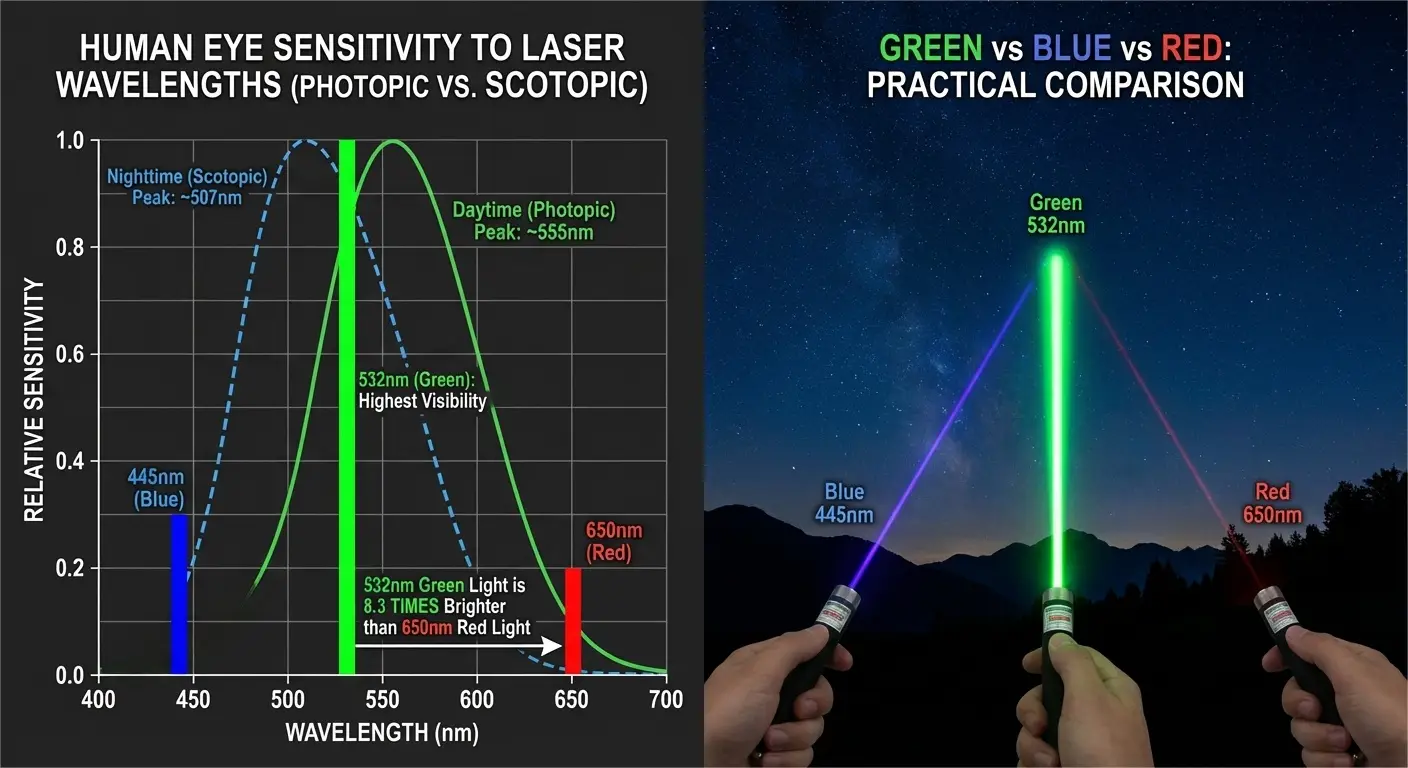
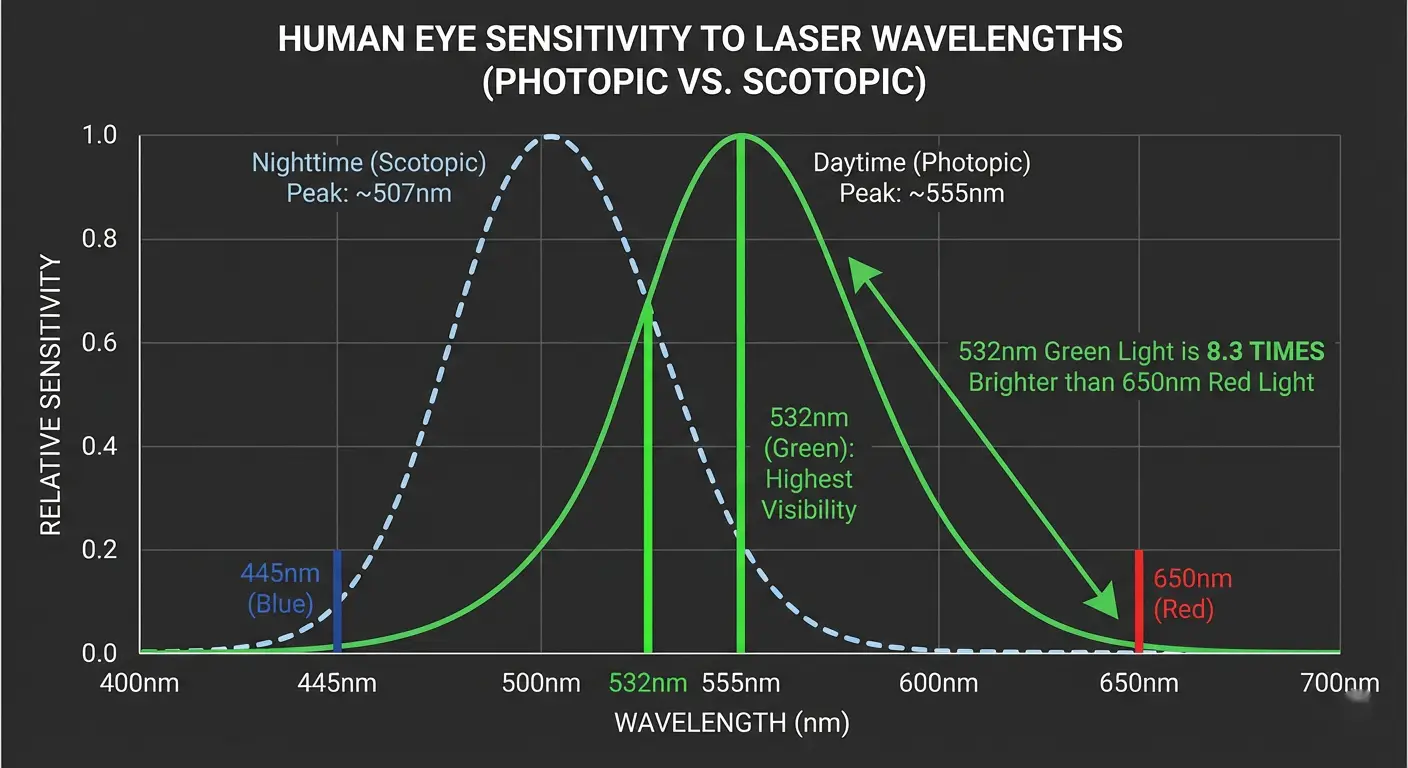
Human Vision Sensitivity
According to standard visual models from the CIE luminous efficiency function
and CVRL datasets:
- Photopic peak ≈ 555nm
- Scotopic peak ≈ 507nm
532nm lies between these peaks, making it highly efficient for human perception.
Brightness Comparison (Same Power)
Using standard CIE data:
- 532nm ≈ 29.7× brighter than 445nm
- 532nm ≈ 8.3× brighter than 650nm
These values come from raw datasets, uses standard data files provided by CVRL: the CIE 1924 photopic V(λ) for photopic vision, and the CIE 1951 scotopic V′(λ) for scotopic vision. I have extracted three common laser wavelengths.
👉 Important: these describe eye sensitivity, not full atmospheric visibility.
How Much Power Do You Actually Need?
A 2010 observational study tested 23 participants under urban night conditions.
Results (summary available via LaserPointerSafety):
- Average threshold: ~2.38 mW
- Most users: 1.5–3.5 mW
Conclusion:
A laser under 5mW is typically sufficient for stargazing
👉 If you’re unsure what power ratings actually mean, see: [Internal] Laser Pointer Power Guide
Real-World Astronomy Experience
Astronomy communities consistently report:
- Green is easiest to see in group settings
- Widely used in star parties
- Cheap units may fail in cold conditions
Additional context from Sky & Telescope
confirms that green lasers are commonly preferred due to visibility advantages.
Green vs Blue vs Red: Practical Comparison
Green (532nm)
- Highest visibility per mW
- Ideal for group stargazing
- Backed by both data and real-world usage
👉 Related safety considerations: [Internal] Laser Pointer Safety Guide
Blue (445nm)
- Performs better in cold environments
- More stable diode technology
However, it appears dimmer at equal power.
Red (650nm)
- Very low visibility in dark conditions
- Not suitable for group pointing
Critical Factors Most Guides Ignore
Environment Matters
Beam visibility depends on:
- Air particles
- Humidity
- Light pollution
Temperature Effects
- Green lasers (DPSS) weaken in cold
- Blue lasers are more temperature-stable
Community discussions (example: Cloudy Nights discussion)
often mention this trade-off.
Product Quality Issues
Common problems include:
- Fake power ratings
- Missing IR filters
- Poor thermal design
👉 Buying advice and pitfalls: [Internal] How to Choose a Laser Pointer
Safety Considerations
According to general safety guidelines:
- Stay at or below 5mW
- Avoid pointing at aircraft, people, or reflective surfaces
👉 Practical safety recommendations: LaserPointerSafety Tips
Final Verdict
Based on:
- CIE / CVRL visual models
- Experimental threshold data
- Real-world astronomy use
Green (532nm) is the most practical and visible laser color for stargazing in most conditions.
However:
- Blue may be better in cold environments
- Red is generally unsuitable
- Build quality matters more than specs
FAQ
What color laser is best for stargazing?
Green (532nm) is typically the most visible to the human eye.
How many mW do I need?
1–5 mW is sufficient for most stargazing use.
Does green laser ruin night vision?
It can if pointed at nearby objects, but proper sky use minimizes impact.
Is blue laser a good alternative?
Yes, especially in cold weather, but it is usually dimmer.
Is pointing at the sky safe?
It can be safe if used responsibly, but risks still exist if misused.